 Louis Hannibal Nez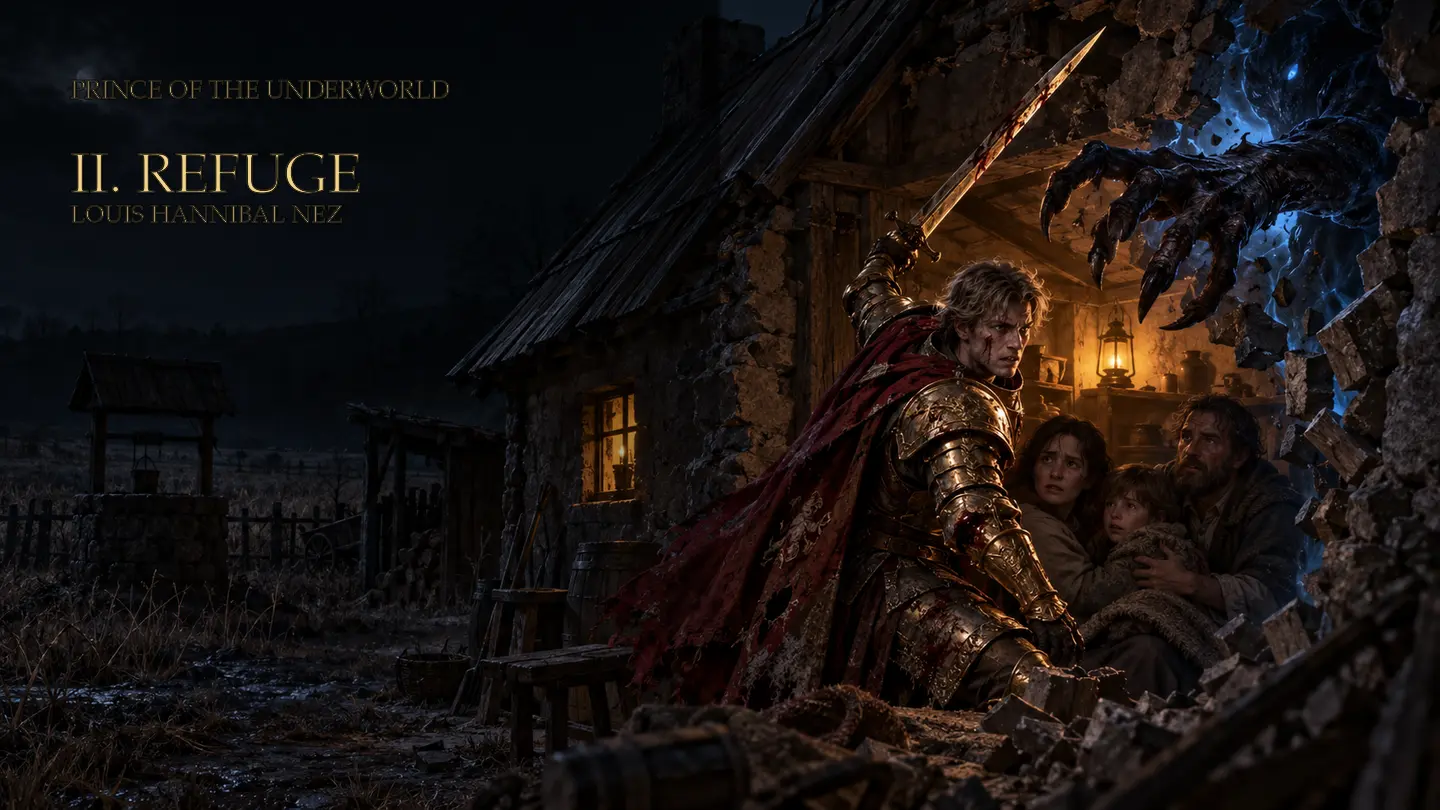
Lajosz takes another step.
The sole of one boot slips on the wet stone, but he manages to keep his balance. East Road stretches before him like a gray strip between the blackened fields. The ancient stones lining the road are covered in moss and ash. Some have broken free of the earth and lie tilted beside the road, like gravestones torn from a cemetery.
Behind him, Tryendryk continues to burn.
The glow of the Golden Citadel no longer reaches the sky with the same intensity. The flames have diminished in some sectors and grown in others. The citadel seems to breathe with difficulty, like an enormous animal that still refuses to die.
Lajosz does not look back.
Dianod’s blood remains dried on his sword.
Whenever he moves his arm, the weight of the blade reminds him of what he has just abandoned. He does not know whether the demons are still pursuing him. For a while, he hears branches breaking behind him and footsteps mingling with the sound of the wind. Then everything falls silent.
That silence is worse. Demons do not scream when they hunt.
Lajosz moves on with one hand pressed against his side. The wound opens again, and blood begins to soak through the fabric beneath his armor. He breathes with difficulty. The night air no longer burns his lungs as much, but each breath becomes shorter than the one before.
In the distance, between two low hills, a light appears. It is not the citadel’s reddish glow or the demons’ bluish radiance. It is a small, yellow, trembling light. A flame protected behind a window.
Lajosz leaves the road. He walks downhill among the dry stalks of an abandoned field. The ground is covered with hardened furrows and the remains of plants that break beneath his boots. Every few steps, he has to stop to catch his breath. The light remains there, motionless, while the rest of the kingdom seems to move around it.
As he draws closer, he makes out a low house built of dark stone and hardened mud. It has a sloping roof of wood and metal plates. To one side stand a shed, a well, and a small garden enclosed by stakes. The place looks like a modest farmstead, but it is not abandoned.
A rope stretches across the entrance path. Pieces of metal hang from it and strike one another whenever the wind moves them.
Lajosz stops in front of the barrier.
Something moves behind the house in the darkness.
He draws the golden sword. The effort pulls a groan from him. The tip of the blade tilts toward the ground. For an instant, he thinks a figure is approaching among the trees. Then he makes out the silhouette of a man holding an axe.
“Do not take another step,” the man warns him.
Lajosz tries to remain upright.
“I need water.”
“There is a well on the road.”
“I cannot reach it.”
The man raises the axe. He is not young. His shoulders are broad, his hair gray, and a short beard covers part of his face. He wears a heavy coat, mud-caked boots, and holds a small candle in his other hand. His eyes stop on the golden armor, but almost immediately move to the sword.
“Step away from the house.”
“I am not looking to hurt you.”
“That is what they all say.”
The door opens behind the man. A woman appears with another candle in her hand. She is shorter than he is, and her hair is gathered beneath a dark scarf. She remains in the doorway without coming any closer.
“Lenyon,” she says, “do not leave him out there.”
“We do not know who he is.”
“He is wounded.”
“He may be pretending.”
Lajosz feels his legs give way again. His sword strikes the earth, and he braces himself on the hilt. The woman watches the movement.
“No, he is not pretending.”
Lenyon does not lower the axe.
“He could draw them here.”
“They are already close.”
As if the words had summoned them, a sound passes through the night. It is not a scream or a roar. It is the sound of something slowly scraping across a stone surface. Lenyon looks west. The woman blows out her candle. The field sinks into darkness.
“Come in,” the woman says.
“Onvána…”
“Come in, Lenyon.”
The man hesitates. Then he lowers the axe, steps away from the barrier, and gestures toward the house. Lajosz crosses the entrance path as best he can, with the strength he has left. As he passes Lenyon, the man studies the emblem of Tryendryk beneath the mud and the dented golden plates.
“That armor is not doing you much good,” he mutters.
“I know.”
“Then take it off before you come inside.”
Lajosz does not answer.
The inside of the house is colder than he expected. There is a main room with a table, two benches, a stone hearth, and a staircase leading to an upper level. The walls are covered with tools, ropes, clay containers, and small pieces of metal. There are no decorations except for a wooden carving depicting a figure with open hands before a circle.
A girl watches Lajosz from the foot of the stairs. She is thin and wears a pale shirt, dark trousers, and a woolen shawl over her shoulders. Her hair falls loose on either side of her face. She does not appear frightened. She studies the sword, the armor, and the blood dripping from Lajosz’s side.
“Ánvana,” Onvána says, “bring hot water.”
The girl does not move.
“Is he a soldier?”
“Bring the water.”
Ánvana keeps her eyes on Lajosz for another moment. Then she disappears through a side door. Lenyon closes the door and slides a wooden bar into place.
“How many are coming behind you?” he asks.
“I do not know. Many. Ten, perhaps eleven.”
“Demons?”
“Probably.”
“That is not an answer.”
“It is the only one I have.”
Lenyon turns toward him. In the dim kitchen light, his expression changes. He no longer looks merely distrustful. He also looks tired.
“Where do you come from?”
Lajosz looks at the table.
“The Golden Citadel.”
Onvána points to a bench.
“Sit down.”
“I cannot stay.”
“Then die standing, if that seems better to you.”
Lajosz sits.
The armor creaks as he bends his legs. Lenyon approaches cautiously and helps him remove the plates from his chest. One of the straps has been cut. Another is so badly crushed that he has to use the axe handle to loosen it. When he removes the last piece, Lajosz’s shirt is revealed, stuck to his skin with blood. Onvána approaches with a bowl of hot water. Ánvana follows her, carrying several strips of cloth.
“We have no medicine,” Onvána says. “Only water, salt, and a few dried leaves.”
“That will be enough.”
“You do not know whether it will be enough.”
“No.”
Onvána cuts the cloth with a small knife. The wound stretches beneath his ribs and continues toward his abdomen. It does not appear deep, but the blood has soaked through several layers of clothing. The woman cleans his skin without asking questions. Lajosz clenches his teeth.
“You can scream,” Onvána says.
“It would not help.”
“Sometimes it helps you endure it.”
“I do not want them to hear me.”
Lenyon remains beside the door.
“They already know we are here.”
Onvána looks at him.
“Not necessarily.”
“A lit candle in an isolated house can be seen from the road.”
“I put it out.”
“After he came in.”
Ánvana approaches the window and watches the outside through a crack in the wood. She does not seem frightened, but she does not take her hand away from the knife at her belt.
“There is no one,” she says.
“Not yet,” Lenyon replies.
Onvána places a clean cloth over the wound and tightens it firmly. Lajosz bends forward.
“What is beyond the farmstead?”
“The road continues to Ítsza Bridge,” Lenyon replies. “After that comes the border.”
“Is it open?”
Lenyon does not answer immediately.
“Was it?”
“This afternoon, yes.”
“And now?”
“Since the citadel began to burn, no one knows what is open and what no longer exists.”
Onvána finishes bandaging him.
“People have been arriving from the east all night. Some say the queen consort is still in the citadel. Others insist they saw her escape. They also say the prince is dead.”
“What do the soldiers say?”
“Soldiers say whatever they need people to believe,” Lenyon replies.
Ánvana steps away from the window.
“There is a line of carts on the road.”
“How many?”
“More than ten.”
Lenyon curses under his breath.
“Refugees?”
“Entire families. They stopped beside the bridge.”
“Then the guards will not let anyone through.”
Lajosz struggles to sit up.
“I need to get there.”
Onvána rests a hand on his shoulder.
“Not before you stop bleeding.”
“I have no time.”
“Time does not belong to you.”
Lajosz looks into the woman’s eyes. They are dark and calm, but they hold something he has not found in the citadel’s soldiers or the nobles he has known all his life. There is no obedience. Nor is there reverence.
“Who are the guards?” he asks.
“Men from Tryendryk,” Lenyon says. “Some belong to the bridge garrison. Others came from the eastern lands. No one knows whom anyone obeys.”
“And they let refugees through?”
Lenyon gives a dry laugh.
“They let through those who have a seal, money, or a name that still matters.”
“I have a name that matters.”
The words escape before he can stop them. The room falls silent. Onvána turns toward him. Lenyon stops watching the door. Ánvana looks at Lajosz with a different kind of attention.
“Everyone thinks that,” Lenyon says.
Lajosz lowers his eyes. Dianod’s last image returns to his memory. The boy demanded a promise as though both their lives depended on it. Then he threw himself at the demons with a small knife. A name can matter and still be useless. Onvána removes the empty bowl.
“You should sleep.”
“I cannot.”
“Then close your eyes without sleeping.”
“If I stay, I put you in danger.”
“You are already inside our house,” Onvána replies. “Danger came with you, but you did not necessarily bring it.”
Lenyon looks at her.
“We do not know that.”
“We do not know the opposite either.”
A metallic noise comes from outside. The pieces hanging from the rope strike one another. Lenyon puts out the candle. Ánvana steps away from the window and takes her knife.
“Are they here?” she asks.
No one answers. The sound comes again. This time it is accompanied by human voices.
“Open in the name of Tryendryk!”
Lenyon looks at Lajosz.
“Can you walk?”
“Yes.”
“You do not look like it.”
“I can.”
“Then do it without arguing.”
Lenyon opens a trapdoor in the floor beside the hearth. Beneath it, a narrow staircase descends into darkness.
“It is a storage room,” he explains. “There are grain sacks and tools. You can hide there.”
Lajosz looks at his sword.
“I cannot leave it.”
“If you take it, they will find you.”
“No.”
“If they take it from you, at least you will remain alive.”
Lajosz tightens his grip on the hilt.
“They will not take it.”
“That depends on how many of them there are.”
They pound on the door insistently and violently.
“Open!”
Lenyon takes up the axe. Onvána positions herself in front of the trapdoor. Ánvana remains beside the window, knife in hand. Lajosz descends. The stairs end in a low room that smells of earth, grain, and damp. Sacks are stacked against the walls. In one corner rests a dismantled cart. Lajosz moves behind it and holds the sword against his chest. From above, he hears the wooden bar being removed.
“What is happening?” Lenyon asks.
“We are looking for a wounded man.”
“There is no one here.”
“We saw a light.”
“This is our house. We light candles when we want.”
“We also saw blood on the road.”
“There are animals on the farm.”
“We are not looking for animals.”
The voice belongs to a young man. It does not sound cruel, only exhausted. Lajosz crouches behind the sacks. The trapdoor remains open. From there he can see part of the main room. The boots of two soldiers cross the floor. A third figure stays beside the door.
“How many people live here?” the soldier asks.
“My wife, my daughter, and I.”
“No one else?”
“No one.”
“Where is the girl?”
“Here,” Ánvana answers.
“Come closer.”
Ánvana obeys. Her steps stop a few inches from the trapdoor.
“Have you seen a soldier?”
“No.”
“A man in golden armor?”
“No.”
“Someone fleeing from the citadel?”
“I have seen the fire.”
“I did not ask that.”
“Then no.”
The soldier remains silent.
“Do you think this is funny?”
“No.”
“I do not like being lied to.”
“Neither do I.”
Lenyon steps in before the situation can worsen.
“My daughter has done nothing.”
“They all say the same thing.”
The boots move toward the hearth. A hand shifts the bowl Onvána left on the table. The soldier examines the bloodstained cloth remaining along its edge.
“What is this?”
“A bandage,” Onvána says.
“For whom?”
“For my husband.”
“What happened to him?”
“A tool struck his side.”
“Where is the wound?”
“Under his clothes.”
“Show it to me.”
“No.”
Onvána’s answer is calm. The soldier turns toward her.
“What did you say?”
“I said no.”
“I can search you.”
“You can try.”
The silence becomes heavy. Lajosz slides one hand toward his sword. He cannot see the soldier’s face, but he can imagine the scene. An armed man facing an unprotected family. Three soldiers against a woman, a farmer, and a girl. If he comes up, he will kill the first before the others can react. Then he will have to kill the rest. He cannot do it. Not again. Dianod did not ask him to become a killing machine.
“We have orders to close every road to the bridge,” the soldier says. “No one crosses without authorization.”
“Why?” Lenyon asks.
“Because the border is under threat.”
“From demons or from people?”
“From both.”
Something strikes the door from outside. Everyone turns toward the sound. The blow is not human. It is too strong and too slow. A second impact makes the hinges tremble. The soldiers draw their swords.
“What was that?” one of them asks.
The man standing at the door does not answer. Outside, something scrapes against the stone wall. Lajosz recognizes the sound. The blue-eyed creature is there. The soldiers begin to retreat. Lenyon closes the door and replaces the bar. Onvána takes Ánvana by the arm and leads her toward the back of the room.
“How many are there?” the soldier asks.
“I do not know,” Lenyon says.
“You live here.”
“They do not belong to my farm.”
The first soldier approaches the window and looks through the crack. A blue glow passes through the darkness outside. The man steps back.
“There is one.”
“One?” another asks.
“It is not alone.”
The creatures begin to move around the house, but do not attack yet. They pass between the walls, their bodies brushing against the stone. The pieces of metal hanging from the rope ring without any wind touching them. Lajosz steps out from behind the sacks. Lenyon sees him from above.
“What are you doing?”
“If you stay here, you will die,” Lajosz says.
“If you go out, you will die too.”
“I can draw them away.”
“You do not know how many there are.”
“I know what they want.”
“What do they want?”
Lajosz looks at the blood on his clothes.
“Me.”
The soldier at the door raises his sword.
“Who are you?”
Lajosz looks at him from the trapdoor but does not answer.
At that moment, one of the creatures strikes the wall with such force that the roof creaks. Dust and small stones fall onto the table. Ánvana looks up.
“They are coming in.”
Lenyon turns toward the soldiers.
“There is a back exit.”
“Where does it lead?”
“To the fields.”
“We cannot go outside.”
“Then stay here.”
The youngest soldier looks at his companions. None of them seems willing to remain inside the house. The creature strikes again. This time a crack opens in the outer wall. Lajosz climbs the stairs and takes his sword. Lenyon blocks his way.
“No.”
“Move aside.”
“I will not let you draw that in here.”
“If they get in, you will need it.”
“You do not know who we are.”
“I do not need to know.”
Lenyon holds his gaze. For several seconds, neither moves. Then the farmer steps aside.
“The back exit is behind the shed. There is a dry channel that reaches the road to the bridge. It cannot be seen from the main road.”
“Why are you telling me this?”
“Because if the creatures follow you here, we will also see them die.”
Lajosz understands the truth of his words. Lenyon is not acting out of compassion. He is acting because his family needs the man to leave. Even so, he is giving Lajosz something he has no obligation to give.
“Can you walk?” Onvána asks.
“Yes.”
“Do not lie.”
“I can walk.”
“That is not the same thing.”
Ánvana appears beside the back door. She wears a heavy coat over her shoulders and holds an unlit lamp.
“The channel is clear,” she says.
Lenyon looks at her.
“Are you sure?”
“There are tracks, but none are recent.”
“Whose?”
“I do not know.”
The wall shudders again. A deformed hand breaks through the crack. The soldiers retreat. One falls against the table. The other raises his sword and remains motionless, unable to decide whether to strike.
Lajosz pushes open the back door. Cold air enters the house. Before leaving, he looks at the family. Onvána has one hand on Ánvana’s shoulder. Lenyon holds the axe beside the entrance. The soldiers prepare to face something none of them understands.
“Thank you,” Lajosz says.
Lenyon does not answer. Onvána does.
“Do not thank us yet.”
Lajosz goes outside. The shed stands a few steps from the house. He runs crouched until he reaches an opening between two low walls. Beyond it begins the dry channel. It is a narrow ditch covered with grass and branches. The ground slopes west toward the river. Before entering it, he hears the first scream. It does not come from a demon, but from one of the soldiers. Lajosz turns. The house wall gives way with a roar. Blue light spreads across the roof and turns the stones into wet, gleaming surfaces.
A creature far too long emerges among the wreckage of the wall. Lenyon strikes one of its limbs with the axe. The creature barely moves. Lajosz takes a step toward the house and stops. Inside, Onvána screams her husband’s name. Ánvana answers. The soldiers attack without coordination. One of their swords shatters against a claw.
Lajosz can go back and try to save them. He can also die beside them without succeeding.
Dianod’s face returns to his memory. The boy ordered him to run, as though Lajosz’s life had a value he still could not understand, and so he enters the channel. He moves with difficulty through dry mud and roots. The slope forces him to brace himself against the walls. Every few yards, he has to stop to breathe. Behind him, the farmstead fills with blows, screams, and splintering wood. He does not look back.
The channel continues beneath a stand of trees. When the ground levels out, Lajosz kneels and remains still. The night falls silent once again. He waits. He hears no footsteps behind him, nor Lenyon’s voice. Lajosz closes his eyes. He knows he has fled again. This time he is not running only to save himself, but because someone showed him a path. He still does not know whether the family is alive.
At dawn, the channel empties into a hollow. From there, Lajosz watches East Road. Farther on, through the mist, a stone structure rises across the river. Ítsza Bridge has four arches and low towers at both ends. Dark, rain-soaked banners hang from the towers. Soldiers are stationed at the entrances. There are carts too: dozens of them remain stopped beside the road. Some are loaded with furniture, blankets, and animal cages. Others carry people sleeping in heaps beneath cloths. A woman holds a child against her chest. An old man sits on the ground with his hands tied. No one crosses.
Lajosz makes out a wooden barrier stretched across the bridge. A metal plate bearing the crown’s seal is fixed to one of its posts. Even from a distance he recognizes the emblem; it belongs to Rev. Beneath the seal, an inscription orders the road into Reszászország closed until further notice. Lajosz remains hidden among the grass. He does not know whether the order truly came from the queen consort. In fact, he does not even know whether Rev is still alive. He does not know who currently has the authority to close the only road west while Tryendryk burns behind him. Perhaps it is his uncle Tiklos who has that authority, but he cannot be sure.
The only thing he understands is that the bridge is watched by terrified men. A faint sound comes from the farmstead. It could be the wind, an animal, or someone still breathing.
Lajosz looks back. Then he watches the bridge. The border lies beyond the barrier. The kingdom that may be able to help him is only minutes away, but between him and Reszászország stand soldiers, refugees, sealed orders, and a dark river carrying ash. Lajosz lowers his eyes to his sword. Dianod’s blood remains stuck to the blade. He cannot cross the bridge as a prince. Not yet.
He covers himself with the coat Onvána left him and leaves the hollow by the opposite side. East Road lies before him, filled with people waiting for an authorization that may never come. Lajosz blends in with the refugees. For the first time since he left the Golden Citadel, no one looks at him as a prince, or even as a man. Now he is only another wounded body trying to reach the other side.