 Louis Hannibal Nez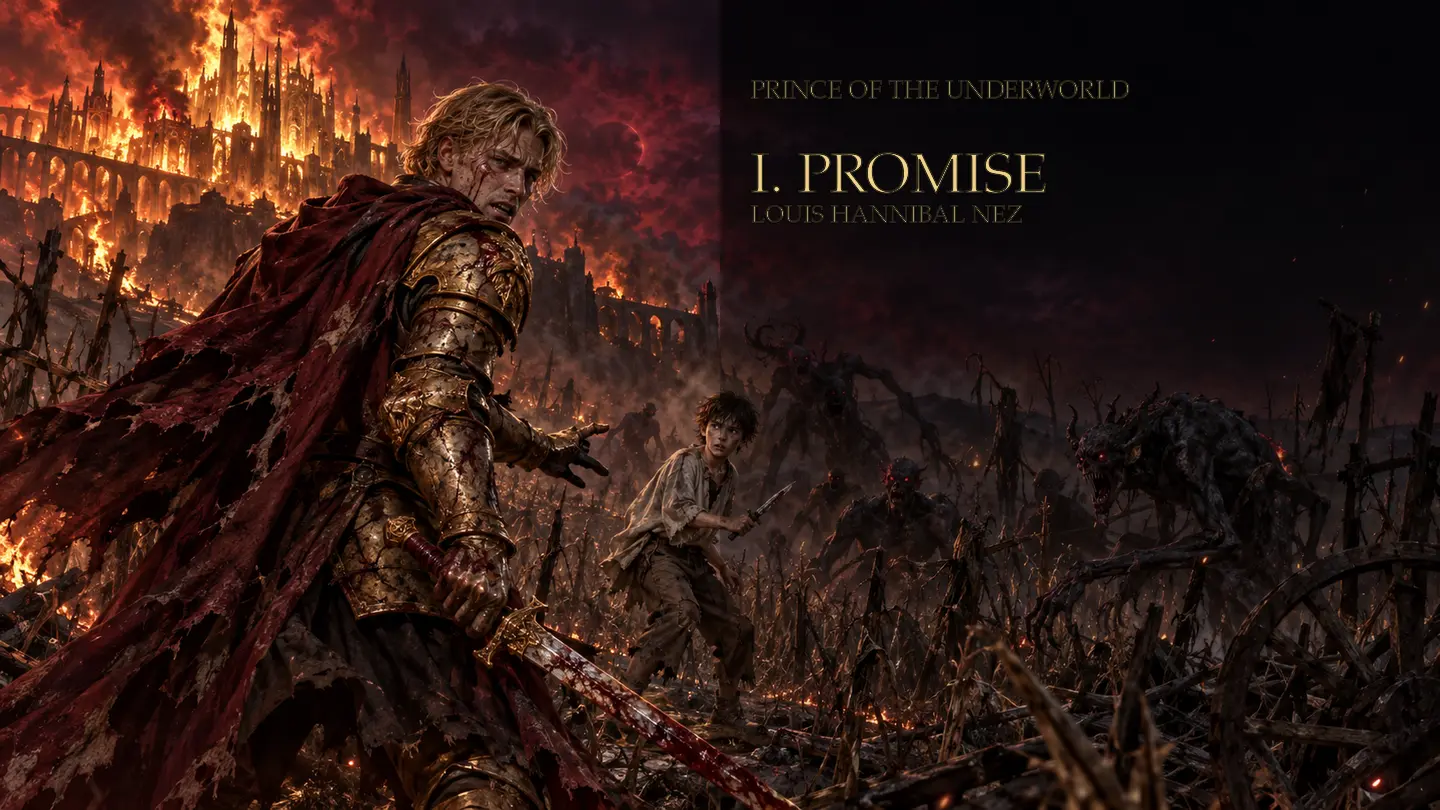
Lajosz runs without knowing how long he has been fleeing.
The air enters his lungs like a blade. Each breath burns his throat and leaves a metallic taste in his mouth. He lost the golden helmet somewhere along the way, though he cannot remember when. He does not know how much longer it will be before his body stops responding. He simply continues as best he can; he stumbles, but he keeps moving.
Behind him, beyond the lowlands and abandoned fields, the kingdom of Tryendryk is burning like never before.
The glow of the Golden Citadel rises above the horizon like a second setting of Küny. It is neither warm nor beautiful. The golden walls reflect the fires in the outer inhabited districts and turn the violet sky into a sick, reddish expanse. From time to time, a column of smoke darkens the citadel’s radiance, then drifts away again, driven by the wind.
Lajosz does not dare look for long. Each time he does, he remembers the unbearable screams, the horses bolting through the streets, the doors smashed open, the bodies that no longer move, and the soldiers’ voices shouting for reinforcements while something enormous pounds at the walls from the other side. He remembers his mother, Rev, the queen consort, being pulled away from him by the crown’s guards.
He also remembers Minoszet among the crowd, separated from her family and lost inside a citadel that no longer obeys anyone.
He does not know whether either of them is still alive, or whether he will ever see them again. The only certainty he has left is that he must reach East Road and go farther still, crossing a bridge he barely knows by name. He will have to enter the unknown, where the kingdom of Reszászország begins. Armies, fortified cities, and men capable of facing whatever escaped from the northeastern lands still remain there.
If he can reach the border, he can ask for help, perhaps return, and save his people. He repeats this to himself whenever he can, while his legs threaten to give way. He can still go back. He can still save them.
The golden armor he wears stopped feeling like protection long ago. The plates weigh on his shoulders and strike his ribs with every step. Some are dented; others have lost their inset stones. Dried blood covers much of his chest and mixes with the mud splashed up his legs. His sword hangs at his waist, but he has no strength to draw it.
The ground slopes gently toward an area of abandoned farmland. The rows of plants have become dry stalks, bent beneath the weight of ash. An overturned cart blocks the road. Lajosz has to detour and continue between the hardened furrows.
Then he hears the first sounds: a distant, desperate scream. After that comes the noise of something heavy striking the earth. Lajosz quickens his pace as much as he can.
The demons have already left the citadel; he does not need to see them to know it. He heard them inside the Golden Citadel—their harsh voices, their hoarse growls, and that dark tongue that seems made of stones dragged across metal. He knows a group is advancing behind him, fast and without pause.
A flock of birds bursts from the nearby trees and crosses the sky in disarray. Some collide with one another or fall to the ground although nothing visible has touched them.
Lajosz feels his knees give way. He braces one hand against his side. Beneath the armor, the wound has opened again. Blood runs across his abdomen and down to his waist. He clenches his teeth and continues. The path to East Road is still farther ahead. He cannot stop.
Something moves among the neighboring crops.
Lajosz stops abruptly and reaches for his sword.
A small figure appears between the dry stalks. He runs toward Lajosz with his head lowered, stumbling every few steps. He is a thin boy covered in dust and ash. He wears an oversized shirt, patched trousers, and a short knife fastened at his waist.
He does not see Lajosz.
Lajosz tries to step aside, but they collide violently. The boy falls onto his back. Lajosz loses his balance and ends up kneeling on the damp earth. His sword strikes a stone. For several moments, neither of them moves.
“Are you hurt?” Lajosz asks.
The boy looks at him with wide eyes. He has a cut across his forehead and a dark mark on his cheek.
“You… you’re the prince.”
Lajosz feels the blood turn cold in his veins.
“Get up.”
“You’re Lajosz.”
“Get up and run.”
The boy does not obey. He looks at the golden armor, the dented shield, and the emblem of Tryendryk still visible beneath the mud.
“They said you were dead.”
“If that is the rumor, it is best that it keeps circulating.”
A roar shakes the air.
They both turn toward the Golden Citadel. Beyond the fields, a black cloud rises above the walls. Bluish flashes move inside it, electric, like lightning trapped among the ashes.
The boy struggles to his feet.
“Are you heading for East Road?”
“Yes.”
“Then you’re going the wrong way.”
Lajosz looks at him without understanding.
“Reszászország is west.”
“I know. But the road is watched.”
“By whom?”
The boy takes a moment to answer.
“By them.”
Another cry cuts through the night, and this time it does not come from the citadel. Lajosz hears the uneven pounding of several creatures moving through the trees. The sound is approaching quickly. The boy tightens his grip on the knife.
“What is your name?”
“Dianod.”
The name hangs between them, insignificant and definitive at the same time.
“Dianod, if you know another way, guide me.”
“There is no other road that will take you to the border.”
“Then keep running.”
Dianod shakes his head.
“I can’t.”
Lajosz studies the boy’s dirty face. He cannot be more than twelve or thirteen cycles old. He is too small to be there, too thin to face any of the creatures drawing near.
“I’m not leaving you.”
“You can’t take me with you.”
“I can try.”
“No.” Dianod looks toward the trees. “You have to go on.”
Lajosz stands. The effort draws a groan from him. For a moment, he has to lean on his sword to keep from falling.
“What is happening here brings only death,” Lajosz says, “but if you come with me, perhaps we can reach the border together.”
Dianod lets out a short, joyless laugh.
“Together, where? To the kingdom of Reszászország? To Sovereign’s Harbor, another capital like the Golden Citadel, where the poor can die outside the walls while the rich watch from above?”
Lajosz lowers his eyes.
“You don’t know who I am. You don’t know whether I am the man you say I am.”
“I know exactly who you are. The armor is unmistakable. So is the way you speak. And so is the way you look back every time you hear a scream.”
The creatures are close now. Something heavy breaks branches.
Lajosz draws a sword with a golden, razor-sharp blade. The movement sends a sharp pain through his right shoulder, but he manages to remain standing.
“Dianod, come with me.”
The boy looks at him for a long moment.
“When you become king,” he says, “do not allow another Poverty Village to exist in Tryendryk.”
Lajosz does not answer.
“Did you hear me?”
“Yes.”
“Do not promise it to me as a prince. They make promises when they want something.”
The branches tremble behind them.
“Promise me as the man who will one day have to rule the entire kingdom. Promise me as a friend.”
He pauses. The silence between them grows longer.
“So that your staying alive will be worth it,” he adds.
Lajosz feels unable to breathe. A knot forms in his throat and tightens.
A few steps away, a small fire burns among the dry plants. It may belong to a family that abandoned the area during the night. Near the flames lie an overturned pot and a pile of blackened blankets.
Dianod looks at the fire. Then he looks at Lajosz’s golden sword, polished and covered in inset stones.
“Promise me.”
“I promise.”
“Say it.”
Lajosz tightens his grip on the hilt, carved and covered in inset stones.
“When I am king, there will never be another Poverty Village in any of Tryendryk’s territories. I promise you, young Dianod.”
Dianod holds his gaze.
“Now go.”
Lajosz does not move.
The first creature emerges from the trees. Its body is hunched and unnaturally long, covered in dark skin that looks wet. Its arms end in deformed hands with thin fingers and inverted joints. Other figures advance behind it, some with humanoid bodies, others joined to animal limbs.
A blue light glows inside the first creature’s face.
Dianod raises his knife.
Lajosz takes a step toward him.
“No.”
“Run.”
“I’m not leaving you here.”
“Go. You have already left me something.”
Dianod throws himself at the creatures. He does it without shouting. He has no armor or sword and no chance of winning. He has only that small knife and the promise he has just wrested from a prince.
The first creature strikes him with the back of one hand. Dianod is hurled across the ground. Before he can rise, another figure lunges at him.
Lajosz moves forward, but he cannot stop watching what is happening to Dianod.
A demon steps into his path. The golden sword crashes against a claw, and the impact numbs his entire arm. He staggers backward and nearly falls. The creature opens its mouth. Inside there is neither tongue nor teeth, only a pulsing darkness.
Dianod gets back to his feet.
He hurls himself against the back of the creature in front of Lajosz and stabs it in the neck again and again. The demon turns. Dianod barely has time to look at it.
One creature seizes him around the torso and lifts him from the ground. Another approaches from behind. A third tears the knife from his hand.
“Run!” Dianod shouts.
Lajosz stands frozen.
He watches the boy’s body disappear beneath those dark shapes. He sees Dianod’s hands striking at the claws holding him and one of the creatures opening his side, while another throws him against the ground like a rag doll.
Dianod screams once.
Lajosz wants to turn back, to attack, to fulfill the promise that very instant, even though he is not yet king and does not know how.
But then he understands that Dianod is not fighting to win. He is buying time at a price far too high.
Lajosz retreats.
The blue-eyed creature turns toward him. Part of Dianod’s shirt still hangs from its claws. The sky-colored light flares again in the depths of its face.
Lajosz runs. He hates himself for the cowardice forced upon him by flight. He does not look back.
He crosses the dry fields, leaves the overturned cart behind, and continues along the path sloping westward. The pain no longer matters to him, nor does the blood. He hears only the sound of his own footsteps and, behind him, the screams fading one by one.
When he reaches the rise in the ground, he sees a paved road. East Road stretches before him between two rows of ancient stones. Far beyond, the passage toward the bridge leading directly to Reszászország begins. A leaning post marks the border with letters almost erased by the weather.
Lajosz stops, still inside the territory of Tryendryk.
Behind him, the normally violet sky of his kingdom burns and turns red.
He looks at the golden sword covered in blood. He does not know how much of that blood belongs to the demons and how much to Dianod.
He closes his eyes.
For an instant, he sees the boy’s face again.
When he opens them, he takes a step west, following East Road.
Then another.
He has not crossed the border yet, but there is no longer any road back.