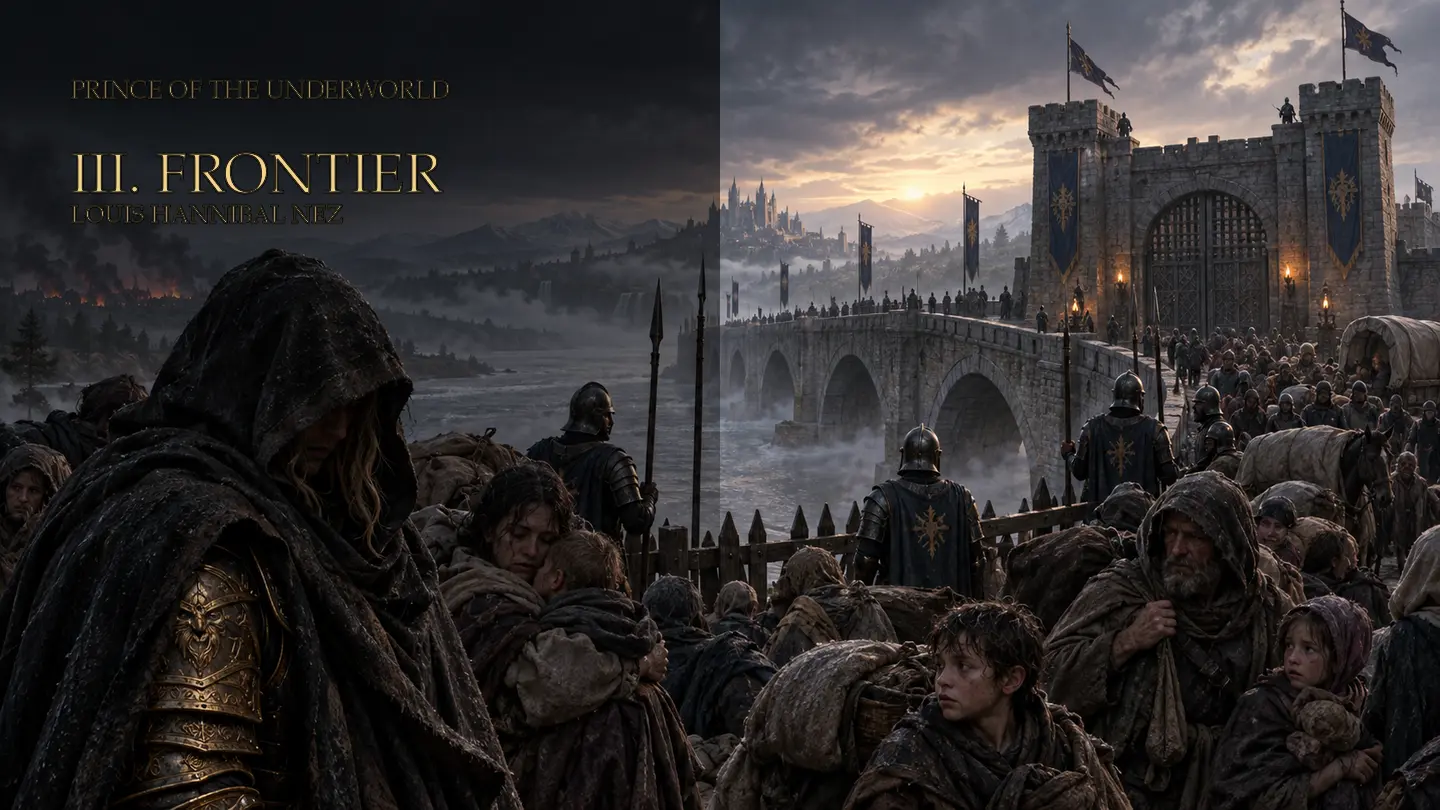
Ítsza Bridge does not open.
The line of refugees remains motionless before the iron gates. Some have spent hours beneath the fine rain falling from the hills. Others carry sleeping children, empty sacks, or wounds covered with rags. No one speaks much. The voices die away each time a soldier raises his spear.
Lajosz remains among them with his head bowed. Onvána’s cloak still covers his body. Beneath it, the golden armor feels like a second skin, rigid and heavy. Every movement reminds him that he is still carrying everything he is trying to escape. Tryendryk lies behind him. He does not need to look to know that the kingdom is still burning.
A soldier comes down the line and inspects the refugees one by one. He asks them for seals, permits, coins, or names that still possess some value. Those who have none of these are pushed toward a muddy area beside the wall.
A woman tries to explain that her husband is on the other side.
The soldier strikes her mouth with the back of his hand.
No one moves.
Lajosz feels his body tense. His right hand slowly closes, although his weapon is not within reach. He knows it would take only one step to push the soldier aside and say who he is. He knows his name still carries weight, even if Tryendryk has fallen.
But he also knows what would happen afterward.
The men at the border would hand him over to whoever controlled the crossing. If Tiklos sits on the throne, Lajosz’s survival makes him a threat. If Rev is still alive, his name might help find her. In either case, he would stop being a refugee and become a piece on the board again.
The soldier continues forward.
“You.”
Lajosz raises his eyes.
The man points at the cloak.
“What are you hiding?”
“Nothing.”
“Everyone hides something.”
The soldier pulls at the edge of the cloth. Lajosz steps back slightly. The movement reveals part of the armor, a golden flash beneath the rain.
The man narrows his eyes.
Before he can pull the cloak away, someone stumbles into him from behind. The line compresses. An old man falls to the ground and drags two other people down with him. A child begins to cry.
The soldier loses his balance.
Lajosz uses the instant to cover himself again.
“Back!” the guard shouts.
The crowd obeys with a speed that seems rehearsed.
Then he hears a familiar voice.
“Lajosz!”
He does not turn.
The voice calls again, closer now.
“Lajosz!”
This time he recognizes the tone. It is Ánvana.
The girl appears between two carts, her hair stuck to her forehead and a dried wound on her cheek. Onvána follows, holding Lenyon by the arm. Lenyon’s eyebrow is split, and he walks with difficulty. The man looks at Lajosz for several seconds, as though he is still deciding whether he should be glad to see him.
Onvána reaches them.
“We thought you were dead.”
“I thought the same of you.”
“The house fell,” Lenyon says. “But the channel was not completely dry. Onvána found an exit behind the stable.”
Ánvana looks at the cloak.
“Did you hide with that?”
Lajosz does not answer.
Onvána understands.
“Do not take it off again,” she murmurs. “Not here.”
The bridge remains closed. On the other side of the wall, the towers of the border post rise above the mist. Beyond them there is no village, only a low palisade, the checkpoint, and several roads crossing and splitting toward different parts of Reszászország.
The difference is unbearable.
A deep sound comes from the rear of the line, like a distant roar. Some people raise their heads. The soldiers hear it too, though they pretend not to.
A captain appears on the wall.
“Open the passage for those who are registered!” he orders. “The rest wait!”
The gates begin to move.
The line divides.
Lenyon searches through his clothes and takes out a small wooden plate marked with the emblem of a farming family. The captain watches it from above and makes a gesture of contempt.
“That is useless.”
“We are from the eastern district,” Lenyon says. “We have the right to pass.”
“You had that right before the order.”
“We cannot go back.”
The captain looks toward the smoke spreading behind them.
“No one goes back.”
A group of soldiers comes down to the line. They separate those with documents, although some papers are already soaked and barely legible. The rest must remain on the bridge until there is room.
Onvána squeezes Ánvana’s hand.
Lajosz watches the guards push Lenyon to one side. One of them tears the wooden plate from his hand and throws it into the mud.
“Wait!” Lajosz says.
The soldier turns.
“What did you say?”
Lajosz feels the weight of every gaze.
He could say that the plate belongs to an honorable family. He could order them to let the family through. He could demand an audience with whoever is in charge of the border.
But he has no visible authority. Only hidden armor and a family name he must keep buried.
“The man is wounded,” he replies. “He cannot walk alone.”
The soldier strikes him in the chest.
The concealed armor takes the blow. Pain spreads into his shoulder.
“I did not ask for your opinion.”
Ánvana steps between them.
“Leave him alone!”
Onvána catches her before the guard can touch her.
“No,” she whispers. “Do not make them notice you.”
The words hang between them.
Lajosz understands that they have all learned the same rule: survival requires not drawing attention.
At the far end of the bridge, someone screams.
It is not a human voice.
The sound passes through the air with a vibration that makes the stone railings tremble. The horses pulling the carts rear. The crowd breaks apart. Some run toward the gate; others try to turn back.
The soldiers raise their weapons.
“Nobody move!”
No one listens.
A dark figure appears among the trees on the Tryendryk side. It is too far away to make out its shape, but it advances at an impossible speed. Others emerge behind it.
People begin pushing one another.
A child falls between the adults’ legs. Ánvana slips free of Onvána and disappears in the confusion.
“Ánvana!” her mother cries.
Lajosz lunges toward the place where he last saw her.
A horse strikes the ground. A cart overturns. The crowd opens for an instant, and Lajosz finds the girl crouched beside the railing with her hands covering her head.
He lifts her.
“Do not look back.”
“Are they here already?”
“No,” he lies.
Lajosz hands her to Onvána. Then he turns toward the end of the bridge.
The creatures have not yet reached the gates, but the soldiers have seen them. The captain shouts an order. Archers take their positions along the wall.
“Open!” he roars. “Open now!”
The gates pull completely apart.
The crowd enters Reszászország as though passing through a wound.
Lajosz crosses with the family.
As he passes beneath the stone arch, he looks at the ground. A white line crosses the bridge and marks the border between the two kingdoms. There is no magic in it. No barrier or ceremony. Only a strip of lime worn down by thousands of footsteps.
Lajosz steps on it.
On the other side, the air seems colder.
The soldiers close the gates behind them.
The blow of the iron echoes across the bridge.
For the first time since the fall of the Golden Citadel, Tryendryk is completely separated from him.
The refugees leave the border post by one of the roads leading inland. No one explains where they are going. They only know they must get away from the bridge.
Ánvana stays beside Onvána. Lenyon walks with a pale face, leaning against a cart. Lajosz follows behind them, still covered by the cloak.
After half a day’s march, the palisade of Fénecs begins to stand out against the sky. From a distance, a dark obelisk can be seen at the center, surrounded by a broad square. Houses cluster around it. Smoke rises from chimneys, stalls are closed, and armed groups stand at every corner.
As they approach, they reach a stone sign announcing the name of the place: Fénecs.
The village is full of refugees.
The soldiers lead them toward the central square. There, names, origins, and occupations are recorded. Those who cannot prove they have a definite destination are forced to remain along the outer perimeter.
Lajosz hears accents from different kingdoms. There are merchants from the coasts, farmers from the mountains, and families who claim to have spent days crossing secondary roads. They all speak of demons. They have all seen something the authorities prefer to deny.
A man argues with a guard.
“My brother is inside the village.”
“Then let him come and get you.”
“He cannot. He is ill.”
“That is not my concern.”
The guard pushes him out of the line.
Farther on, a group of soldiers gathers around a wooden structure.
Ánvana looks in that direction.
“What is happening?”
No one answers.
The crowd moves slowly toward the shouting. In the center of the square stands an execution post. A man is tied to it with his hands above his head. His shirt is torn, and his face is covered in blood.
An official reads a document before the people.
“The accused is found guilty of spreading false alarms, inciting disorder, and collaborating with enemy forces. During the night, he attempts to open the village’s eastern gate and claims that a demonic horde is approaching from Tryendryk.”
The condemned man raises his head.
“It is not false.”
His voice is barely audible.
The official continues reading.
“The sentence is issued in the name of the border authority.”
“It is not false!” the man shouts. “I have seen them! They are crossing the forest!”
Some people step away. Others cross themselves.
A soldier strikes the condemned man in the stomach.
Lajosz watches his eyes. He does not see the look of a liar. He sees the same terror he saw in the soldiers at the bridge.
“They are going to kill him,” Ánvana says.
“Yes.”
“Why?”
Lajosz looks at the official.
“Because everyone needs to believe he is lying.”
The condemned man screams again.
“Closing the gates will not help! They are not armies! They are not coming to negotiate!”
A captain approaches the post.
“Do you still want to continue?”
The man breathes with difficulty.
“I want someone to listen.”
Lajosz feels something break inside him.
He has seen those creatures. He has seen them tear Dianod apart. He has seen them descend on Tryendryk while the soldiers abandoned their posts. The man is not inventing anything.
He takes a step toward the square.
Onvána grips his arm.
“No.”
“He is telling the truth.”
“That does not mean you can save him.”
Lajosz looks at her.
“How do you know I cannot?”
“Because everyone here is afraid of the same thing. And when people are afraid, they need someone to blame.”
The official finishes reading.
The executioner approaches the post.
Lajosz moves forward.
“Wait!”
Heads turn.
The captain studies the cloak, the mud-caked boots, and the pale face.
“Do you have something to add?”
“Yes. I have seen them too.”
A murmur moves through the square.
The official lowers the document.
“The demons?”
“Yes.”
“Where?”
“In Tryendryk.”
“Are you a soldier?”
“No.”
“Then what are you?”
The question reaches him with brutal precision.
Lajosz looks at the condemned man. From the post, the man watches him, surprised to find someone willing to support him.
“A refugee,” Lajosz answers.
The captain smiles without humor.
“A refugee cannot challenge a sentence.”
“The sentence is false.”
The captain approaches.
“Do you know the accused?”
“No.”
“And you expect us to believe your word?”
“You do not have to believe me. You only have to stop and look at the forest.”
Some people raise their eyes toward the walls.
The captain gestures.
Two soldiers seize Lajosz by the arms.
The condemned man tries to rise.
“Let him go! He knows what he is saying!”
The captain stands in front of Lajosz.
“You are not in Tryendryk now. Here, no one is saved by having a family name.”
Lajosz feels something hard brush his neck. One of the soldiers has drawn a short sword.
“What is your name?” the captain asks.
Lajosz does not answer.
Silence spreads through the square.
He can say it. He can speak his name and force them to listen. He can show his family emblem, demand diplomatic protection, and claim the right to intervene in any territory that still recognizes the crown of Tryendryk.
But he can also condemn himself.
If the captain recognizes him, he will arrest him. If he does not, someone will sell him. If his enemies learn that he has crossed the bridge, the pursuit will begin again. And Lenyon’s family will be trapped beside him.
The soldier presses the sword against his throat.
“I asked you for your name.”
Lajosz looks at Ánvana.
The girl watches him from Onvána’s arms. Her face is dirty. She still holds the little knife with which she received him at the house.
For an instant, Lajosz sees Dianod again.
He does not remember the boy’s entire face. He retains only a few details: dark hair, labored breathing, and his sad attempts to smile. He remembers the boy’s hands pushing him toward the road and the promise he forced Lajosz to make.
“When you become king, do not allow another Poverty Village to exist in Tryendryk.”
Lajosz swallows.
“My name is Dianod.”
Ánvana frowns.
“Dianod?”
“Yes.”
The captain appears bored.
“I do not know that name.”
“You do not need to know it.”
Lajosz turns his eyes toward the condemned man.
“That man is not guilty.”
“And how do you know that?”
“Because he is telling the truth.”
“Then prove it.”
The captain points at the sword.
“Tell me who you really are. Tell me what authority you have to contradict a sentence issued by the border.”
Lajosz does not answer.
The condemned man understands before anyone else.
“You know who you are,” he murmurs.
Lajosz looks at him.
“Shut up.”
“If you say your name, they will let me live.”
The square seems to stop.
The man is not pleading for mercy. He is offering Lajosz a way out. He knows that the authority Lajosz is hiding has more force than all his words.
The captain turns toward the condemned man.
“What did he say?”
Lajosz looks away.
“Nothing.”
The executioner climbs onto the platform.
“No!” the condemned man cries.
Lajosz frees himself from one of the soldiers and steps toward the post. The second guard strikes him in the back with the hilt. He falls onto one knee.
Pain cuts through his body.
He could rise, disarm both men, reach the post, and cut the ropes.
But then he would have to draw his sword, move like someone trained to kill, reveal the armor, and stop being Dianod.
The condemned man screams again.
“Tell them who you are!”
Lajosz remains still.
The executioner pulls the rope.
The man’s body jerks against the post.
Ánvana screams.
Onvána covers her eyes.
Lajosz raises his head, unable to look away.
The condemned man takes too long to die. His feet strike the wood. His hands search for something that is not there. His mouth continues to move, but no sound reaches the square.
Then the body becomes still.
The executioner steps away.
The official folds the document.
“The sentence has been carried out.”
No one applauds or protests.
From the walls comes the ringing of bells: once, twice, three times.
The soldiers turn toward the forest.
Beyond the houses, behind the eastern defenses, a column of dark smoke rises among the trees. The same shape Lajosz saw at the bridge appears above the ridge.
People begin to run.
The captain orders the village gates closed.
The official tears the document in two.
Lajosz remains kneeling beside the post.
He has crossed the border and received another name. Even so, he has failed to save anyone.
Ánvana slowly approaches. Onvána tries to stop her, but the girl continues until she stands in front of him.
“Why did you say your name was Dianod?”
Lajosz looks at the condemned man’s body.
“Because someone with that name saved my life.”
“Where is he?”
Lajosz raises his eyes toward the palisade. Smoke spreads across the forest and hides the sky.
“In Tryendryk.”
Ánvana does not understand the answer.
Lajosz rises with difficulty. In the square, soldiers begin pushing the refugees toward the houses. No one yet knows what is approaching. No one wants to say it aloud.
Lajosz looks at the Fénecs obelisk, motionless at the center of the village.
For the first time since leaving the Golden Citadel, he understands that the kingdom he has just entered is not prepared to save itself either.
And he understands something else.
If he wants to keep Rev alive, find Minoszet, and return to Tryendryk someday, he will have to keep walking as a stranger, as a refugee, as Dianod.
 END OF AVAILABLE CHAPTERS