 Louis Hannibal Nez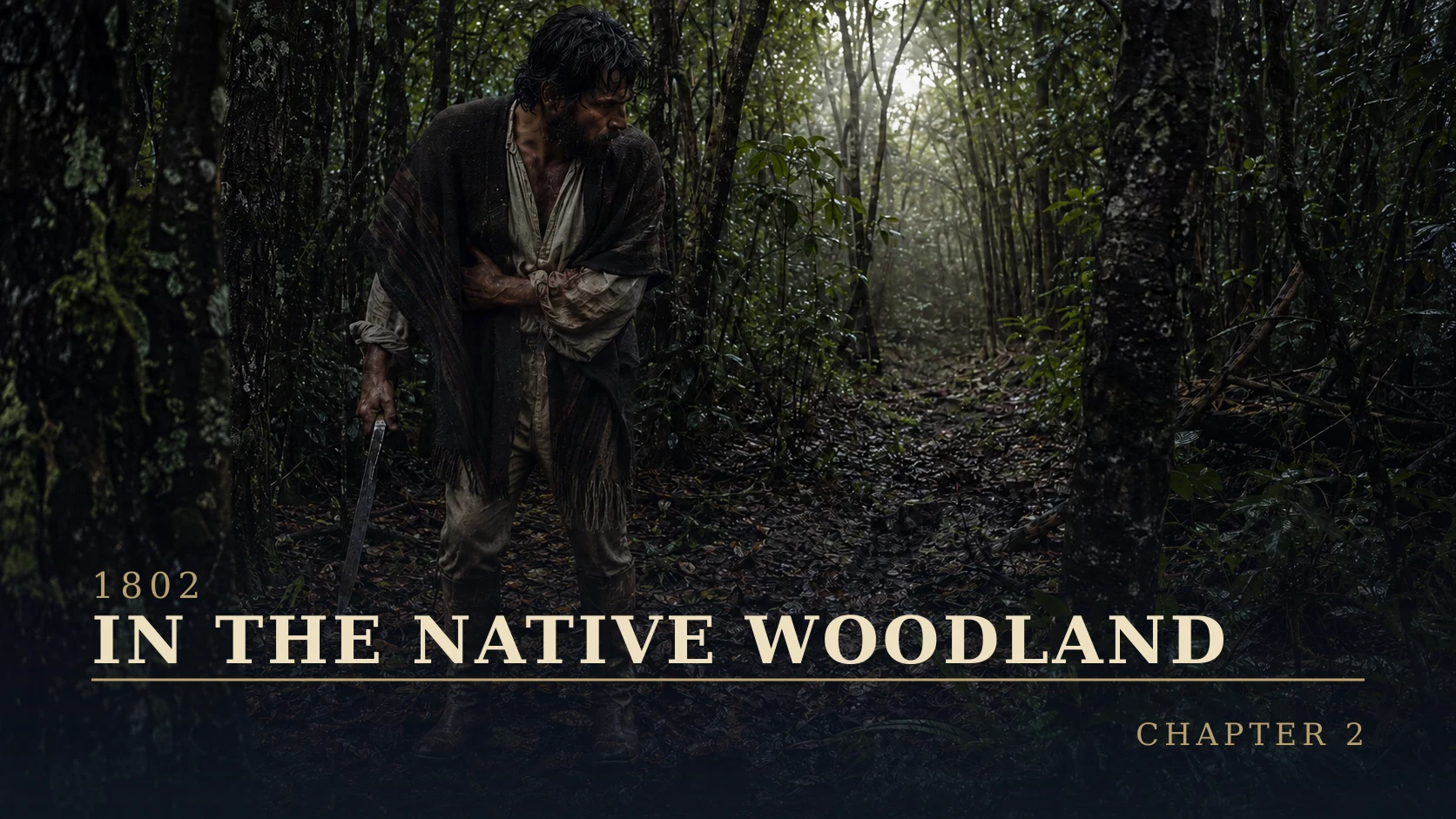
Ramiro Ibarra Pérez vaults over the wire fence. On the other side, his boots land in a puddle of muddy water that splashes in every direction.
Once across, he stops. Before him lies the edge of a native woodland—a dark stain upon the vast grassland, made up of tall trees fed by the nearby stream. Their trunks are thick and dark and smell of wet wood; branches broken by the wind cover the ground beneath their leaves.
He approaches the nearest tree, turns and presses his back against its trunk beneath the rain. The drops are less intense under the branches. He removes his poncho, wraps it around his right arm and draws his long facón: a straight, dark, worn blade without ornament. Its handle is bone, eroded by use, irregularly veined and slightly hollowed where the thumb rests.
The blade does not shine; it absorbs the light. He grips it in his left fist and enters the undergrowth. The rain eases gradually as he moves from trunk to trunk, keeping his back covered while studying the way ahead. He sees no one and tries to keep his boots from crushing brittle branches or leaves, though he cannot entirely avoid them.
His senses sharpened beneath a drizzle slowed by the canopy, Ramiro advances and takes cover, determined not to be surprised by buckshot again. Enough warm blood already runs from the wounds in his left arm, which feels hotter by the moment, almost burning in places.
At the same time, he studies the ground as closely as circumstances allow. He searches for a footprint—anything that might reveal María Antonieta's path or even her position, for she may still be hiding beneath the same branches. But the earth is too densely covered in leaves, sticks, grass and weeds.
"I know you're there. Show yourself. Esteban left you a letter. Give it to me."
No answer comes. The sounds of the woodland deceive him: a crackle, a whisper, the click of a shotgun. In truth, he hears nothing but rain—drops striking different surfaces all around him and imitating other recognizable sounds.
He pushes deeper into the heart of the woodland, darting from trunk to trunk without remaining exposed for more than a fleeting instant. His left hand is already soaked in warm blood from the fresh wounds. He cannot tend them now, but the pain distracts him more than he would like.
"Show yourself, damn it!" Ramiro insists, exasperation creeping into his voice.
Again there is nothing: silence, rain, drops and wind.
Hidden behind an ancient tree whose trunk is so thick it might be the mainmast of an enormous ship, Ramiro considers his position. He knows words alone will not draw María Antonieta from hiding. And if she is no longer in this woodland, he is wasting precious time and giving her an advantage he cannot afford.
He decides to risk using himself as bait. Circling the thick trunk, he steps in front of it and exposes himself to a possible shot.
"Come out now, Ñata! Give me that letter… and maybe you stay alive!" Ramiro offers, inviting her into the open.
Awkward, breathless and slow, María Antonieta emerges from behind a rock, holding her chest with one hand and aiming the shotgun with the other. Beneath the hand at her chest, her dress bears a hole that does not bleed. Ramiro watches her with his hands open beside his hips.
"You die today, you son of a bitch," the old woman spits.
"Give it to me and I'll leave," Ramiro insists.
"It isn't a letter. Agustín!" she shouts.
A young man immediately steps from behind a tree, gripping another shotgun firmly in both hands and aiming it at Ramiro.
"You're going to drag your son into this?" Ramiro asks without looking away from the young man.
"He's your nephew, you son of a bitch," María Antonieta snaps back.
Ramiro stops looking at Agustín and turns his gaze to the old woman again.
"Give it to me, Ñata—whatever Esteban wrote on that paper."
María Antonieta reaches beneath her petticoats and pulls out an envelope that was once white but is now yellowed, stained and old. She waves it before her face. She remains breathless and visibly pained in the chest, yet no blood can be seen dripping from the supposed wound.
"Is this what you're looking for?" she asks, holding it up.
Ramiro takes a few moments to assess the tense situation. María Antonieta aims her shotgun from seven or eight paces away. Agustín, whose presence he had not suspected, has him covered from about ten paces. The thick trunk behind Ramiro cannot be reached, however quickly he moves. Between the three of them there is only foliage.
"Are you prepared to lose everything over that paper, Ñata?"
"I'm losing nothing." She shakes the envelope. "Come here, Agustín!"
Agustín moves toward her without lowering his aim. When he reaches her, he remains there, still pointing the shotgun.
"Give it to me," Agustín says.
"You know what you have to do, boy. We already talked about it. Here." María Antonieta hands him the envelope.
Agustín takes it, slips it inside his shirt against his skin and slowly backs away until he disappears beneath the trees.
"I'll wait for you, old woman," he calls from the distance before vanishing.
Ramiro instinctively starts forward, but the old woman threatens him with a shot and he holds his ground. Soon a horse neighs, followed by the drumming of hooves moving away at a trot. Agustín is escaping on horseback. Ramiro grows impatient: if he loses his nephew's trail, he may never find the letter.
"You shouldn't have dragged the boy into this, Ñata," Ramiro tells her.
Without another word, and as swiftly as he can, he hurls the facón at María Antonieta's head.
The weapon spins through the air and crosses the seven paces so quickly that María Antonieta barely has time to move aside. The tip cuts her slightly, but she avoids the worst of it. She turns the shotgun back toward him, but it is already too late—Ramiro is upon her.
With his free left hand, Ramiro seizes the shotgun and tears it away. He throws it behind him, grips the old woman's throat and pins her against a tree. He unwraps the poncho from his right hand and, once it is free, examines the hole in her dress where a wound ought to be.
Pushing a finger into the bullet hole, he discovers that beneath the dress María Antonieta is wrapped in thick leather that caught the lead ball he fired earlier. She is bruised but unharmed.
"You knew I was coming. You prepared this." He shakes the heavy leather. "How did you know?" Ramiro asks without much gentleness.
"Your famous letter said so. You'll never find it," the old woman assures him before spitting in his face.
"Where is your son going?"
"Die, you son of a bitch. Do what you have to do. I'll never tell you anything."
Ramiro draws the remaining loaded flintlock pistol from the side of his sash and aims it at María Antonieta's face.
"Talk."
"No."
"Talk! Where is Agustín going?"
"You have no idea. Follow him… go on, follow him to hell, where you belong."
The man does not take long to answer.
"You first," Ramiro says, and pulls the trigger.
The shot cracks through the native woodland. Birds flee in terror from the tremendous report.
Ramiro drops the old woman's lifeless body onto the leaves and branches with contempt. He returns the pistol to its rain-sheltered place in his sash, picks up his poncho and drapes it over his torso. Then he searches the woodland floor for his facón and, once he finds it, returns it to his sash as well.
When he is done, he goes back to the old woman's body. The idea of the leather protecting her chest appeals to him. He examines it again and nods. He searches the entire body—skirts, neckline, petticoats, stockings, shoes and even her hair. To his disappointment, he finds nothing. Time is against him, so he leaves her there on the woodland floor.
He moves away from the body and heads toward the place where he believes Agustín left the trees. He is not far wrong. Beyond the hundreds of trees forming that dark mark in the landscape beside the Sarandí stream, he finds a horse—probably the one María Antonieta intended to use in her escape.
Ramiro approaches, strokes the horse's neck and looks into its eyes; the animal returns his gaze. Its brown coat feels warm beneath his hand. He studies the ground and clearly sees the tracks left by Agustín's horse when it departed. So much rain has softened the earth; they will not be difficult to follow.
He returns to the horse and checks the saddle. A leather saddlebag hangs on the left side of its belly, containing cooked meat, bread, two peaches and an apple. Another bag on the right holds dry powder and dozens of lead balls.
Ramiro strokes the horse's neck, pats it twice and mounts. Feeling the stranger, the animal neighs, rises onto its hind legs and flails the forelegs in the air. It repeats this three times while Ramiro clings to the reins and locks his strong legs around its rounded belly. He remains in the saddle until the horse yields.
Then Ramiro strikes that hard, rounded belly several times with his heels. The horse surges away along the tracks of Agustín's mount. He must find him sooner rather than later, for Agustín now carries the letter written by his father Esteban and inherited by his mother, María Antonieta.
Now, however much it pains him, the pursuit leads Ramiro after his own nephew, Agustín Ibarra Del Monte.