 Louis Hannibal Nez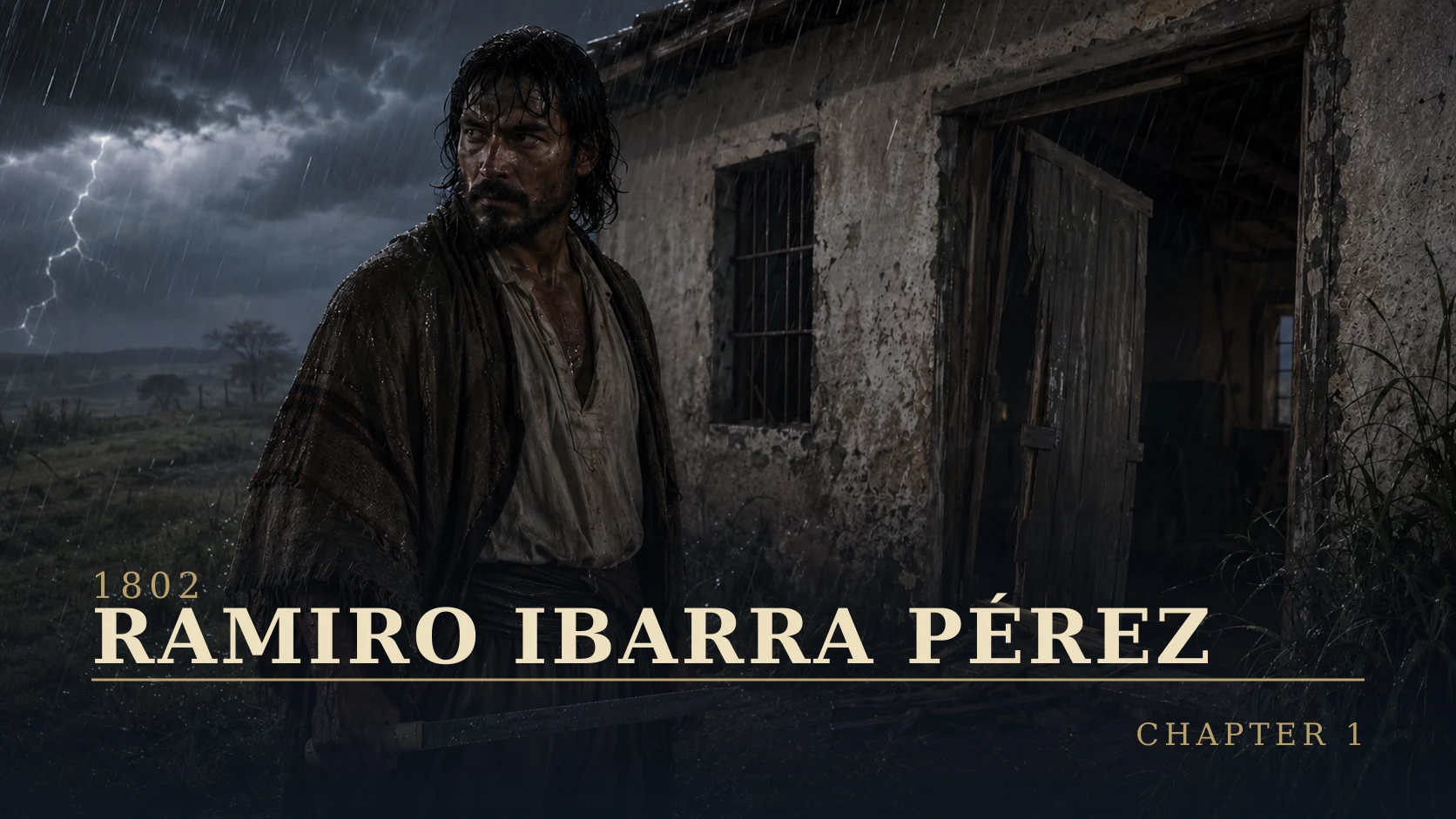
It is April of the year eighteen hundred and two, in the countryside of the Banda Oriental. Suddenly, a powerful and untimely storm erupts.
Over the lands of Porongos, black clouds burst into spectacular lightning that soon becomes thunder. Rain abruptly falls in vast, heavy curtains. It is autumn, yet the countryside near the Sarandí stream is cold—bitterly cold. Almost nothing ever happens there.
Beneath the pounding rain, thunder reverberates from the heavens to the ground and shakes everything. Shortly afterward, a man appears near the bank of the stream. Completely drenched, strong and athletic, with a sullen face and a short beard and mustache, he forces his way through the tall reeds and leaves the rain-spattered watercourse behind.
His hair is black, neither very short nor overly long. His facial hair is the same color. His eyes are dark brown, made darker now by the storm. He walks with light steps that somehow look heavy—firm, forceful, his body leaning forward. Despite his age, there are scarcely any wrinkles on his face.
The most striking feature around his eyes is a pair of small moles positioned, by coincidence, almost symmetrically beneath them. The mole under his left eye is slightly larger than the one beneath the right, though at a glance they seem identical. His nose, too, is somewhat prominent and stands out in profile.
As he advances beyond the reeds, he pulls up his chiripá and the poncho worn over his loose shirt. Colt-hide boots cover his feet. He readjusts his sash and the belt where his facón rests, feeling for its hilt without breaking stride.
Not too far away, visible between the rolling folds of the ridge, the man—Ramiro Ibarra Pérez—spots an estancia. He heads toward it. The property looks solitary and isolated beneath the dense curtain of water, with thunder sounding without pause. He does not stop.
When he reaches the farmhouse, he wastes no time. A hard kick from the sole of his right boot smashes the door open. The lock gives way, the wood splinters, and the door flies backward into a wall.
Prepared for danger, he draws the facón with his left hand and removes his poncho to wrap it around his right arm. He enters the farmhouse. A hallway lies ahead and a staircase rises on the right. There is a door to his left. He follows the stairs upward with his gaze, dismisses them, and enters through the door, alert.
The moment he steps inside, he sees an old woman seated in a rocking chair. Her face is deeply wrinkled, made more so by the anger she displays. Her long gray hair is twisted into a bun above the nape of her neck. A long blue dress clings to a body so thin it looks skeletal.
Even so, the old woman looks strong. She holds a shotgun aimed at Ramiro while her toothless mouth bites uncontrollably at the air as she grumbles. Her boots look as old as she does.
"María Antonieta," Ramiro says with contempt.
"I saw you come in, Vasco," María Antonieta growls.
"Lower the gun."
"You don't give orders in my house," she snaps.
"Where is your husband?"
"Underground."
"Don't lie to me."
"Look for him in hell."
With that, María Antonieta raises the shotgun and pulls the trigger. A mighty blast resounds inside the farmhouse, competing with the thunder outside beneath the driving rain.
The shot shatters the window behind Ramiro. Pellets spread out and sweep through everything in their path—wood, glass, poncho cloth and flesh.
He throws himself to the floor an instant before the blast reaches him, though several pellets still lodge in his left arm. His facón falls from his hand. From the back of his sash, he draws a heavy flintlock pistol made of dark metal, with a wooden grip, bronze ornamentation and a thick barrel.
He rolls to his right, rises onto one knee, aims and pulls the trigger. A flash precedes the report, sending a lead ball as accurately as the circumstances allow. It strikes María Antonieta squarely in the chest, surprise frozen across her face.
The rocking chair topples backward and the old woman spills hard onto the floor. Outside, the rain turns windblown and another peal of thunder explodes among the clouds. Raindrops enter through the broken window. Ramiro stands, approaches María Antonieta's motionless body and nudges it with his boot to make certain. She is not breathing.
With a sigh, Ramiro returns the carefully concealed weapon to the back of his sash, sheltered from the rain so the powder remains dry and hidden from enemy eyes. He then feels for a second pistol on the right side of his sash, also concealed, dry and loaded, ready should he need it.
He moves away from the rocking chair, retraces his steps and retrieves the facón from the floor. He returns it to the left side of his sash. Out in the hallway, he passes the staircase and crosses the farmhouse through another room and the kitchen. He opens the rear door and steps into the yard. The rain envelops him again.
There he sees what lies behind any house of this kind: grass carpeting the ground, clothes and sheets hanging from a line, and a well with its pulley. Ramiro moves away from the door, farther into the rain, circles the well and continues. Three meters beyond it, he finds a cross driven into the earth and approaches.
He crouches before the cross and runs his thumb over the wood. A name has been crudely carved into it: Esteban Ibarra Pérez. After reading it, he lowers his gaze and squeezes his eyes shut beneath the rain.
"Son of a bitch," he murmurs.
He clenches his right fist, growls and goes rigid. At last he spits to one side and surges to his feet. Leaving the wooden cross behind, he returns to the door and enters the kitchen. Dripping, completely soaked by the cold rain, he searches the farmhouse: drawers in the dressers, cupboards, papers on a desk, every book on the shelves of a library.
Furious and disappointed at finding nothing, he returns to the front room and looks at the rocking chair lying on its side. He crouches beside it and, more astonished than he has ever been, touches the floor where María Antonieta's body lay only an instant earlier. Nothing is there now—only a trace of warmth beneath his left hand.
He springs upright. Enraged, he kicks the rocking chair, sending it sliding across the floor into a wall. He rushes outside, takes several steps and searches in every direction. María Antonieta is nowhere to be seen, and any trail of blood she may have left is swiftly erased by the relentless downpour.
He studies the ground, advances, crouches, stands and turns again and again toward every possible direction. At last he notices a suspicious mark in a patch of mud among the grass around the farmhouse. He approaches and examines it. It is a fresh, shallow boot print. It could be María Antonieta's.
He rises and looks in the direction the boot was heading. Farther on stands a sizable native woodland, apparently beyond the estate, separated from it by a wire fence some distance ahead. Rain streaming over his face, Ramiro studies the trees.
He snorts, grimaces in pain, drapes over his torso the poncho that had been wrapped around his right arm and grips his wounded left arm, pellets still embedded in it. Then he moves quickly toward the native woodland, following María Antonieta's trail.