 Louis Hannibal Nez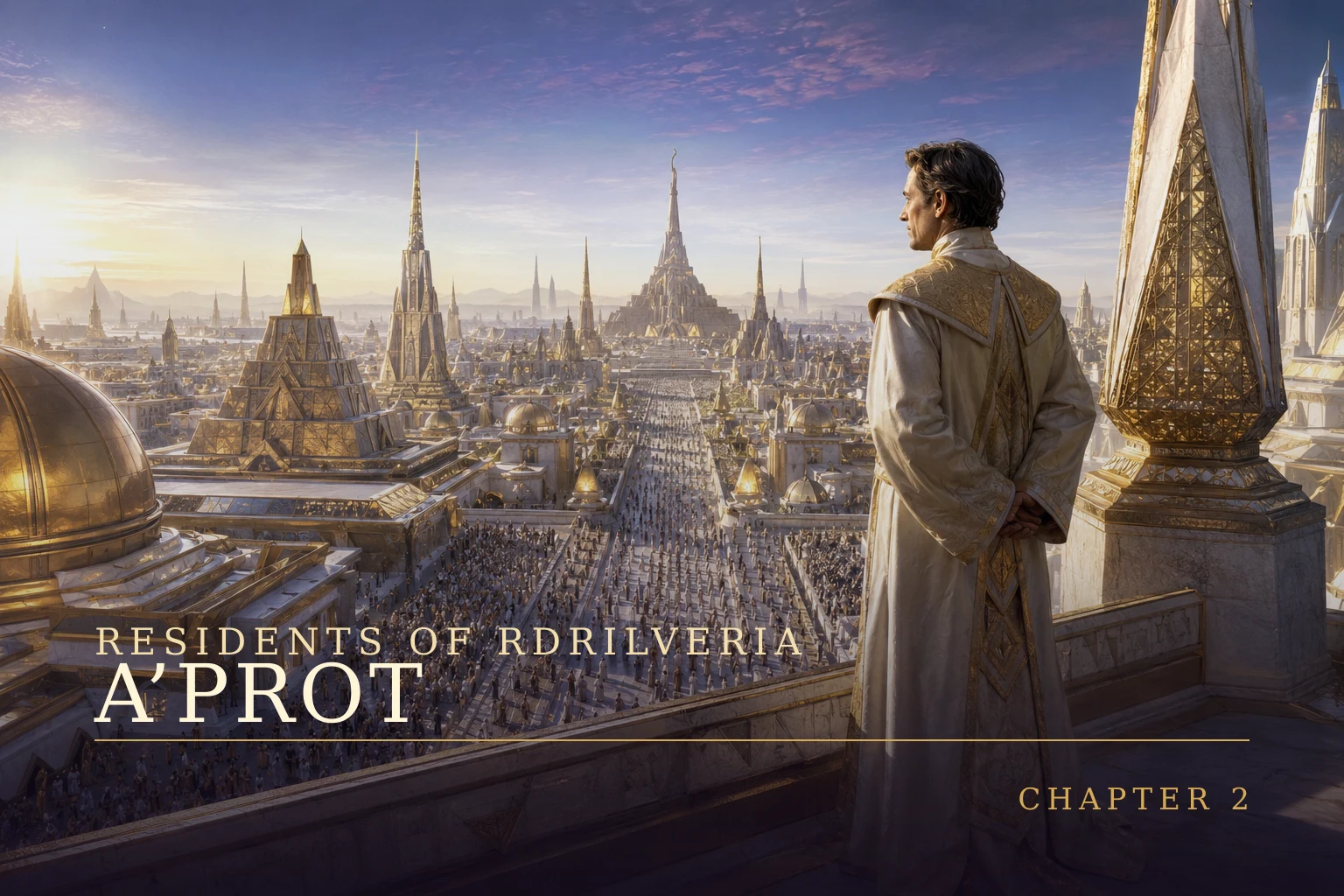
A profound suffocation laden with anguish awakened the man some mother had named A’Prot on a sunny morning. It was life cycle five hundred and fifteen, eleven cycles since Élsomrov had been named king of Rdrilveria. His magnificent, indestructible crown rested as always upon his head while he—older now, but wiser—wandered the city’s many promenades, mingling with his people regardless of ethnicity, language, or religion.
Elsewhere in the splendid pentaform citadel, A’Prot slowly recovered from his abrupt and painful awakening. His chest felt crushed, his throat knotted, his cheeks soaked with tears. Something was wrong. He knew it was more than the residue of a nightmare. He remained sitting with one hand pressed to his heaving, sweat-soaked chest, barely able to breathe. As Küny’s scorching white rays strengthened along the horizon, the balcony where A’Prot struggled awake grew warmer. This colonist, comrade, friend, neighbor, enemy to many and to none—nothing truly mattered to him. Perhaps that was precisely why the fierce pain in his soul felt so remarkable.
He lived comfortably in Rdrilveria. Nothing was lacking, nor ever would be. As direct counselor to the imposing King Élsomrov, A’Prot lived however he pleased, though without the luxuries enjoyed by men of his station in the kingdoms of a future Zyllyön he could never have imagined. The cost of the privilege of living among strangers would never have interested him. Of course it did not: life in Rdrilveria was magnificent. He knew it, enjoyed it, and cared for nothing else. With those few thoughts and the nightmare’s images still within him, A’Prot stared outside in agitation.
Many meters below his balcony, thousands of residents filled every visible part of Rdrilveria, enclosed by the thick, tall, colorful walls protecting the formidable multiethnic citadel. Within them stood houses, promenades, plazas, lakes, parks, even streams. Everything shimmered as intangibly as the air A’Prot and all the others breathed. The people rejoiced, overflowing with every sensation from cycle to cycle. Each knew perfectly well that, in truth, no one could feel anything at all—and that they felt everything at once.
After all, feeling nothing was the blessed ignorance bestowed upon the residents by life and fate, but above all it was a divine gift from Élsomrov, chosen of the gods. The wondrous monarch had completed Rdrilveria in cycle five hundred of the Rdrilveria Era. Now, in life cycle five hundred and fifteen, the fortress possessed a splendor no one half a millennium earlier could have imagined. Its residents lived prosperous lives filled with cheerful routines. Naturally, people like A’Prot remained infinitely radiant from one cycle to the next. That was how he had felt until the previous cycle. This bright morning was different.
He did not know how he should feel so soon after waking. The reality of his nightmares had led him along painful, tragic, dark roads unknown to the other residents. On mornings like this, A’Prot usually rose very early to surrender himself to the luminous dawn. He considered it the most beautiful moment in Küny’s cycles and felt privileged to witness nature’s power from the great height of his balcony. He never missed the spectacle. Nothing else could compare with its native and extraordinary light, worthy of contemplation in peace, without fear, concern, or haste.
A’Prot preferred to lose a little sleep, rub his eyes clear, and make each dawn into a daily celebration. None of those sensations touched him on this strange morning. He tried to leave behind the sickening anguish with which he had awakened and forced himself to summon positive energy. He needed to begin his routine well, as in any cycle. He had to perform his customary duties, whatever they were; the nightmare had made him forget even those. He knew one task was abandoned for another, and ethics mattered little when residents neither spoke, reasoned, nor negotiated with one another. It was ridiculous—he recognized that—and yet highly beneficial.
He wiped the inevitable tear-crusted sleep from his eyes, rose, washed, and dressed in his customary violet tunic edged with white stitching. He put on sandals woven from silver thread. As usual, though with effort this time, he left the warm balcony and stepped as cheerfully as possible onto Rdrilveria’s endless promenades. One of the many ziggurats belonging to the D’agam’anat people rose behind him in their district. After descending its steep stairs, he finally reached the citadel’s endless pedestrian paths.
He walked across rounded paving stones and encountered compatriots, neighbors, perhaps even friends, though he had no wish to deceive himself. Greeting others brought A’Prot no joy, yet somehow it also made him immensely happy. He drew in deep breaths of warm air and prepared to return every greeting imposed upon him by social obligation.
While he observed those unwritten rules, King Élsomrov waited elsewhere in the citadel for the leaders of each people to demand that he honor his word. The sovereign had not fulfilled every promise made at the conclave held only a few cycles of Küny earlier, and several leaders had grown anxious. Élsomrov feared that poor decisions born of almost inevitable inexperience might provoke the imminent mass departure of the Vurians led by Vuriann, the Randszpretrok led by Kaneo, and the Bredermann led by Hans.
Survival was believed almost impossible beyond the high stone walls, in the lands toward which the Vurians intended to travel. In a decision incomprehensible to many, members of those peoples whose convictions opposed the dominant order chose to attempt life outside Rdrilveria. The dissidents, certain of their purpose, rejected the masters’ studies. Nearly all those scholars agreed that beyond the citadel lay only rot, contamination, corpses, devastation, uncontrollable weather, mutation, pandemics, and death.
Districts belonging to those peoples looked like ghost towns—mute and empty. The few inhabitants visible appeared only to draw water from cisterns, hang clothes from lines, or purchase goods at a market. Élsomrov had begun to suspect that his unifying declaration at the conclave, which allowed some Vurians to leave for the world beyond the walls, had been a disastrous mistake. He understood even more clearly that matters would worsen when he prohibited anyone else from leaving. For the moment, a fragile peace lingered upon the promenades through which A’Prot walked, sustained only as long as the king could restrain the dissidents’ wrongdoing.
The D’agam’anat residents around A’Prot knew what had happened with the Vurians, though they considered themselves apart from the problem. That suited Élsomrov and the Episcopal Council. Tuk’Tat, leader of the D’agam’anat, had won the coveted permission to build temples venerating G’Hol’Iak’Hon, known among the other peoples as Gholiakhon, absolute god of the underworld. A’Prot now passed the foundations of the enormous sanctuary. To the left of his path rose the stone frame of what would become Gholiakhon’s magnificent temple, the tallest in Rdrilveria and perhaps in all Zyllyön.
Around the main structure, wooden scaffolds crowded with laborers disappeared toward the sky. Ten other great temples were planned, monuments on a scale never before seen by humanity in Zyllyön. Driven nearly mad by work, D’agam’anat laborers threw themselves into the project directly and indirectly.
Oblivious to it all, A’Prot walked on, dodging temple workers, pedestrians, and itinerant merchants. In his view, greeting one or two neighbors each morning was a reasonable price for preserving his status, health, and above all his safety. He considered this while crossing Rdrilveria’s long promenades, repeatedly struck by how densely the residents filled them that morning. At dawn, people walked, ran, and leaped everywhere across every path in every district. A’Prot continued through the multiethnic landscape.
He crossed the district that had always formed part of his routine, at least since his first memory—confused and somehow prefabricated. He reached a quieter shortcut with a stone wall to his left. Suddenly, a man almost as young as he was began circling him, sometimes blocking his way, sometimes appearing behind him or at either side. The man drew as close as he could, smiled, retreated, and waved.
“Holi, holi, holis! A’Prot, how are you this morning?” the cheerful resident asked in the D’agam’anat tongue.
His face was festive, displaying an enviable excess of delight. He was one of many passersby wandering that quiet promenade, and yet not merely one more. A’Prot knew this particular resident, who behaved as though a different and delightful surprise awaited him each morning. He walked backward before A’Prot, intent upon remaining face-to-face with his neighbor. He flailed his arms as if swimming, without grace or skill, though he did not care. At times, the clumsy effort of matching A’Prot’s pace while moving backward became irresistibly funny. He sometimes laughed so hard that even the solemn, sad, and listless A’Prot nearly joined him.
“Hello, C’Krach,” A’Prot said, offering nothing more.
He barely lifted or turned his gaze toward the man. He wanted to be rid of him quickly. C’Krach perceived this at once. Something was wrong with A’Prot. Far from showing concern, he smiled and laughed even more.
“Well now...” C’Krach said, pausing without taking his eyes from him. “Well, well, well. What is happening this morning? I do not see the happy face you wear in other cycles.” Suspicion and mischief animated his cheerful features.
“It would not interest you, C’Krach. It is a long and tedious tale. I would not wish to interrupt your eternal rest,” the reserved A’Prot replied with lowered head.
“Hmm... I understand, I think. But I can also tell it is grave,” the perpetually cheerful C’Krach deduced.
The deduction delighted him. He was still trying to walk backward, with better results this time, and enjoyed it like a small child.
“No, C’Krach. It is not grave,” A’Prot clarified in irritation.
He frowned at the man who would not stop waving his arms before A’Prot’s face while retreating blindly.
“You always tell your neighbor everything. Come now, you always do. If it is not grave, then tell me, tell me, tell me.” Somewhere within A’Prot, C’Krach’s insistence brought him to the boiling point.
“Stop flapping your arms like that, you great bird,” A’Prot snapped.
“Come, tell me, tell me, tell me.” A’Prot paused before speaking again.
“I had a strange dream,” he finally confessed, bitterness touching both voice and face.
“A nightmare?” C’Krach asked, continuing his clumsy performance.
“No. Fortunately, it was not a nightmare,” A’Prot clarified without much relief.
“What did you dream?” C’Krach asked. A backward step nearly brought him to the ground, and he laughed uncontrollably for a long and wearisome moment.
“I dreamed of a woman,” A’Prot confessed when his neighbor stopped laughing. C’Krach smiled and opened his eyes wide.
“And what is wrong with that, you degenerate?” he exclaimed before bursting into laughter again.
“She was not just any woman,” A’Prot cut in coldly.
“Ah... Who was she?” his neighbor asked eagerly.
“You do not know her.” A’Prot tried to dismiss the matter. He looked overwhelmed and no longer wished to answer.
“There is no one in Rdrilveria whom we do not know,” C’Krach reminded him with no little pressure, waiting for more.
“I do not even know her myself,” A’Prot admitted, his voice sad and dull.
“Ah... Then what is troubling about dreaming of a woman you do not know?” C’Krach wanted to understand.
“I know her from somewhere,” he said uncertainly.
“Hmm... you have lost me. Do you know this woman or not?” the confused C’Krach exclaimed.
“I do not know. It is confusing,” he confessed, his sorrow deepening. He stopped, and his neighbor did the same.
“Do you see the women all around us?” C’Krach asked, extending his arms toward them.
“Of course I see them, C’Krach,” A’Prot confirmed after being forced to survey the landscape.
“Any one of them might be the woman from your dream.” C’Krach grinned from ear to ear.
“Or perhaps none of them,” A’Prot reflected aloud.
“Or perhaps none. Spoilsport.”
“I do not know.” A’Prot tried to end the matter. He wanted to reach his destination quickly, wherever it might be. He resumed walking, and so did C’Krach.
“Then what troubles you about the dream?” C’Krach insisted, following with irritating closeness.
“Troubling or not, I loved her, C’Krach. I loved that stranger as I have never loved anyone. She was so beautiful and sweet.”
A sepulchral silence that was not truly silent followed. Other residents could still be heard. C’Krach considered the answer without losing his smile, then spoke.
“That is not very common, my friend. We D’agam’anat do not love. Remember?” was all C’Krach said.
“I know,” A’Prot answered, thoughtful and uncertain.
“I doubt it is even possible. We can fornicate for pleasure with whomever we wish—you know that, you have done it. We procreate, but we do not love. Not that, my friend. We cannot.” C’Krach spoke with utter conviction.
“Possibly...”
“Then?”
“Then I dreamed of her, C’Krach. I do not know, all right? She was beautiful, in some precarious place, surrounded by danger and defenseless. I could do nothing for her, though I wanted to.”
“And then?” C’Krach asked eagerly.
“And then nothing. Dreams do not respect our laws, C’Krach. They answer to no religion, rule, or conduct. They are only dreams, and in this one, what I have told you occurred,” A’Prot defended himself.
C’Krach still could not remove the smile from his face, though it was clear his neighbor had begun to worry him.
“Could it perhaps be the expression of a desire?” C’Krach asked, still smiling as before.
He flailed both arms more desperately when he turned and saw his back nearing an ancient projection in the stone wall. He veered right to avoid it.
“I do not know. I have no answers, C’Krach.”
His companion evaded the stone with his customary clumsiness. It was almost impossible not to laugh—or at least smile—at such awkwardness. A’Prot, however, came nowhere near either.
“If this is a desire you mean to pursue, it could become a problem, my dear neighbor,” C’Krach warned with genuine concern for the man whom he, at least, considered a friend. A’Prot stopped, and C’Krach with him.
“I know,” A’Prot reflected aloud.
“Forget it. Return to us. Be the happy resident you have always been,” C’Krach pleaded.
“I will put it this way.” C’Krach prepared himself, delighted by the anticipation.
“I am listening, listening, listening!” C’Krach celebrated, tracing circles with his arms. The spinning made him dizzy, but he fought not to fall.
“When I felt that I loved her, C’Krach—or better still, when I felt that she loved me with all her heart—I began to question certain things about Rdrilveria. Do you understand?” He waited for C’Krach to respond, but the other man looked stunned, so A’Prot continued. “By making me feel what she felt, she made me question our entire existence in Rdrilveria.”
He spoke softly so no one would hear, but the stone walls betrayed him, amplifying his words. Invisible crossfire erupted as innumerable residents—serene, silent, and now motionless—turned their eyes upon him. In that precise moment, no one who heard him failed to twist their head and fire a look of absolute disapproval.
“You should lower your voice, my friend,” C’Krach suggested.
“I have nothing else to say. That was all.”
“I do not understand how you reached such a conclusion. What I know is that no resident in his right mind could be foolish enough to question the finest existence any of us could have received.” As C’Krach argued, the smile that had seemed indelible slowly faded from his face.
“Do you truly believe that?” A’Prot asked with the deepest sorrow ever seen upon a face in that citadel.
“Without question,” C’Krach reaffirmed with great confidence.
A’Prot took several moments to answer and first examined his surroundings. Every resident within sight had stopped. They had heard him and abandoned every activity at his words. All those he could see—and, without exception, those he could not—had turned to face him. A’Prot focused upon the eyes of the neighbor with whom he had been conversing, unaware of the other inquisitorial stares upon him.
“Do you truly believe it, C’Krach? Do you believe we were made to live without ever experiencing love?”
A’Prot’s question finally stabbed the smile from C’Krach’s face. He stopped moving his arms, though those motions seemed the very source of his happiness. No longer walking backward, he froze before the question. Without a word, C’Krach retreated from A’Prot. When his back reached the other residents, the multitude swallowed him. He disappeared. A’Prot lifted his chin and discovered the stares arriving from every direction. He did not search for his companion. That would have been foolish.
He tried to identify which words from his supposedly private conversation had offended them. He saw people who no longer walked, ran, or leaped, but stared at him with revulsion, hatred, and countless other unpleasant emotions. They were the same neighbors as always, except now they watched openly without speaking or blinking.
Then, when A’Prot least expected it, he saw the woman from his dream among the multitude.