 Louis Hannibal Nez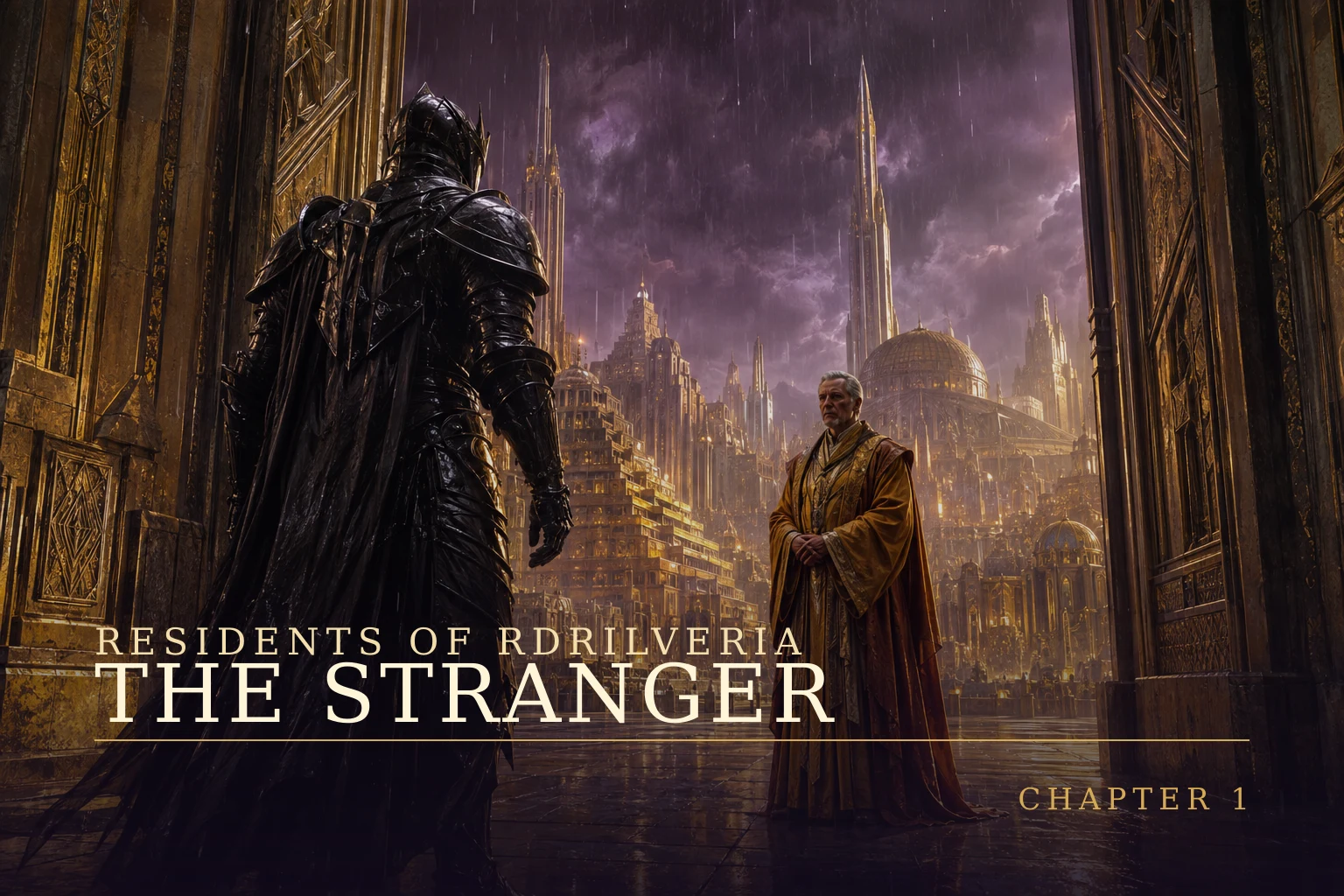
Many legends claim that humanity first came into existence within the pentaform citadel of Rdrilveria, cradle of the human beings who inhabit the world of Zyllyön.
One day, the inhabitants of the citadel witnessed the arrival of an extraordinary visitor. The eyes of Rdrilveria’s residents—and more than a few pointing fingers—turned toward an object falling from the sky. Each people within the multiethnic citadel interpreted the event in its own way. The Bredryvek believed it heralded the arrival of Vakroy, the prophet they had awaited for centuries. The Morguendis, by contrast, had no doubt that the object had been cast down by Solaris, the mother star of Zyllyön known among the Bredryvek as Küny. Whatever it was, it fell with terrible force. It tore through atmosphere and cloud, crossed the sky above all Rdrilveria, and struck the earth several kilometers from the Eternal Gates, the citadel’s only entrance or exit.
After the explosions split the sky, only an immense and profound silence remained. People left their homes and gathered upon walkways and plazas, around fountains, in gardens and floating forests, searching for an answer. To the sentinels stationed in the southern watchtowers on either side of the Eternal Gates, the scene was clear. Whatever Solaris had cast down had carved a long furrow through the earth and opened a V-shaped channel among the surrounding jungle trees. Those sentinels, along with dozens of soldiers atop the pentaform walls, witnessed the unknown object break apart completely.
When the thing from the sky had disintegrated, a man emerged from the earth amid dust and splintered wood. The captain of the sentinels, a soldier named Élsomrov, saw a powerfully built man two meters tall whose body was entirely concealed by armor and helm. The metal was dull, worn, and black as obsidian. In his left hand, he carried a solid shield, heavy and thick, made from the same metal; in his right, a wholly metallic flail, gray and equally dull. With the slow inevitability of rain-laden clouds, the outsider advanced toward the Eternal Gates.
“Identify yourself, stranger! What business brings you here?” Élsomrov demanded before the man stopped directly before the gates. He received no answer.
Élsomrov, captain in command of the watch that afternoon, ordered two archers to prepare to fire upon his signal. Above them, the clouds covering the violet sky could no longer hold their water and released it. Even before the rain began, thick mist had clouded the view from the high ground upon which Rdrilveria stood. Raindrops rattled against the soldiers’ primitive leather breastplates and the stranger’s solid armor. Cuts, dents, notches, scratches, and stains already marred that armor. It appeared to have survived dozens of violent battles.
“Remove your helm, stranger! Identify yourself! Show respect to the authority receiving you in Rdrilveria!” the captain insisted. His words only made the visitor assume a defensive stance. “If you refuse what is demanded, we will attack,” Élsomrov threatened.
He immediately raised his left hand. Two archers drew their bowstrings and waited to release as soon as the captain lowered it. The stranger’s hidden face unsettled the hundred soldiers watching him. His refusal to answer made them tense, impatient, and anxious. No one was more uneasy than Élsomrov, though he had shown extraordinary tolerance toward a silent man standing before the citadel’s only gates when any visitor should have been pleading for entry. Visits to Rdrilveria were rare. In this remote age of Zyllyön, all known humanity lived within those walls.
From time to time—and less frequently with every passing cycle—people arrived at Rdrilveria begging for food, drink, and shelter. Many residents had first entered that way when the citadel was still under construction, no more than a utopia advanced by the prophet Vakroy, later elevated into the god of gods. Five hundred life cycles had passed since Vakroy departed for Zammön, the coastal paradise from which he would watch over and protect humanity. Now, near life cycle six hundred, almost no outsiders reached Rdrilveria’s towering sealed gates, barred from within by massive wooden beams. Those who did arrive came dying, diseased, and dressed in rags.
Thus the presence of this strong, healthy, apparently well-fed, and well-equipped man shattered every belief. Before the hundred watchers upon walls and towers stood someone who might belong to a civilization that had not developed inside Rdrilveria. If so, an unknown enemy might exist somewhere beyond the citadel, ignored until that moment. The soldiers murmured such theories while the stranger defied their captain’s demands. Their frightened faces made those thoughts easy to read.
“I ordered you to remove that damned helm!” the captain demanded again, left hand still raised.
The bowstrings tightened as the hearts of young men carrying weapons they had never used began to race. More than one drew a blade while awaiting the order, though the wall beneath and before them offered some measure of safety. Yet despite the captain’s shouts from eleven secure meters above the ground, the stranger did not move. Within the thickening mist and falling rain, his metal-clad body seemed an inert statue.
His patience exhausted but reassured by Rdrilveria’s defenses, the captain dropped his left hand. The archers fired almost instantly. With movements as swift as a dragonfly’s wings, the stranger crouched and raised his triangular shield. Both arrows struck its dull surface, broke, and fell upon the wet earth. The visitor’s speed astonished everyone; his enormous body looked far too heavy for such agility.
In the silence that followed, the rain became deafening. Then a sound exploded across the ground. At first, captain and soldiers mistook it for thunder, as though the storm might turn violent at any moment. But the noise took shape, becoming words, and nearly everyone understood its source. The stranger was speaking for the first time, his voice powerful and strange.
“I could grant you priceless knowledge. I could speak of life, death, and all the mysteries that rob you of sleep. I could share an eternity’s compendium of wisdom, for it lies within my power and you have need of it. But you know only one language—the warlike discourse of blood and death. You remain too primitive, at least for now. Therefore, I shall address you in the only language you understand. Send me your champion, some warrior of the highest order, the most powerful within those walls. Send him here, and we shall fight to the death at once.” The stranger’s many-layered, quadraphonic words were too complex for most of the men.
Some soldiers laughed and others smiled, but a few recognized the danger before them and could say nothing. The captain of Rdrilveria’s guard, who had eaten well the previous night, slept even better, and made love to his wife, had no intention of allowing this unexpected visit to complicate his day. As the stranger had predicted, everyone understood one thing without question: they must send him the finest gladiator Rdrilveria had ever known. One soldier was the first to invoke a name, hammering his right foot upon the ground.
“Broderius, Broderius, Broderius,” he chanted. Other soldiers joined beneath the captain’s watchful eye.
The captain looked down beyond Rdrilveria. The stranger had become a marble statue once more. The chants invoking the gladiator multiplied and grew stronger. Inside the pentaform walls, neither rain nor mist distracted the residents who heard the name. News that a stranger had challenged Broderius traveled faster than the chant itself. Before long, word of the challenge reached Broderius.
By the time the mighty gladiator learned of the matter and abandoned his thermal baths, nearly all Rdrilveria proclaimed his name as that of a hero. Once he understood what was required, Broderius negotiated an enormous reward for defending the citadel from the foreign invader. Rdrilveria’s twelve-member Episcopal Council, established by Vakroy himself before his departure for Zammön, signed a preliminary agreement that would make Broderius and seven generations of his descendants wealthy if he defeated the threat. Secretly, the Council hoped the gladiator would die and the army would crush the stranger. That outcome would spare them the cost, entertain the people, and eliminate the danger.
Broderius accepted the agreement and prepared to march into battle. The rain stopped during the episcopal negotiations, though threatening clouds remained above Rdrilveria. The imposing gladiator donned his thickest battle gear: a leather breastplate, a bearskin helm, boots made for mud, iron bracers, and double protection for his manhood. He selected his favored weapons, a heavy iron shield and a seven-spiked mace.
Before he dressed for combat, three women and a young boy coated his body in oil so that his opponent’s blows might slide from his skin. The oils made Broderius gleam beneath the cloudy sky when he finally emerged into Rdrilveria’s crowded streets. He had rarely felt so glorious. Every resident seemed to cheer his name as a chariot drawn by six horses carried him toward the citadel gates. Neither his thick beard and heavy black mustache, nor his long hair and severe scar-covered face, diminished the people’s adoration. His popularity had never stood so high.
People showered him with flowers from both sides of the road. Colorful blossoms covered his path and filled the citadel with intense fragrance. The residents kept half their bouquets to welcome the triumphant gladiator home. As Broderius approached the gates, the Episcopal Council planned celebrations that would last several cycles of Küny. The festivities would entertain the people and refocus them upon the increasingly unstable path of faith.
After decades of absolute seclusion, Rdrilveria’s gates were unbarred beneath the residents’ attentive eyes. The massive beams withdrew through their appointed mechanism, then gears began to turn and pull the two leaves of the enormous pentaform gateway apart. As though by magic, the gates opened wide at the precise moment Küny’s powerful rays pierced the clouds and bathed the residents’ faces. Only then, with the entrance fully open, did the common people see Broderius’s opponent for the first time. Their astonishment deepened.
Still stationed atop the wall, the captain received a scroll from a messenger. He read it and looked around at his men, all waiting for answers. He tucked the scroll between breastplate and skin, approached the edge, and studied the stranger. The man had remained in precisely the same position since delivering his convoluted speech, waiting like a statue of metal. Across the threshold stood Broderius. He stopped his chariot, climbed down, and approached with his fiercest expression, iron shield in one hand and mace in the other.
“Let us finish quickly. I have wine to drink, riches to swim in, and women to fornicate,” Broderius said as he approached his opponent.
Like everyone else watching, Broderius saw that his opponent did not move. He interpreted the stillness as fear. The man stood defensively but remained utterly motionless. Broderius rushed him and slammed his iron shield against the stranger’s dark triangular one. The collision was brutal. Before the entire crowd, Broderius staggered backward with fierce pain in his left arm, while the stranger—just as powerfully built but much taller—held exactly the same immovable position.
“What is happening?” Broderius managed as he rose.
The moment he regained his feet, he swung his mace and readied another attack, shifting the shield upon his injured arm. He launched himself at his motionless opponent and struck hard, hammering chest, back, and head. Broderius tried to bring him down with blows to thighs and ankles, but achieved nothing. His mace, famous for destroying shields throughout Rdrilveria, left not one dent, scratch, or mark upon the stranger’s armor and helm.
Unsatisfied, Broderius attacked more savagely, striking everything within reach with all the strength his arm possessed. Such blows would have splintered any man’s bones. Once again, they did nothing to this opponent’s metallic shell. Exhausted, Broderius paused to recover his breath. The stranger moved without warning, attacking with a dull sword. The first stroke cut Broderius’s shield in half and took his left arm with it. The second severed the gladiator’s right arm, which crashed to the earth with the mace still in its hand. The third and final stroke passed through Broderius’s neck.
When the stranger withdrew the dark blade, the gladiator fell forward, face down and dead, to the horror of all present. The stranger immediately strode into the citadel, ignoring every arrow fired at him. Once inside, a guard of spearmen attacked with the violence born of panic, thrusting from every direction and aiming for every part of his body.
“The armpits and neck! Armpits and neck!” the captain shouted from the wall as he descended the stone stairs with his men to reinforce the guard. No one could stop, wound, or kill the stranger who had entered Rdrilveria.
“I do not wish to harm anyone. Cease your attack, or I shall be forced to kill you all,” the stranger warned.
“Stop! Stop! Stand aside!” the captain ordered upon reaching them.
His men obeyed but did not retreat far, forming a circle with spears aimed at the outsider. The captain broke through it and approached. Standing before the man, he felt diminished; the stranger towered at least three heads above him. At close range, he confirmed that armor and helm remained untouched, an impossibility before his eyes.
“Who are you? What do you want in Rdrilveria?” the captain asked.
“I want peace—your lasting peace. And I want union among all your divided peoples.”
“You have not answered me. Who the devil are you?”
“Only someone seeking this community’s prosperity,” the stranger replied.
“We already have a prophet, whether you like it or not. His name is Vakroy!” shouted an old man in a toga.
The elder arrived with eleven others dressed like him and bearing symbols commemorating the prophet he had named.
“You admire your prophet so deeply, yet you do not know him when you see him?”
Those words struck the twelve robed elders—the bishops of the Episcopal Council—with absolute astonishment. The shock was greater still among everyone surrounding the stranger.
“You claim to be our prophet?” another bishop demanded.
“As I told you while I still stood beyond the walls, you understand only violence, and so violence is what I gave you. I can give you more. You may attack me in a thousand ways, and none shall kill me. If I wished, I could kill every one of you without pain or fatigue. Even your finest soldiers would perish from exhaustion before I did.” Whispers multiplied among residents, soldiers, and bishops. “But that is not why I came. I have brought something that will grant humanity peace forever. Race, language, creed, and culture divide you, yet they matter less than what unites you. From this day onward, union must be your purpose. For that, I have brought you something.” The stranger raised his hands toward his head.
Everyone expected him to remove the helm. Instead, with unexpected delicacy, he unscrewed what appeared to be a simple ornament from it. Once freed, the object in his hands was unmistakably a crown. It was plain, dull, and dark, without jewels or needless relief. Its only distinction was a series of inscriptions carved inside and out in a language no one recognized. The stranger knelt upon one knee, then the other, lowered his head, and extended the crown upward in both hands, offering it to the men around him.
“With this crown, I leave you my legacy of peace, an object that shall unite every caste and all humanity into one people beneath a worthy rule. Whoever bears it shall receive wisdom, clarity, and peace for himself and his people. Differences, circumstances, and disputes will not matter. The bearer shall always possess the wisdom to know what must be done and shall govern with intelligence, cunning, empathy, and above all love for his fellow human beings, for humanity, and for the world of Zyllyön, which shelters him without asking anything in return.” Though the stranger spoke clearly, nearly everyone listening found his meaning bewildering.
“How do we know you are not a demon or a sorcerer? How can we be certain this is not a trap?” one bishop asked as he approached.
“There are no half-truths or hidden meanings in my words, only the desire for lasting peace among you and with the world around you. But I shall give you one warning.” The approaching bishop stopped three paces away.
“What warning?” the bishop asked.
“Only one whose soul is pure, innocent, and penitent may touch this crown without suffering terrible consequences.”
“I am penitent. I am the eldest member of this episcopal order. No one deserves it more than I.” The bishop approached the stranger.
He seized the crown in both hands and pulled, but could not tear it from the stranger’s metal gauntlets. It felt cold—colder than the surrounding air—but soon began to heat beneath his wrinkled fingers. The old man released it when the heat became painful, yet the burning did not leave him. He shook his hands and rubbed them against his toga, but the agony spread through his body until he could endure no more. By the time he fell, the bishop was dead.
“I knew that old whoremonger was neither chaste nor holy, but I am,” another bishop declared, rushing forward to seize the crown.
He too failed to remove it and suffered the same fate. Seven bishops attempted it in turn and died. The others abandoned the effort.
“Anyone may try,” the stranger said, turning slightly.
The crown now rested directly before the captain of the guard. Encouraged by his men, who considered him honorable, he stepped forward and dared the attempt. He grasped the crown and lifted it effortlessly from the stranger’s hands, then placed it upon his own head. Thus, according to legend, began Élsomrov’s long reign—the first to govern Rdrilveria, all humanity, and the world of Zyllyön in his own name.