 Louis Hannibal Nez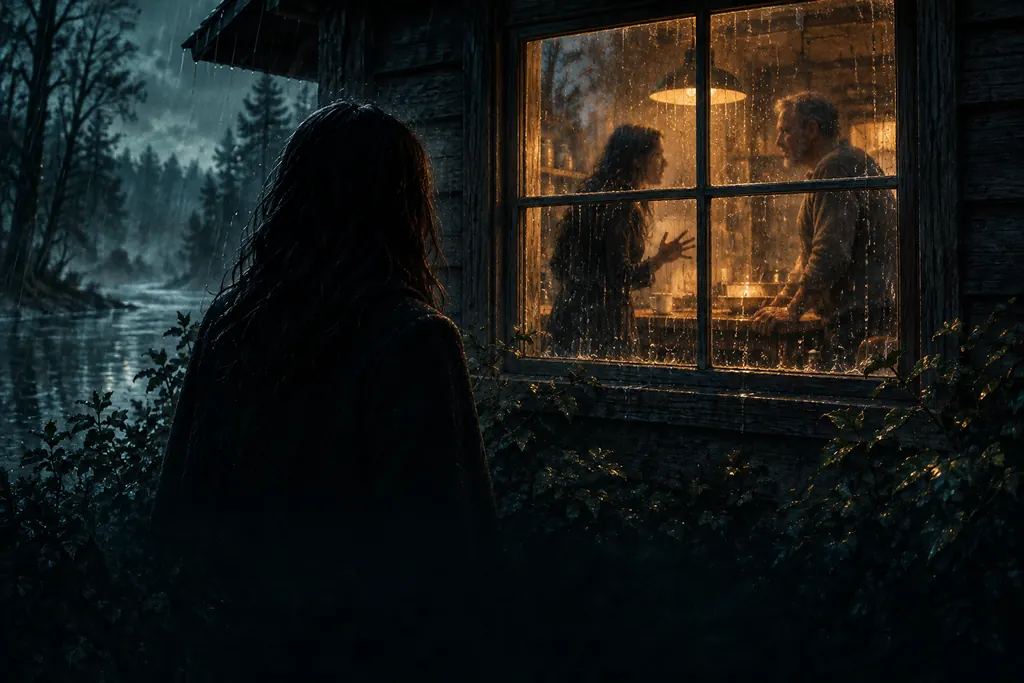
Marie stands motionless before the cabin.
Rain beats hard against the deck and roof, yet the building seems untouched by the storm. The porch lantern is still burning. Its yellowish light falls on the entrance, the SUV, and a stretch of wet wood.
Marie studies the vehicle.
It is identical to the one Joseph drove to the cabin. If this is the same property, then Joseph has returned. But if she is on the opposite side of the stream, she cannot understand how everything could repeat itself so precisely.
She does not dare go inside.
The cabin feels familiar and strange at once. The thought of opening the door and finding someone inside fills her with a fear she cannot master.
She decides to look through a window.
She moves cautiously around the building, hunching against the rain. Reaching a kitchen window, she stops beneath it. At first she hears nothing. Then, through the wind and water, she makes out voices.
Two people are arguing.
Marie recognizes one of them.
She edges closer. She still cannot make out the words, but the tone unsettles her at once. The second voice sounds familiar too.
She presses her back against the wall and stands still, listening. The argument grows more heated. One voice shouts. The other answers with a suppressed fury that soon turns to insults.
Marie feels her heart begin to pound.
She cannot explain why, but she is certain she knows both people inside.
Slowly, she straightens and raises her head above the windowsill.
What she sees leaves her motionless.
A man stands in the kitchen with his back to her, wearing the same shirt Joseph wore before he left. Facing him is a woman in the same dress Marie herself was wearing a couple of days ago.
Stunned, Marie tries to tell herself that these are not the same Joseph and Marie from the other cabin.
She tries to see whether the woman’s face is the one she sees in the mirror each morning. It moves beyond the glass, misted on the inside and streaming with rain, but she cannot make it out clearly.
Her double stands before Joseph, agitated, her hair disheveled, wearing an expression Marie has never seen on herself. The other Joseph backs away, trying to answer her.
Marie cannot hear what they are saying. The glass, fogged within and wet without, the rain, and the shock of what she is seeing reduce their words to distant sounds. All she can make out are the shouts, the abrupt movements, and the growing violence of the scene.
Her double strikes Joseph.
Once at first.
Then again.
The man tries to shield himself, but she keeps attacking him with her fists, hurling insults Marie cannot make out.
Marie puts a hand over her mouth. She cannot turn away.
The woman inside the cabin has the same hands and is the same height as her. Perhaps she has the same face too, though Marie cannot be sure of that. Yet she seems possessed by a fury Marie does not recognize.
Something in her movements frightens Marie more than the attack itself: a cold resolve, as though she has stopped seeing Joseph as a person.
The other Joseph falls against a cabinet.
Her double pauses for a moment. Breathing hard, she looks around the kitchen.
Then she sees a knife.
She takes it.
Marie understands what is about to happen before it does.
Her double approaches Joseph, who is still trying to get up. He raises a hand and seems to say something. The woman does not answer.
She plunges the knife into his chest once, then again, then a third time.
The other Joseph collapses to the floor.
Marie tries to draw back, but her legs will not respond. She keeps staring through the window as blood begins to spread across the man’s clothes.
Her double stands beside the body.
The knife hangs from her hand.
Nausea rises in Marie. She pulls away from the window and falls to her knees in the mud. Water lashes her face, but she barely feels it.
For a few seconds, she cannot think.
The image repeats itself over and over: the knife descending, Joseph’s body falling, the expression her own face must have worn during the attack, though she never truly saw it.
Marie closes her eyes.
“It can’t be.”
The words are barely audible beneath the storm.
Perhaps she is dreaming. Perhaps the breathlessness she suffered on the bridge has caused a hallucination. Perhaps rain, exhaustion, and fear have distorted everything she sees.
But the scene was too vivid to be a mere hallucination.
Marie looks back toward the window.
The kitchen is empty.
She can see neither her double nor Joseph’s body. Only the lights, the furniture, and a dark stain spreading across the floor.
A new possibility forces its way into her mind.
Perhaps she is not seeing a parallel reality. Perhaps she is seeing a moment that has not happened yet.
The thought paralyzes her.
Marie struggles to her feet. Mud falls from her knees, and rain streams down her face. She looks toward the bridge, barely visible through the curtain of water.
She has to go back.
It does not matter what she has seen. It does not matter whether it is a nightmare or a warning. She must get back before Joseph returns to the cabin.
Marie starts running downhill.
Before long she trips and falls face-first into the mud. The impact hurts her hands and chest, but she does not stop. She gets up and keeps descending through the rain.
She falls several more times.
She feels the pain, but it remains somewhere behind the terror. She can think only of Joseph, of Sunny, and of the cabin where she has left her life.
When she finally reaches the bridge, she stops.
The stone structure stretches out before her. There is no rain on the other side, and the landscape seems wrapped in a strange light.
Marie remembers what she felt while crossing it.
She remembers the wind that moved nothing, the cold, the absence of oxygen.
For a moment she thinks of stopping. Then she looks back. The hill, the cabin, and the lantern have vanished into the storm.
Marie runs toward the bridge.