 Louis Hannibal Nez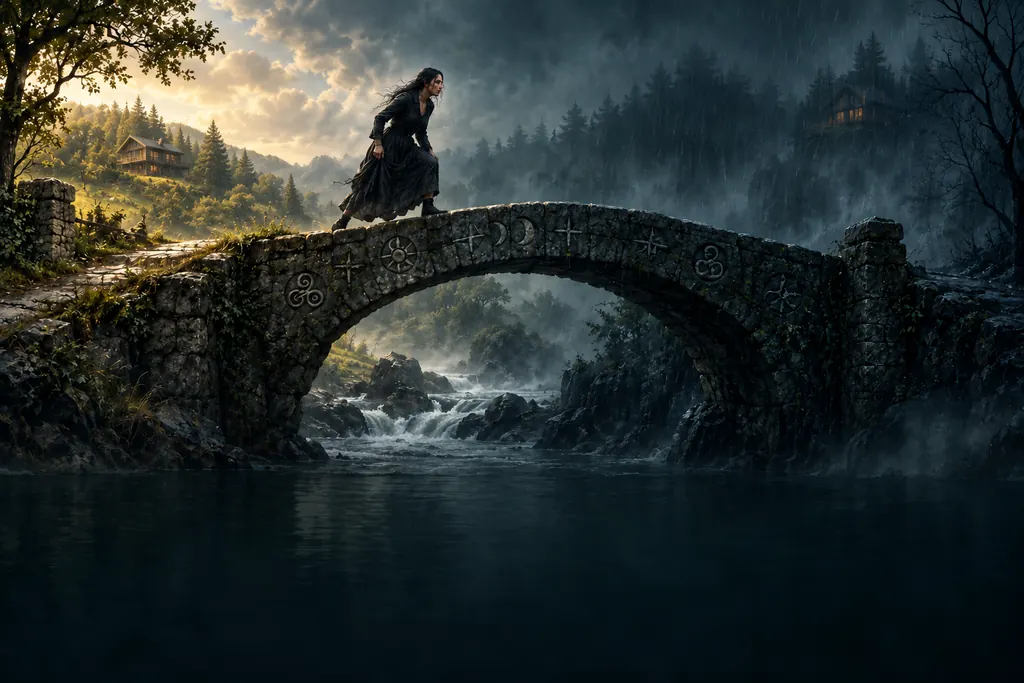
Sunny is asleep in her room.
Marie watches her from the doorway for a few seconds. Then she goes down to the dining room, takes a sheet of paper, and writes a brief note. She does not want to wake her or explain where she is going. She leaves the paper on the table beside the keys and walks out of the cabin.
From the deck, the bridge looks much closer than it really is.
Marie follows a narrow path down the slope, though she soon realizes it is hardly a path at all. Vegetation grows unchecked, and shrubs block her way. More than once she has to push branches aside and force her way through thorns that tear her clothes and scratch her arms.
The stream looked small from the cabin, yet the distance seems to grow as she descends. Marie cannot tell how long she has been walking. The steep, uneven ground demands more effort than she expected.
When she finally reaches the water, she stops to catch her breath.
The stream is wide, its current powerful. Large rocks rise above the surface, splitting the flow into small rapids whose sound mingles with the wind and the rustling trees.
Marie looks back.
The cabin where Sunny is sleeping seems far away, almost suspended on the slope. From here, the opposite building is easier to make out. The light that has drawn her attention at night seems to be roughly halfway up the hill.
Marie goes on.
After pushing through an even denser stretch of vegetation, she reaches the bridge. She pauses before crossing. The stone arch rises over the stream, solid with age. The carvings that looked like simple ornaments from the deck now reveal more intricate forms. Some seem to depict animals. Others resemble distorted faces or incomplete human bodies.
Marie does not let herself study them for long.
She crosses the bridge.
At first, everything seems normal. The stones underfoot are wet and slippery, but her steps are steady. Then, about halfway across, a current of air passes through her body from right to left.
The wind is fierce and icy.
Marie shudders.
She looks at the trees. Not a branch stirs. The shrubs are motionless, as though the gust existed only in the space her body occupies.
Her hair does not stir either.
Marie tries to move on, but suddenly it feels as though her lungs have been emptied. She opens her mouth and tries to breathe. She cannot draw in any air.
Her chest begins to burn.
She puts a hand to her throat. Her body freezes, unable to make sense of what is happening. This is nothing like ordinary breathlessness: it is as though the space around her has lost its oxygen.
Marie looks toward the far bank.
A few yards still remain.
She forces herself to move. Struggling forward, she clings to the stone parapet when her legs begin to fail. The need to breathe becomes unbearable. Panic surges through her and, without another thought, she runs for the far end of the bridge.
The moment she steps onto the opposite bank, the wind vanishes.
Marie drops to her knees and drags in a desperate breath. Then another. And another. She breathes like someone emerging from an asthma attack, her chest tight, her head buzzing.
Then the first drops begin to fall.
Marie lifts her face.
The rain comes suddenly, as though a storm has been waiting on the other side of the bridge. Within seconds it thickens. The sky darkens, and the water soaks her hair and clothes.
When she manages to stand, she finds the ground covered in mud.
She is startled by how wet the earth is. There has been no rain on the other bank, and the weather had stayed dry at the cabin. Here, though, the mud looks as if it has been rained on for hours.
Bewildered, Marie looks up at the sky.
She could turn back. The thought comes clearly to her. But she has already come this far, and the light is still visible higher up the hill.
She goes on.
The ground rises unevenly. Marie follows a muddy track that disappears among shrubs and rocks. She struggles along, slipping several times. Her legs ache, and her clothes are growing heavy with water.
As she climbs, she tries to convince herself how reckless she is being. She has left Sunny alone in the cabin and ventured into unfamiliar terrain in a downpour, all to discover the source of a light that could be anything.
But she is too close now.
All she hopes is that Sunny will not wake before she gets back.
Marie keeps climbing. At one point she turns to look toward the stream. The cabin where they are staying is almost impossible to make out through the curtain of rain. The trees have hidden the bridge.
When she looks ahead again, the light reappears.
It is closer.
Marie stops.
The yellowish light flickers in the rain-darkened landscape, exactly as she saw it from the deck. It looks nothing like a campfire or a reflection of the moon. It is a glow that stays in one place, at the level of a cabin she still cannot see.
Marie feels her stomach tighten.
The possibility she has tried to reject since the first night begins to take hold. Even now, she does not dare put it fully into words.
She keeps climbing.
The slope grows steeper. In places Marie moves almost on all fours, clutching roots and stones to keep from falling. Mud covers her hands and knees. The rain blurs her vision.
At last she reaches the upper part of the hill.
With an effort, she straightens.
A cabin stands before her.
Marie goes still.
The building is the same shape as hers: two stories, broad windows, and a wooden deck facing the stream. Beside the entrance is an SUV identical to the one Joseph drove there.
The mysterious light comes from the lantern above the porch.
Marie stares at the cabin, unable to breathe.
Then she turns slowly toward the landscape.
The hills, the stream, and the bridge stretch out before her in exactly the arrangement she has seen from her own deck. For a moment she cannot tell whether she has crossed the stream or somehow remained on the same bank.
Rain falls on her face.
Marie looks toward the cabin she has just left. Distance, storm, and darkness make it hard to distinguish. The building before her, by contrast, seems to belong to her.
She does not know which of the two is real.