I
The record of Plinius
Knowledge of Zyllyön's celestial bodies survived through successive copies of notes, scrolls, journals, and books reaching back to the ancient citadel of Rdrilveria.
Among those documents are the writings of Old Plinius, an archmaster, cartographer, and tireless traveler. His observations reveal how Küny and Kava order light, time, and much of the world's culture.
II
Küny
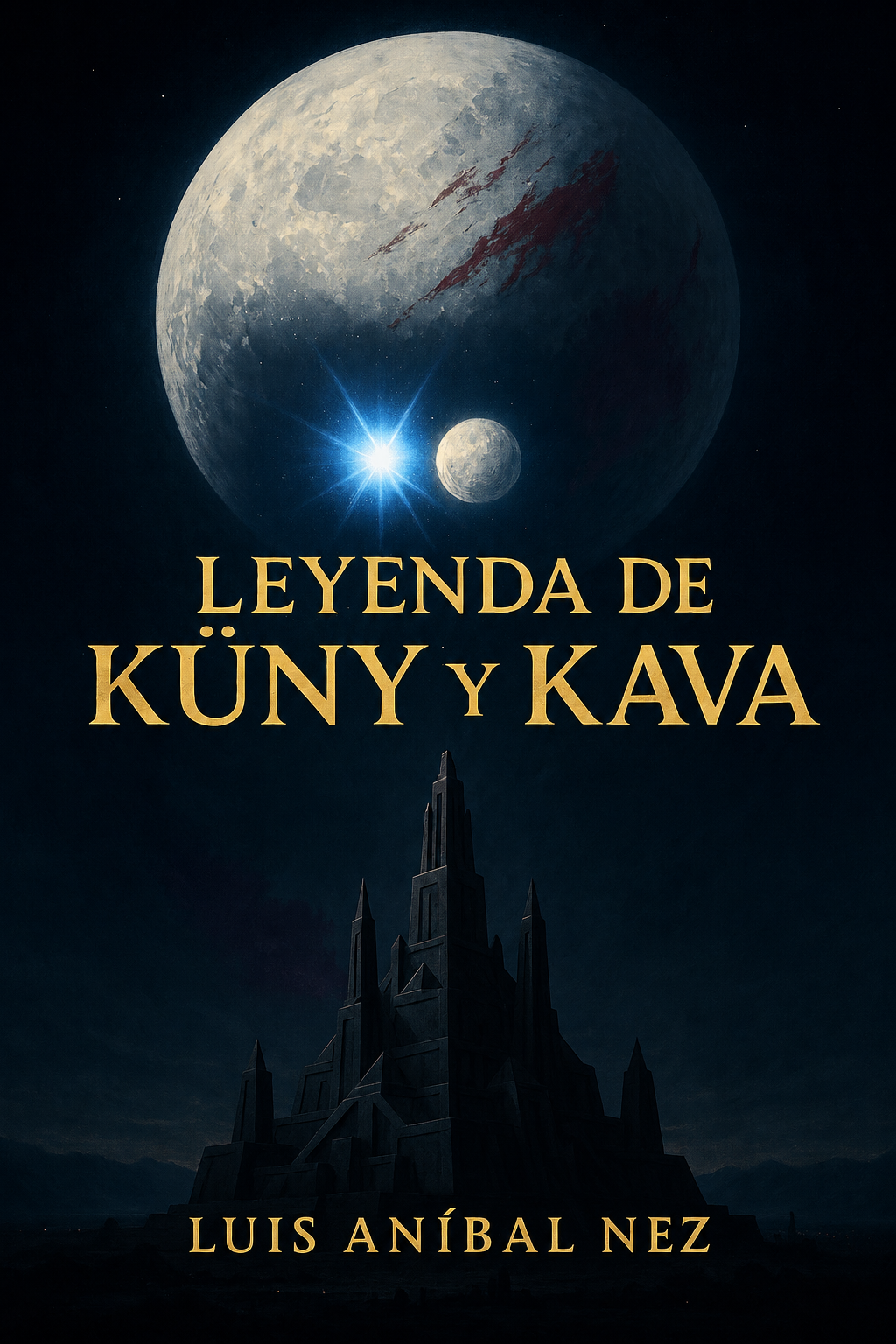
Küny is the binary star that dominates the daytime sky. Its name joins Kün—fire in the ancient Common Tongue—with Y—water or drop: a drop of fire formed by two stars shining as a single sidereal lamp.
Kün is yellow, intense, and the smaller of the pair. Y is immense, blue-white, and more luminous. Other peoples use names from their own languages; among the Morguendis, the pair is known as Solaris.
Its energy sustains life on Zyllyön, shapes climates and harvests, and makes the measurement of time possible. The interval between dawn and dusk is one cycle of Küny. Twenty-eight such cycles form one cycle of Kava.
III
Kava
Kava is the great white moon that rules the night. Vast red fractures cross its surface, visible from Zyllyön as glowing scars upon its glacial brightness.
Its synchronous rotation keeps one face turned toward Zyllyön. The combined radiance of Küny falls across it, yet the red fractures remain its unmistakable feature even beneath that light.
Kava orders calendars, tides, art, mythology, and belief. Its cycle is divided into four phases: Avak, Vaka, Vaak, and Kaav. During Avak, only a thin halo can be discerned; during Vaka, an arc appears to the observer's right; during Vaak, to the left; and during Kaav, its entire white, fractured disc shines in full splendor.
Before the dawn of memory, Küny and Kava already ruled the firmaments of Zyllyön. Kingdoms change and peoples disappear, but both lights continue to mark time from an intangible, unreachable distance.
 End of document