 Louis Hannibal Nez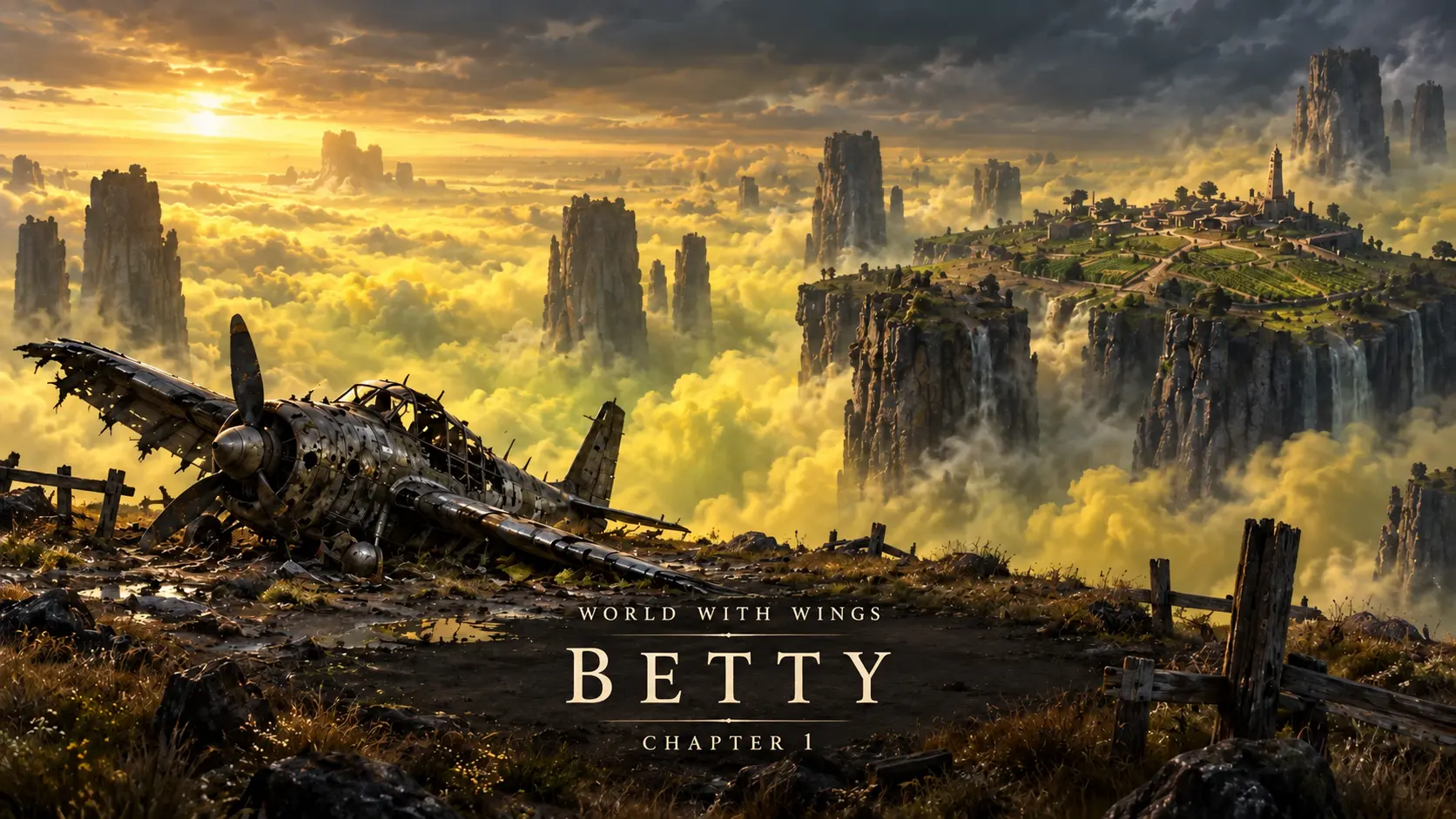
An aircraft bursts violently out of a sea of clouds.
For a few seconds it seems to be flung clear of them. The front propeller turns with a barely perceptible irregularity, but enough to make the whole structure vibrate. A panel of the fuselage shudders beside the left wing, and the electric engine maintains a high-pitched whine that rises and falls without settling into any consistent rhythm.
The clouds remain below; they are not white. Their enormous surface stretches to the horizon in shades of yellow, ochre, and green so faint that, seen from that altitude, they could be mistaken for the colors of dawn.
The aircraft’s pilot, Dominic Francis Marcind, knows they are not.
They are pollution: suspended water mixed with chemical particles that Betty’s sensors have been advising him not to enter for several minutes, as if he still had a choice.
Marcind pulls on the yoke.
“Come on...”
Betty responds late. The nose rises slowly and the aircraft gains a few meters while the pilot looks alternately at the horizon and the indicators in front of him: voltage, integrity, temperature, pressure, among others. Some readings are still within acceptable limits, but others are not.
A hard blow shakes the cockpit. Marcind recoils instinctively. Something metallic shoots away behind the right wing and disappears.
“Perfect.”
He looks back at the instrument panel. He does not know which part he has just lost, and perhaps it is better not to know. He has flown long enough to distinguish a damaged aircraft from one that is in the process of dying. Betty belongs to the second category.
A shadow passes across the clouds. Marcind turns his head and, for an instant, sees nothing but the yellow clouds. Then the shadow emerges: another aircraft, much larger and darker. Its fuselage is so low and elongated that it resembles an enormous knife blade moving horizontally over an ocean of gases. It has no visible propeller and leaves no trail. Nor does it produce the thunder that should accompany a machine of such size.
He knows the model—or at least he knows its reputation. The inscription along its side confirms what he already suspected.
ORAX I
“Shit.”
The aircraft continues forward. It does not climb toward Betty; it has no need to. It moves several hundred meters below, its dark belly grazing the highest formations in the cloud bank.
He tilts the yoke to the right. Betty turns with difficulty. Orax does too, though not immediately. A few seconds later—enough of them—Marcind changes course again. The dark aircraft corrects its heading once more. Marcind has no doubt now: it is following him. He reaches for the transmitter.
“Orax One, this is Dominic Francis Marcind, military identification...”
The radio answers with static. Marcind changes frequency.
“Orax One, confirm receipt.”
Nothing. A red light comes on in front of him. Marcind looks at it. Then he looks at the sky.
“No.”
The engine temperature rises: thirty-nine, forty-two, forty-six. He presses several controls. Betty’s whine becomes even sharper.
“Come on, come on...”
Fifty-one.
Then something crosses in front of the cockpit. He cannot identify it. A nearly white line vanishes into the sky. A second later he hears an explosion behind him. The aircraft shudders. Betty tilts to the left. Marcind fights the yoke.
“Betty!”
Another line. This time he sees it. It comes from Orax I. It is not a warning: they are firing at him.
He lowers the nose. Betty plunges toward the clouds. The yellow world swallows him again. Visibility vanishes immediately and the cockpit begins to vibrate. Small particles strike the windshield. Marcind checks the instruments. Orax has disappeared from view; the radar has not. The signal is still there, drawing closer.
He descends farther. The clouds grow darker and darker. Lower still: one hundred twenty meters, one hundred, eighty. He has no idea exactly what lies below. Navigation maps offer barely any information about this region. The recorded terrain is far, far below. Betty emits a different alarm. It takes Marcind a moment to recognize it: proximity. He frowns, looks at the altimeter, then at the surface radar.
A vertical shape appears in front of him.
“What...?”
He pulls the yoke with both hands. The column rises out of the clouds. It is gigantic. A wall of rock climbs in front of Betty until it disappears above the cockpit. He turns violently. The wing passes only a few meters from the surface. For an instant he sees stone, hardened earth, roots, and something dark embedded in the rock that he cannot identify. Then the column vanishes. Another alarm sounds—another shape.
He turns the other way. A second column emerges, then a third, and another. They are not floating. They rise from some depth hidden by the clouds. They are monstrous needles driven into an invisible ground.
Marcind stops breathing for several seconds and stares at them. Some have irregular summits; others appear surprisingly flat. On one of them he thinks he sees vegetation, but that cannot be. He passes beside it and confirms it. Trees, very small or very distant.
Something strikes Betty again. The aircraft drops several meters. Marcind tries to regain altitude, but the engine releases a harsh sound. The electric whine disappears. The propeller keeps turning on inertia. Marcind looks at the panel.
“No.”
He tries to restart it. Nothing. He tries again. Nothing. Betty begins to lose altitude. The columns now pass slowly on both sides as the aircraft descends toward the gaseous yellow sea.
Marcind searches for a surface—any surface. The nearest summits are too small or covered with rock formations. Much farther ahead, another one appears. It is broad and nearly flat, with green patches and lines. The pilot narrows his eyes. They are not lines but structures.
“Well...”
There are houses there, small structures crowded together on the summit of that impossible column. And apparently there are people too.
Betty continues to lose altitude. Marcind calculates the distance. He does not think he will make it. He reduces the weight by releasing a lower compartment. The mechanism takes time to respond. At last he hears the impact. The aircraft rises just enough.
The surface of the strange plateau approaches. Now he can distinguish paths, crops, and even a tall structure resembling a tower. The people below begin to run. Marcind extends the landing gear. One of the lights remains red.
“Of course.”
The left wheel has not come down. There is no time. The earth already fills the windshield. Marcind shuts down the systems, crosses one arm in front of his face, and Betty strikes the ground with a thunderous impact. The right landing gear holds for only a few meters. The aircraft turns. The left wing touches the ground. Metal crashes against the rocks and the propeller disintegrates. Betty tears through a fence and keeps skidding until another impact violently shakes the cockpit.
He loses his sense of direction. He blinks. He thinks he sees the sky, then the dirt, then the sky again, and finally a wall. The aircraft stops. For several seconds there is no sound at all. Marcind tries to breathe. His chest hurts and blood fills his vision. He does not know whether it is coming from his forehead or somewhere worse. He tries to find the harness release, but his fingers will not obey.
He hears voices outside. They multiply. He cannot understand a word. A little later he hears blows against the fuselage. He tries to reach the weapon beside his seat, but cannot. The world begins to darken before his eyes. Before losing consciousness, he manages to look through the shattered windshield. He sees people surrounding Betty, wearing simple clothing. Some hold objects that look like tools or primitive weapons.
And behind them, beyond a few structures, he sees the edge of that surface. Beyond the edge there is no descending mountain, no valley, no continuation of any kind. He sees only the sky above, the boundary where the land ends, and, beyond the precipice, the endless ocean of yellowish clouds.
Marcind manages to take this in through the dizziness caused by the blow to his head. Then everything in his eyes goes dark.