 Louis Hannibal Nez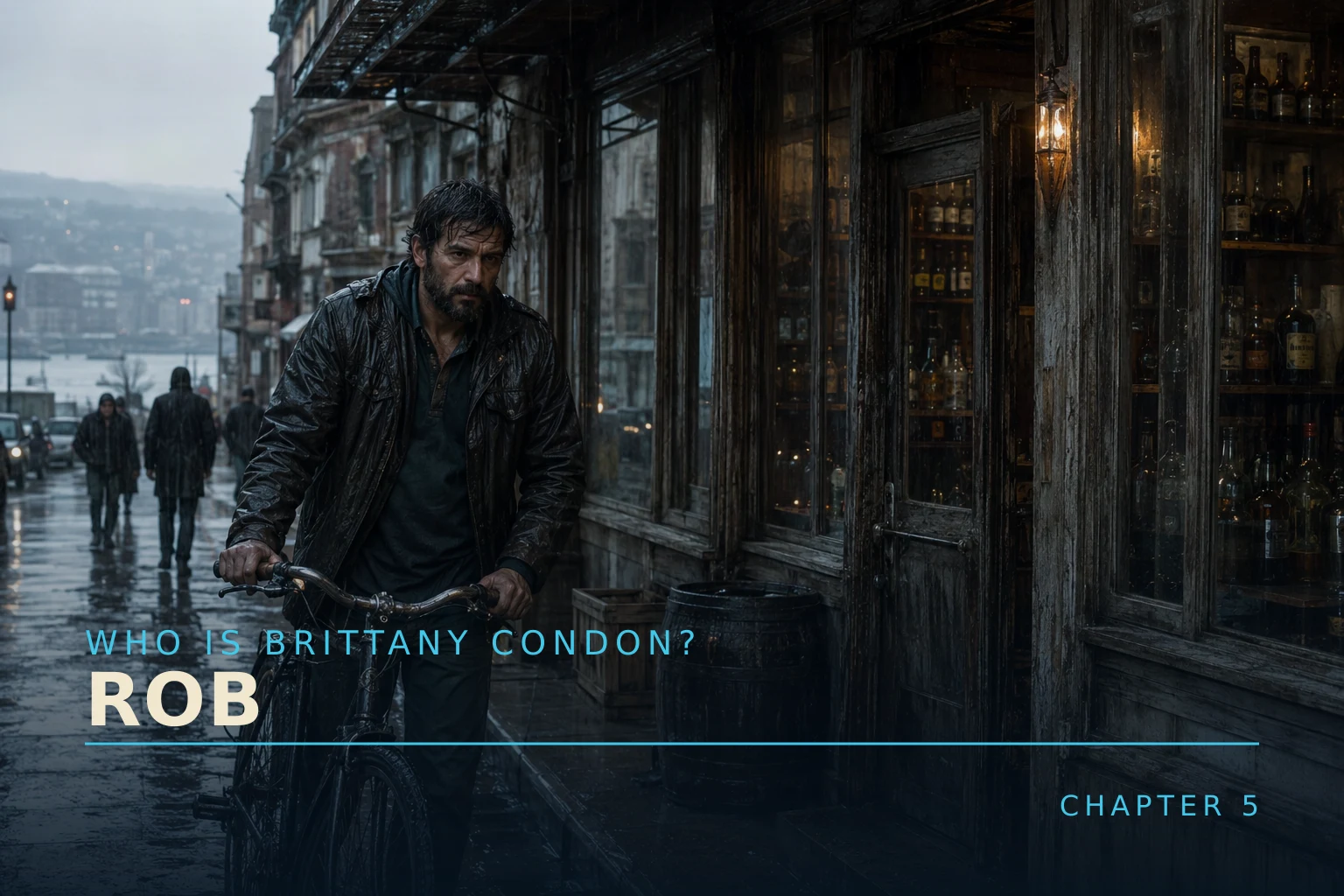
The khaki-colored façade of the Happy Drunk Liquor Store in West End is illuminated by the day’s first light. Rob rides toward it on his old, slightly rusted bicycle. Rob cares little for the architectural designs of buildings. In fact, he has no idea that the property he is heading toward belonged to the earliest vestiges of settlement in Stormport. This kind of architecture is a bastion for residents of the city and district, a source of pride, the last remains of a society that no longer exists. But Rob does not give one damn about any of that. Architectural feats mean next to nothing to him.
What Rob would like is to own a business so he can be free of what he calls Slavery. He believes himself capable of opening a shop in the same trade in which he works, taking advantage of the experience accumulated over years. But whenever he begins to dream of it, his mind lands again in a cruel reality that strikes him with tremendous force. His few accounts are in the red; he even owes money to that idiot Dan, his best friend and brother in life. The feeling that he cannot and never will achieve his dreams frustrates him. Dan’s sister, whom Rob calls the Meerkat whether she is present or not, always advises him to work hard and forget utopias—to stop the stupidity, basically. It is precisely because of things like that that he loves her and hates her at the same time.
The Meerkat, whom Rob considers similar in appearance to that animal, may be the only woman who has ever truly fallen in love with him in real life. Even so, she no longer wants to live with him in the boardinghouse room they share. Rob loves her, sometimes. He finds it difficult to fall in love with any woman who is not Brittany Condon—or at least resembles her or measures up to her. In the boardinghouse district where he lives, known as the Condominiums, east of Stormport on the far side of the Eastern Wall, there are no women with such an extravagant profile. Yet no one in the Condominiums judges Rob for the things he has done or still does. That makes him comfortable there.
In any other district, his appearance alone would be enough for a city camera to trigger an alert. So despite the misery, he feels at home in the Condominiums and can no longer imagine living anywhere else. Before some of the area’s busiest streets were paved several years ago, Rob and the rest of the people living in the Condominiums endured the worst hurricane and subsequent flood the area had ever suffered. Ocean water seemed suddenly to have come alive, surging inland from the coast, destroying high artificial levees and laying waste to that entire coastal strip. At the time, the Meerkat and Rob were building their own home in the area beyond an old steelworks linked to Harrington City’s historic industrial expansion—the expansion to which the Condominiums now owe their existence.
Overnight, the coastal strip flooded beneath icy waters, black, filthy, and violently savage. A tsunami destroyed the levees, pressed onward, and swept away every house in its path. The hurricane, catastrophic in scale, left nothing standing. Neighbors who had known one another for years were left without homes, land, or possessions; some were also left without family or friends. Together with hundreds, thousands of people, Rob and the residents of the Condominiums begged Stormport City Hall to let them cross the Eastern Wall. With no response from the city, the victims sought refuge in various places. The mayor refused to open the wall.
No one living in the various districts wanted the poverty and marginalization of the Condominiums spreading into their neighborhoods, streets, and avenues. East of the Eastern Wall, the victims were assembled in an isolated patch of dry ground and given a piece of bread, a cup of soup, and some warm root vegetable. If the beginnings of hypothermia were detected in an elderly person, an adult, or a child, that person received a thermal blanket. The various diagnoses were not assessed by doctors. Senior government officials made the decisions governing the emergency response. No one was granted access to facilities equipped with hospitals of their own, barracks, bunk beds, food, and enough hot water for thousands.
Divisions and subdivisions of the world’s largest megacorporation—the United Humans Revolution, known by the initials UHR—contacted victims through its UHR Humanity division. The planetary, trillion-dollar multinational, owner of spacecraft and satellites and at least a hundred divisions including entertainment, was the only entity to show any sign of life or provide assistance. At the time, its UHR Planetary division had earned the distinction of sending astronauts to Ganymede. Like others, Rob received a tangible offer to join the continuing colonization and terraforming of the Moon and Mars. Many in his position accepted UHR Planetary’s offer, but he did not. Later, UHR reduced its aid as it recruited hundreds of civilians.
No one else brought even the slightest aid against hunger, thirst, cold, and the desolation of having lost everything—sometimes even life itself. Rob still remembers those painful days all too well. He has forgotten not one syllable of the political speeches in which officials answered people’s demands with assurances that there would be work. They described the many tasks supposedly being carried out tirelessly to help the victims. Once the cameras were off and the speech was over, those same politicians completely forgot what they had said seconds earlier. Television programs and other media reduced the hurricane’s damage to charts.
Rob tries not to remember it often, but for some strange reason that morning, as he pedals to work, he recalls the winter when the Meerkat, he, and hundreds of families were left on the street. Just before the hurricane arrived, the Meerkat had expressed her desire to have a child with him, a boy or two. Rob had not wanted to. In time, the Meerkat lost interest. Some victims were resettled in the Condominiums in exchange for a low rent that not everyone could afford. Only single mothers were allowed to move there free of charge. The Meerkat accepted, since her work in the underground shops enabled her to pay the rent. She took Rob with her, and he was not at all happy about it.
During that period, Rob had no way to find work anywhere. He suffered poverty at its cruelest. Political rhetoric no longer even took them into account. Rob and his good friend Dan, who was also his brother-in-law, had to bring money home by any means. And so they labored to find a way through Downtown’s high-security perimeter. They entered Stormport’s financial district at night, at the height of closing hour for the stock exchange, finance houses, and banks. They stole valuables from every passerby they could. Rob seriously injured a woman, though accidentally, in the struggle to snatch an electronic device from her. Drones alerted the officers stationed in the streets.
Dan and Rob were chased down and caught with ease. That same night they were tried, sentenced, and imprisoned in the new, impregnable prison at Prisontown, on the far side of the Eastern Wall. Five years passed before Rob regained his freedom. He returned to the Condominiums and the Meerkat, who did not welcome him kindly. She rejected the idea of becoming his partner again, though she would not leave him on the streets. Her condition for allowing him to stay was that Rob find honest work and never steal again. That was what he did. He searched for months until he finally found a job at an old liquor store in West End. The shop’s owner cared little that Rob was a displaced outsider from beyond the Eastern Wall. In fact, hiring victims from the outer zones entitled him to certain tax benefits, so keeping Rob behind the counter ultimately cost less than employing a Stormport resident. The pay was ridiculous, but it was something. Ever since, Rob gets up at six or seven in the morning, rinses himself with cold water, and pedals toward West End.
This morning, like so many others, he rides his old, rusty bicycle to work. He follows a road along the bank of Buffalo Bayou before turning at a bend that takes him west. He likes the morning landscape in the area, even in the depths of winter with dew on his face and an icy wind blowing head-on. The price of the train or bus is beyond his means. Paying for that trip there and back every day would cost far too much for his moth-eaten pocket. He likes reaching the liquor store early in the morning, enjoying fresh news from the virtual paper, waiting for the first customers eager to carry away something with which to get drunk. When he is already near the store, he hears the rotors of an aircraft in the distance.
Paying it little attention, Rob finally reaches the Happy Drunk Liquor Store. The joyless, resigned man is irritated even by the routine monotony. He dismounts, chains the bicycle to a nearby post, and approaches the metal shutter at the shop entrance just as two pedestrians pass behind him.
"Have you seen that new ad?" one pedestrian asks the other.
"How could I miss her?" the one walking beside him replies.
"She’s a goddess. Bet she isn’t wearing underwear underneath."
"Does she ever wear underwear?"
Rob turns around with a hostile expression and watches them pass, then follows their gazes. They are looking at a new holographic advertisement gleaming between the third and fifth floors of the building opposite the liquor store.
The ring of keys falls from a gaping Rob’s hand when he sees the advertisement. He grips his head in both hands at the sight of a crisp hologram of Brittany Condon. The young woman wears a suggestive top and a tiny flared skirt, which she shamelessly tosses upward as she swivels her hips.
"It’s true, she isn’t wearing underwear. Does she never wear any?" Rob says, then licks his lips.
An elderly woman leaning on a cane approaches.
"Young man, what time does the liquor store open?"
"Whenever I feel like it."
"Don’t be impertinent. I have to buy a present for my grandson."
Rob lowers his gaze, closes his mouth, wipes the corner of his lips, and looks at the old woman who spoke to him.
"Is your grandson a drunk or something?"
"Well! How dare you? How can you say such a—"
"Don’t bother me, you senile old woman. Buy him something else."
The woman mutters something under her breath and moves away, frightened.
Rob picks the ring of keys up from the ground, inserts one into the lock, turns it, and slides the shutter upward. He enters the shop.
Once inside, everything looks just as he left it the day before. He sees two sets of shelves dividing the shop’s cramped interior into four sections. Displayed on them are fine wines from several vintages, liqueurs of various flavors, whiskey, vodka, rum, and many other drinks. One shelf is filled with expensive chocolates, several containing liquor or fruit fillings.
A table rests against a display window. On it sits a hologram made to resemble an antique cash register. Between the table and the wall stands a worn, round, backless stool. Rob settles onto it after tossing the ring of keys on the table. He sighs as though uttering a curse. His faded blue jeans have been worn for more than ten years; his sneakers are older still. His white shirt with red checks smells bad; he has grown accustomed to rarely washing his clothes. The Condominiums have neither running water nor electricity. Over the shirt he wears a red track jacket that somewhat muffles the stench rising from his armpits; he takes it off as soon as he arrives. Pedaling has made him hot.
A baseball cap with its visor facing forward covers the sparse hair that reveals the onset of baldness. A few locks along the sides and back of his head are long, falling past his shoulders. His aquiline nose is somewhat overshadowed by his hard-boiled-egg eyes, so large that no eyelids seem capable of covering them. With those eyes he looks out through the liquor store’s display windows. Outside, West End is slowly rising from the previous night’s hangover. Rob reflects. He knows perfectly well that Brittany Condon gave a concert in Baybeach last night. He will comb through the day’s news until he learns how the event went—and, above all, how she did.