 Louis Hannibal Nez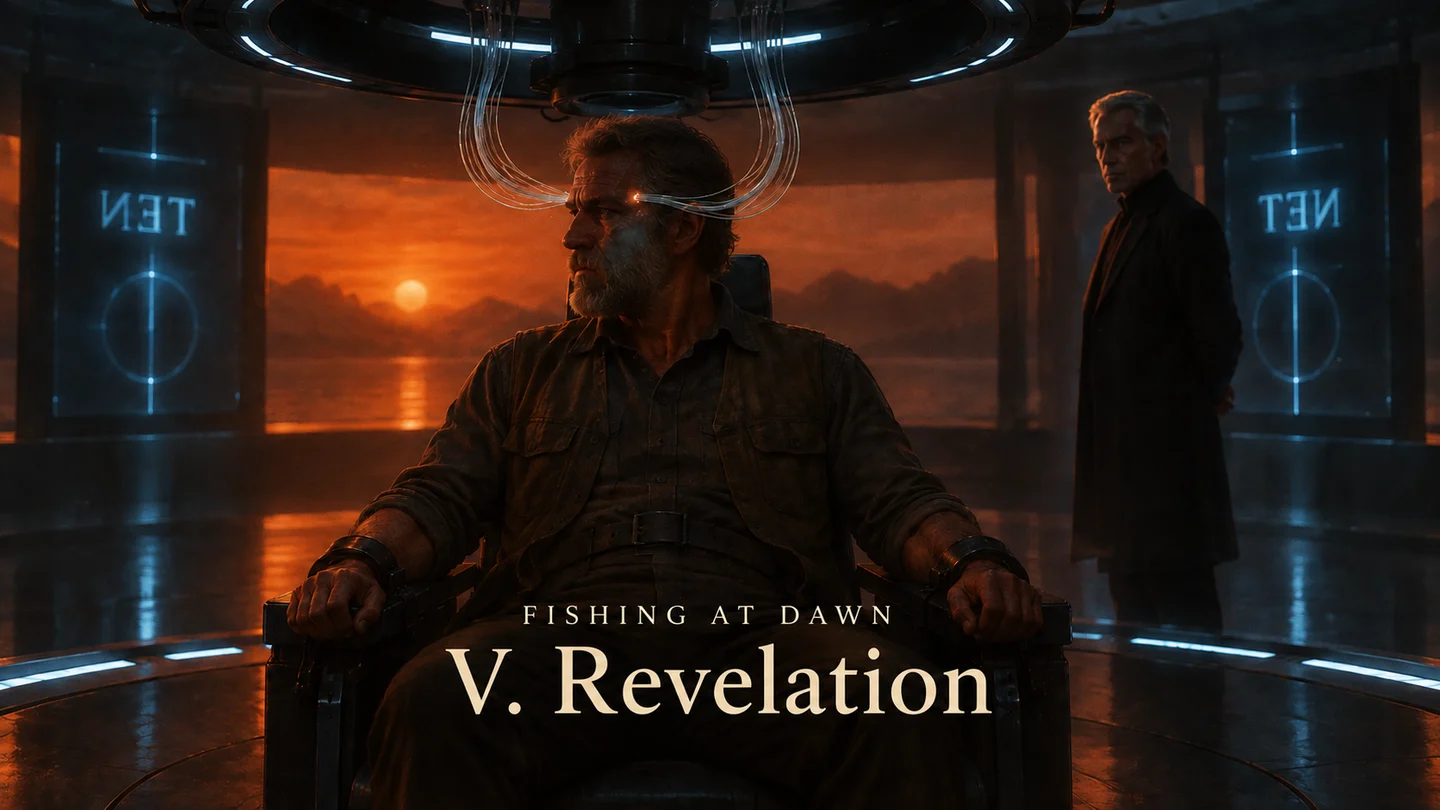
The blow came back from the other side of the mirror and passed through his fist.
It was not pain. It was weight.
The surface gave beneath his knuckles, and a liquid darkness enveloped his arm up to the shoulder. Recen pulled back, but something held him from inside the reflection. The other men did the same a moment ahead of him: they struggled, bent their knees, and opened their mouths before the scream left his own.
The room tilted.
The mirrors stopped showing him. A closed eye appeared in each one.
“Open your eyes,” Calahan repeated.
Recen obeyed.
White light pierced his pupils. He tried to raise a hand and discovered that his wrists were restrained. So were his ankles, chest, and forehead. He breathed through his mouth. The air smelled of metal, disinfectant, and skin kept enclosed.
Above him was a black ring with transparent filaments descending from it. Some were attached to his temples; others disappeared beneath the tight fabric covering his body. Small blue lights traveled along them toward a machine behind his head.
Recen pulled against the straps.
The platform beneath his back vibrated, compensating for the movement.
“Celeste.”
His voice was barely a breath.
No one answered.
The room was circular. There were no mirrors, only dark panels arranged around the platform. Cat’s silhouette remained on one. Numbers and lines Recen did not understand floated on another. On the nearest, three white letters appeared for a second:
NET.
The panel reversed the image as it reflected it onto the adjoining surface.
TEN.
Recen stopped breathing.
The young man with the bicycle appeared behind the letters. He still had his blue jacket, clean boots, and calm face, but he cast no shadow on the glass.
“Good morning, Mr. Skantranovic.”
Recen lunged against the straps. The one across his forehead bit into his skin.
“Where’s the girl?”
“Rosa has been removed.”
“Bring her here.”
“She does not exist outside the environment.”
Recen pulled again. Something beside his right wrist gave with a snap. He could not tell whether it was the restraint or one of his bones.
“Bring her here!”
The blue lights in the filaments accelerated. The pain returned to his skin, first as heat, then as thousands of needles piercing it at once.
“Enough,” Calahan said.
Cat’s figure vanished from the panel.
A door opened in the wall. The man who entered had the same face, though reality had added weariness around his eyes and a thin scar beneath his jaw. Instead of the gray coat, he wore a jacket without lapels over a dark shirt. A blue circle glowed on his wrist, changing shape with every step.
Recen followed him with his eyes.
“I killed you.”
“It was a representation.”
“I felt your throat.”
“That was exactly what the system needed you to feel.”
Calahan stopped beyond the reach of his legs. There was no fear in his posture, but neither was there Cat’s complacent serenity. He held his body tilted slightly back, one hand near the circle on his wrist.
“I’m Dr. Calahan, the clinical director of your treatment.”
“You’re Cat.”
“That’s how we interact with you in that environment.”
“You were him.”
“In part.”
Recen looked at the panel where Ten stood motionless.
“And him?”
“Net runs the system.”
“His name is Ten.”
“That’s what you call him.”
“He told me his name.”
“He chose a name you could retain without recognizing it.”
The letters appeared behind the young man again. Recen read them from left to right, then in the reflection. He felt something shift inside his skull, an old piece searching for its place.
“Seventeen years,” he said.
Calahan did not answer.
“I lived there for seventeen years.”
“For you, yes.”
“The cabin was mine.”
“Those are memories, preferences, and responses gathered during the early stages of treatment.”
“I cut every board.”
Recen closed his eyes. He saw his hands covered in sawdust, a beam resting across two sawhorses, the first fire lit in the stove. The memories had weight, temperature, fatigue. None contained a day before the lake.
“How long?”
“The answer won’t help you.”
“How long?”
Calahan looked at one of the panels.
“Much less than seventeen years.”
Recen opened his eyes.
“You stole them from me.”
“We tried to give you something you had never managed to hold on to.”
“What?”
“A life without victims.”
The room fell silent.
The ring above the platform gave a low pulse. Recen felt the vibration inside his teeth.
“Lila,” Calahan said. “Violeta. Rosa. None of them was a person. They were constructed to assess your response to closeness, contradiction, desire, and loss.”
“They screamed.”
“Because they had to respond to what you did.”
“They bled.”
“Because you expected blood.”
Recen remembered the blade opening Cat’s throat. The blue line before the red. Violeta’s body sinking into the mud. Lila beside the door.
“I killed them.”
Calahan took a moment to answer.
“You chose to kill them.”
Something struck inside Recen’s chest. It was not guilt. It was a door trying to close.
“Rosa remembered me.”
“Rosa began to remember data that did not belong to her. Her contact with you altered the construct.”
“She was Celeste.”
“No.”
The strap around his right wrist broke the rest of the way.
Recen freed his hand and reached Calahan before the man could touch the blue circle. His fingers closed around his throat. This time, he found skin, cartilage, and an irregular pulse.
Two panels opened at once. Four guards entered in dark armor without insignia. They carried no chrome batons, but short rods that crackled as they extended.
“Let him go,” one ordered.
Recen tightened his grip.
Calahan did not try to pull his hand away. He looked at him from very close, his face flushed and his eyes watering from the pressure.
“This,” he managed to say, “is a choice too.”
The first electric shock tore through his back.
His muscles contracted beyond his control. He released Calahan, but did not fall: the remaining straps held him to the platform. The second shock clamped his jaw shut. The third blacked out the room.
He woke walking.
A coarse hood covered his head. His hands were secured behind his back, and a shackle encircled each ankle. Two people held him by the arms. Other footsteps moved ahead and behind.
He could not see, but the place was not silent. He heard doors opening before they reached them, motors hidden behind walls, and distant voices breaking off as the group passed. Beneath his feet, the floor began to move on its own. For several minutes, they walked without moving forward and moved forward without walking.
Recen counted the changes of direction.
Seven left turns. Four right turns. A descent. Two straight stretches that went on too long.
When they removed the hood, he was standing in front of a cell.
The bars were not chrome, but black and dull. They continued upward until they vanished into a height filled with identical walkways. There were cells opposite, below, and above. Some held motionless figures. Others seemed empty. None had a visible number.
The door opened silently.
They pushed him inside.
Recen fell to his knees. The door closed behind him.
The air hit his face with a mixture of stagnant damp, stale sweat, urine, and something sickly sweet he preferred not to identify. An irregular dripping came from somewhere overhead. Beyond the bars, shrieks and isolated sobs traveled through the corridors; at times, a scream erupted and multiplied into echoes until it merged with others. The whole place seemed to breathe through throats that could not fall silent.
The cell had two bunks molded into the wall, a sink with no visible pipes, and an opaque rectangle where the window should have been. A man slept in the lower bunk with his back to him.
Recen rose. The ankle shackles had opened, but his wrists were still bound. He struck the stranger’s shoulder with his foot.
The man woke with a start. He was broad, bald at the crown, and one ear was misshapen by a scar. First he looked at Recen’s boots. Then at his face.
“It can’t be.”
Recen took a step back.
“Do you know me?”
The man sat up. An uncertain smile spread across his face.
“Recen.”
He said the name as though he had just found someone among the dead.
“I’m Mercen.”
Recen searched for a memory and found nothing.
“I don’t know who you are.”
The smile vanished.
“Then they put you back in there.”
“Where?”
Mercen glanced toward the bars before answering.
“In your lake.”
Recen lunged at him. He pressed his bound hands against the man’s chest and slammed him into the wall.
“How do you know about the lake?”
“Because you told me the first time they brought you out.”
“I never came out.”
“You’ve come out many times.”
For an instant, the words drained his strength.
Mercen used the moment to push him away. He did not try to strike back. He stayed beside the bunk, rubbing his chest.
“Every time you come back, you don’t remember,” he said. “Every time, you swear it was the first.”
“You’re lying.”
“I wish I were.”
A gray light appeared in the opaque rectangle. It showed no view outside, only a succession of data. Recen’s name headed a column. Beneath it were dates, red bars, and a repeated word he could not read before the screen went dark again.
“Why am I here?” he asked.
Mercen gave a short, humorless laugh.
“Same reason as everyone.”
“I didn’t ask about everyone.”
The other man studied him. He seemed to be deciding how much he could say without getting too close.
“After the fire, you started killing.”
Recen smelled the smoke before he remembered the fire.
“Celeste.”
Mercen lowered his eyes.
“Yes.”
“Where is she?”
“Recen…”
“Where’s my daughter?”
The question made Mercen glance toward the bars again.
“She died in the fire.”
This time, the memory did not close.
A soot-covered window. Two small hands beating against the glass. Recen running toward the entrance. The ceiling of a corridor collapsing between them. Someone holding him around the waist as he clawed at the ground. A child’s voice calling to him from a place the fire had reached first.
Then sirens.
A blanket over something too small.
Recen sank onto the edge of the bunk.
He did not cry. Tears belonged to the man who had lived beside the lake, and that man was coming apart with the cabin.
“Who started the fire?”
“You never told me.”
“You were there.”
“No.”
“You knew me.”
“I met you afterward.”
Recen raised his head.
“After what?”
Mercen took too long.
“After you started.”
The silence between them changed shape.
Other memories came, but not in order: a wet alley; a man on his knees; the handle of a knife moving in and out of a coat; a woman closing a door; his own knuckles covered in blood that had come from no fish. Unfamiliar faces. Different rooms. Always the same calm afterward.
Recen looked at his hands.
“It wasn’t them.”
“Who?”
“The ones who died in the fire.”
Mercen did not answer.
“It wasn’t them,” Recen repeated. “But they were still alive.”
The other man took a step back.
“Recen, sit down.”
“They could go home.”
“Don’t do this.”
“They could hold their children.”
Mercen raised both hands.
“Listen to me. That happened a long time ago.”
“For me, it happened this morning.”
Recen stood.
Mercen tried to reach the bars. Recen hooked the chain between his wrists around the man’s neck and pulled back. Both fell between the bunks. Mercen struck with his elbows, fought for air, and clawed at the black fabric covering Recen’s arms.
An alarm began to pulse in the corridor.
“Let me go,” Mercen managed to say.
Recen planted a knee between his shoulder blades.
“You remembered.”
“It wasn’t me.”
“And you were still here.”
He pulled the chain.
The cell door opened.
By the time the guards entered, Mercen had stopped moving.