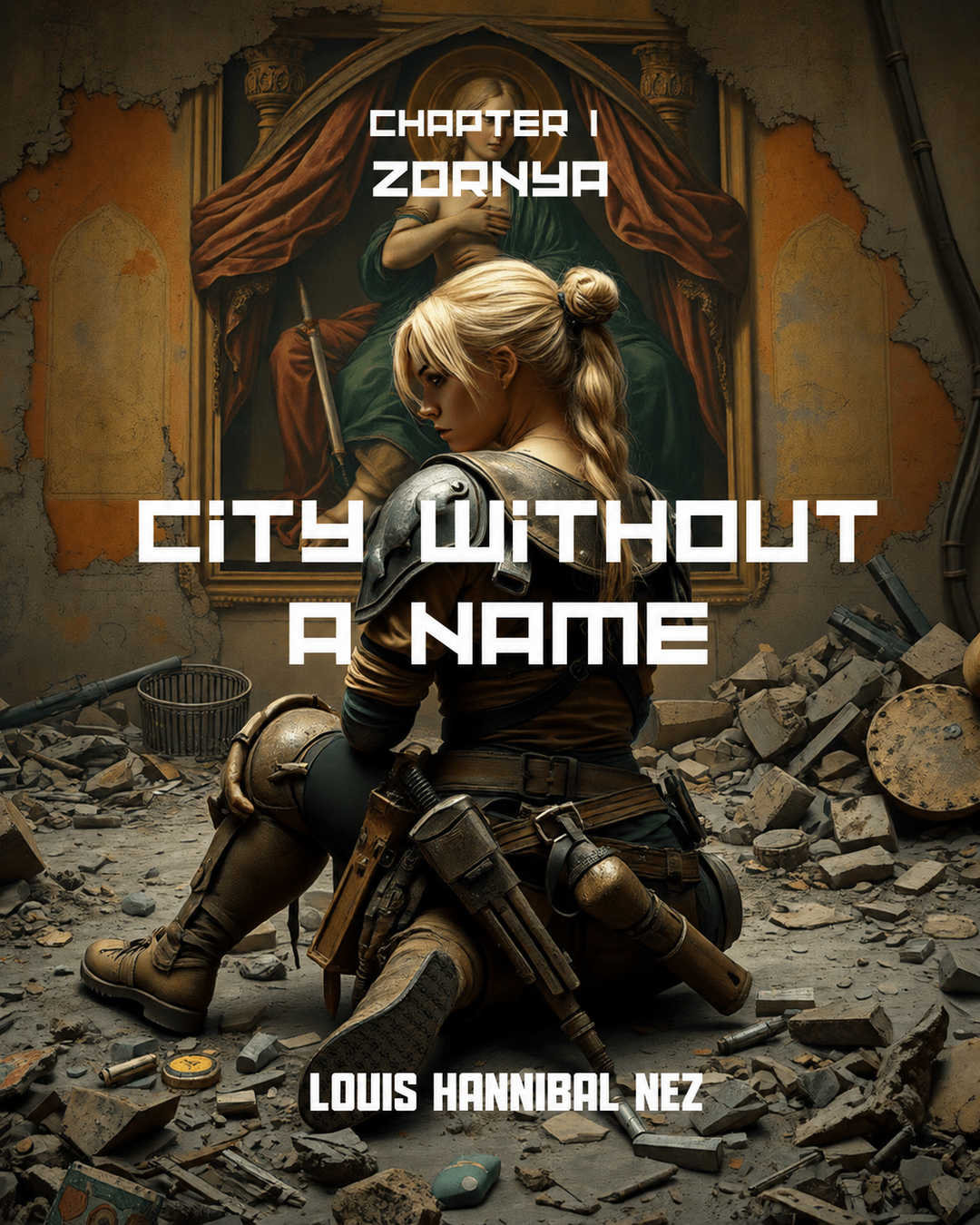
Zornya deserves a rest.
Her provisions are running out after days of relentless progress, so she finally prepares to consume some of them. She always chooses the same: one of the four cans of beans she has left, two sips of water, and a cigarette. With luck, tomorrow she may find something to replenish her supplies before thirst or hunger overtakes her.
She has been moving continuously for ten days, barely resting and sleeping little. She needs to sit on the ground, drink, eat, and savor a cigarette. It is the only pleasure she has left. She has not enjoyed a good smoke in many days.
She scrapes the inside of the bean can with her fingers and eats every last trace. Two sips of water wash the food down, and she settles against the ground to experience the threefold pleasure of smoking again.
When night grows dark, she lights a fire with books, magazines, political leaflets, and a pair of damp banknotes she finds on the ground. Once the flames catch, she sits on the asphalt again. Behind her stands a fragment of wall left upright by some long-ago explosion.
A painted scene still clings to that section of wall, having survived the blasts better than thousands of citizens did. The remnant bears an ancient image—perhaps biblical, though she does not know—of a soft, plump young man beside another figure.
She pays no attention to it. Had she noticed, she would not have cared. That fragment, one of the many still standing, is the last tangible vestige of a ruined city and of the now-forgotten society that once inhabited it.
Around her lie rubble, devastation, half-collapsed buildings, and streets destroyed or blocked by wreckage. The roads are almost invisible beneath everything that has fallen upon them. The entire city has become a colossal ruin without precedent in this century.
This is all that remains of what was once a technological mecca, a super-metropolis that housed more than fifty million people. Nothing survives of its luminous splendor but debris—the remnants of a place once unique and never to be repeated.
At the heart of this chaotic landscape stands a woman born ordinary and innocent, transformed over time into a warrior. She spent years preparing for this journey, which began ten days ago.
She entered the city from the west and intends to advance eastward. Her lifelong childhood friends entered from other points of the compass with the same purpose.
Days ago, a woman died in her arms—an unknown woman who bled uncontrollably from the inside out. The image has not left her mind, yet she feels nothing.
The woman perished, crumbling in her arms like sand in the wind. Almost immediately, Zornya feared she had been directly infected by one of the many viruses artificially designed and released into the city. They still thrive here and there in an age of virulent splendor, waiting for another victim to inhabit.
Since then, she has continued alone through the ruins—utterly alone in a death-filled place that seems impossible to cross. Time stretches into eternity there. She tries not to think too much about it. Nights like this accompany her every day, though they are rarely silent. That worries her.
She is exhausted. It has been a punishing day, and she has eaten nothing. She is hungry and even thirstier. Only after sinking wearily to the ground does she notice the weapons still hanging from her back, their weight betraying them.
She is too tired even to remove them: a heavy rifle, a machine gun, two pistols, a machete, and two knives. She leans against the wall bearing the possibly biblical image, the weapons trapped between her back and the stone.
Sleep becomes unbearable behind her eyes. She knows that surrendering to its sweetness would make her sleep too long—and might amount to suicide. She resists the urge, forcing her mind through question after question without pause.
Lost in thought, she looks toward the stars and the waning Moon. There are no clouds. The air grows cooler as the night advances. For miles around, the ruined landscape is outlined by the weak glow of her fire, which sometimes conjures ghostly shapes from the debris.
Her hair, once golden as an autumn sun at dusk, is now dark, dirty, and hopelessly disheveled. She remembers how it used to fall across her face in childhood and youth, and how much that annoyed her. For a long time—especially since entering the city—her hair and every other aspect of her appearance have been the least of her concerns.
Her mostly dark clothing feels excessive in the heat, chafing against her body. She would like to remove it all, but that would be unwise. The garments are at once the most comfortable and most irritating she has ever worn. In any event, there are no men here to judge her clothes or appearance—and if there are, they are probably enemies.
Her greatest concern is that she is close—far closer than yesterday or the day before—and tomorrow she may draw closer still. She will not survive a month in this place of death. She must reach the district known as Three Bridges as quickly as possible. She dreams of it: her purpose, the utopia she once imagined with Etsuko, Krenera, and Salena, her dearest lifelong friends.
Each new thought draws her slowly toward sleep. Her eyelids grow heavy and her body slips lower. The fire becomes an instrument of hypnosis, a light that soothes her too well. Then, far in the distance, the barking of dogs tears the weight of sleep away—packs so remote they sound like thunder. She does not like dogs.
The barking continues for a long while before fading as the night deepens, and she feels relieved. She fixes her attention on the flames without truly seeing them. The fire dwindles little by little; fewer tongues of flame remain, leaving more ash and smoke. The night’s coolness makes her uneasy.
Sleep attacks again, and she fights it. She cannot decide whether waking or sleeping is worse. Horrible nightmares return whenever she closes her eyes—nightmares she cannot kill because, inside them, she has no weapons. She adjusts her pack of provisions beside her.
She takes a cigarette from the pack and lights it in the flames before her. She draws in the smoke, closes her eyes, and savors it. Her face softened by pleasure, she lets herself fall back against the fragment of wall.
The Sun disappeared into a somber twilight some time ago, yet the eastern sky—where Three Bridges lies—still appears pale blue. Beyond the bridges, a radiant column rises from the ground into the blurred night sky.
She gives the light an irritated glance, sighs, takes another drag, and returns her eyes to the few flames remaining in the fire. The night is deep and cool, and that is not good. A scorching day followed by a cool night suggests that a powerful storm is approaching, like the sea withdrawing before a tsunami.
The silence, meanwhile, makes her suspect an unspoken truce between the warring factions. One side consists of mechanized elite soldiers who hunt people for sport, wielding technology so advanced it resembles magic.
The other side consists of people like her, who barely remain standing from one day to the next. These supposed battles are less clashes between opposing forces than unscrupulous massacres. Whenever this has happened before—or happens now—nothing good follows once the savage fighting resumes.
Whatever may come, Zornya’s objective is clear: reach Three Bridges. For now, this is merely another night in the bloody, uncontrolled war fought day after day in the City Without a Name.
 END OF AVAILABLE CHAPTER