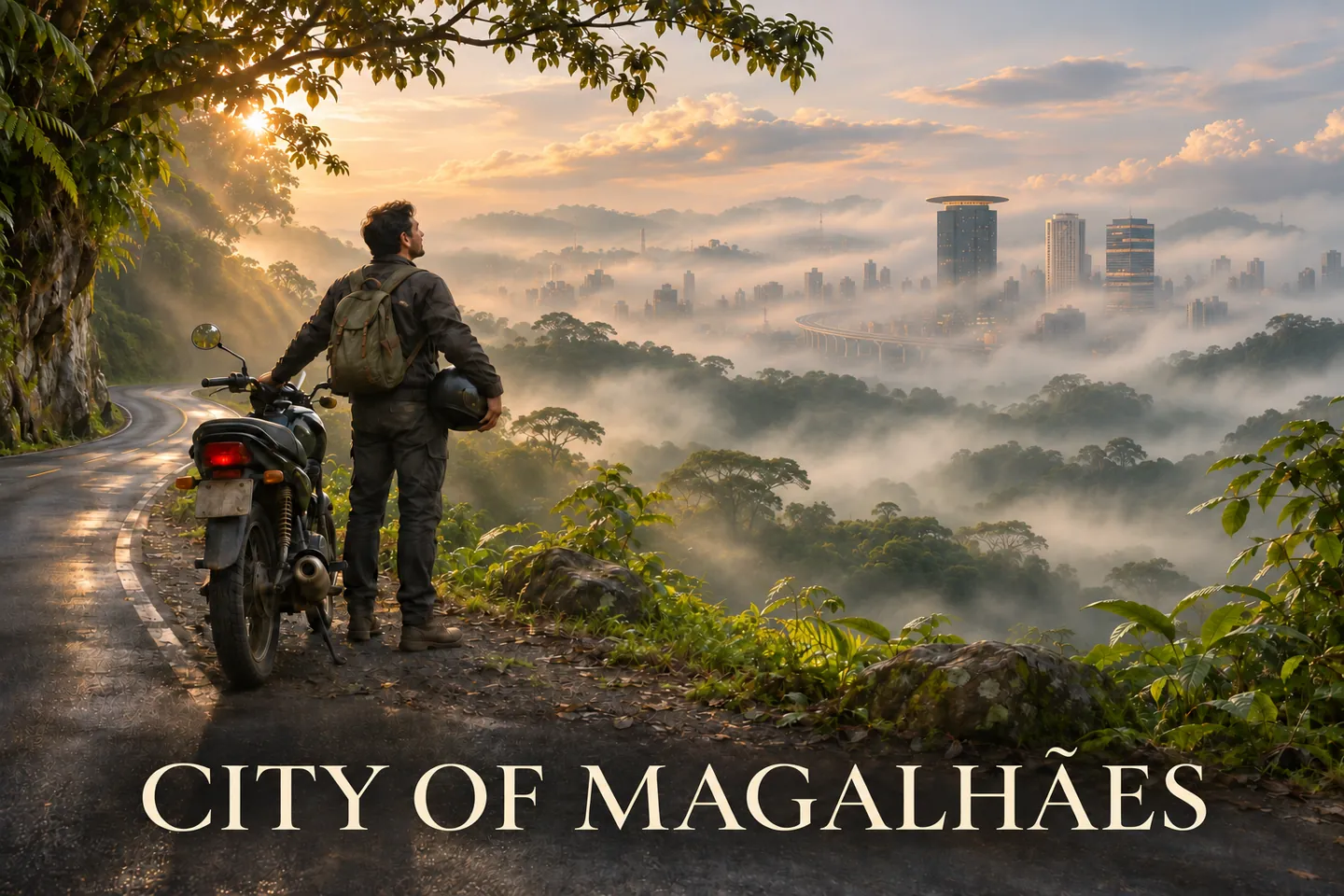
In the first light of morning, the long road seems to lead nowhere.
André has been riding through the jungle along that narrow road for more than two hours without finding a single village. On either side, the trees crowd against the strip of asphalt as it climbs and dips between hills covered in vegetation. The sun barely penetrates the branches. Where its rays reach the ground, moisture rises in little columns that dissolve as the motorcycle passes. André slows his bike to avoid a fallen branch.
A flock of black birds rises from the ditch and disappears into the high canopy. Farther on, a wide bridge of reinforced planks crosses a stream of dark water. The motorcycle rattles over the wooden joints and returns to the asphalt. André checks his watch: it is ten past eight. He left before dawn from a town whose name no longer appears on the signs. There he left a rented room, tools, and a beautiful girlfriend with whom he had not felt happy for months.
In his backpack he carries two changes of clothes, a clean shirt, just enough money for several days, and a letter folded four times. In that letter, an old colleague from the repair shop assures him that he can introduce him to the maintenance manager at a company in the city of Magalhães. He does not promise him a job, but he does promise an opportunity. That is enough for him to risk changing his life.
He knows Cidade de Magalhães from magazine features, photographs he has found online, and a few tourist brochures he has kept for several years. Also from what the truck drivers passing through his town have to say. They speak of factories that work through the night, buildings too tall to fit into a single photograph, restaurants open until dawn, and avenues where people walk without knowing one another. He has never been there.
André has imagined himself in those places so many times that he already feels an absurd familiarity with them. There he will be able to work on better engines than those that come into his shop. He will be able to rent an apartment with large windows and good views, go to the 6D cinema whenever he likes, meet new people, date women without the whole town hearing about it the next day. In short, he will be able to start again without having to explain himself to anyone.
Thinking about this, he smiles inside his helmet and accelerates. The engine responds with a steady hum. The road narrows and begins to skirt a steep-sided range, almost completely hidden by vegetation. For a stretch, a wall of wet rock rises on his right. To the left, through the leaves, a green valley opens out, still filled with mist.
The bend is so tight that he has to lean the motorcycle and shift down to second. He knows the maneuver well and performs it without difficulty. Then, as he comes out of the bend, the immense Cidade de Magalhães appears. André straightens the motorcycle with a sudden movement. For a few seconds he keeps riding without looking at the road. Across the horizon, beyond the last rises of the dense Amazon jungle, stretches an endless concentration of buildings.
He can make out towers gathered in clusters, others standing alone above avenues that look like pale strips, and a forest of smaller buildings filling all the spaces between them. The city continues to either edge of his field of vision until it merges with the haze. Several antennas pierce the morning light. Near the center, a dark building topped by a circular structure stands out.
It is much bigger than André expected. He stops the motorcycle at the roadside, takes off his helmet with a smile, and looks. A gust of very warm air plasters his hair to his forehead. Something buzzes among the leaves behind him. He pays it no attention. He has spent months imagining this moment, but none of the photographs comes close to what lies before him.
“Magalhães,” he murmurs to himself.
The name is lost in the noise of the insects. He puts on his helmet and rides on. As he descends from the range, the horizon opens out. The city seems to advance toward him with every kilometer. The towers grow, the gaps between the buildings become clearer, and the gray mass takes on different shades. In the sunlight, some facades give off brief flashes. Through the mist André makes out cranes, an elevated viaduct, and something that might be the roof of a stadium.
The road heads toward all of this with a naturalness that brings him relief. By midmorning he passes a logging operation. Freshly cut trunks are stacked beneath a shed, and two workers are unloading drums from a pickup. Soon afterward he crosses a strip of burned forest, where the smell of ash still hangs over the earth. A rusty sign appears, announcing a gas station five kilometers ahead.
The motorcycle is beginning to need fuel. André welcomes the excuse to stop; he needs to ask someone how much farther it is. The gas station occupies a cleared plot beside the road. It has two pumps, a sheet-metal roof, a small shop, and a dog of no discernible breed sleeping beneath a bench. Bottles of mineral water stand on a table, surrounded by fat green flies.
A truck driver is eating rice and meat from an aluminum plate, his eyes fixed on a little television that can barely hold a steady picture. The pump attendant is a thin man with a graying mustache. He fills the tank without a word, then wipes the nozzle with a rag.
“Is it much farther to Magalhães?” André asks him.
“No, sir. You’re close now. Very close. You can see it on the horizon, can’t you?”
“Yes, I can see it, but how far?”
The man looks toward the road, as though he could calculate the distance from the trees.
“Even an estimate,” André insists.
“About forty kilometers. Maybe less if you don’t stop.”
André smiles. He thought it would be farther.
“Does this road go straight into the city?”
“Keep going straight. You can’t get lost.”
Inside the shop he buys a bottle of water and a packet of crackers. The woman at the register asks whether he is passing through. When he tells her he is going to Magalhães because he has a contact at a company, she nods without showing surprise.
“My brother works there,” she says as she counts his change. “At a parts factory. He started five years ago and he’s still there.”
“Is he doing that well?”
“He doesn’t complain. He comes once a month and always brings presents... expensive ones.”
André puts away the money. Before leaving, he notices a photograph stuck to the refrigerator. Its edges are somewhat faded: four people smiling in a square, with buildings behind them. The woman follows his gaze.
“That’s my brother. He took it years ago, before...”
“Are they in the city?” André interrupts her.
“Yes. It was taken in Magalhães, quite a few Christmases ago.”
The city in the photograph looks as ordinary and livable as any other, despite the size it assumes from the road. André catches himself studying the faces of the people in the picture, as though one of them might become part of his future life.
“Have a good trip,” the woman tells him.
The dog does not even lift its head when he starts the motorcycle. A new sign announces a bridge over a river and, a few meters farther on, another confirms the direction of Magalhães. André crosses a stretch of freshly repaired asphalt; the tires make a soft sound on the dark surface. The road runs through plantations, plunges back into the jungle, and reaches a clearing where several cattle graze among puddles.
A little chapel with its doors open appears on his left. Farther on are wooden houses raised on stilts and a child rolling a hoop beside the road. Every place falls behind him. Every minute adds kilometers to the odometer. Magalhães remains before his eyes, right there on the horizon. At eleven, after a gentle bend, André notices that the silhouette no longer seems to be changing so quickly. It does not worry him.
The city is enormous; perhaps its buildings distort his perception of distance. At the shop he has seen how distant hills seem motionless even when a vehicle is moving toward them. He rides on. Through the mist he sees the dark building with the circular structure. To its right are two towers of similar height, one with a pale facade and the other crossed by horizontal bands. He recognizes them whenever the road finds an opening among the trees.
It amuses him to recognize buildings in Magalhães from photographs, even before learning their names. He thinks that in a few days he will be able to point them out from a window and say that he first saw them from very far away. The heat becomes particularly oppressive. He opens his jacket to his chest and keeps going. He crosses a viaduct beneath which a swift yellow stream runs. A group of small monkeys moves through the branches above the road, and one more curious than the rest stops to watch the motorcycle.
André slows down. When he accelerates again, the rearview mirror still shows the viaduct shrinking behind him. Ahead, the city retains the same proportions. A little later he checks his watch. He has traveled almost thirty kilometers since the gas station. He should be close to the first neighborhoods. He sees none. He stops beside a concrete marker streaked by rain.
From there the road descends in a straight line, passes through a corridor of vegetation, and climbs again. At the top of the rise, above the trees, the same buildings remain. The horizontal bands on one of the towers are just as distinct as before. André rubs his eyes with the back of his hand.
“Must be the slope,” he murmurs.
He consults the map he keeps folded in his jacket pocket. It is a sheet torn from a road atlas, with his own ballpoint markings on it. The route ends in a red circle: Magalhães. There are no major turnoffs after the range. A secondary line crosses the road several kilometers away, but that one leads south. He has not seen that junction; not yet. He studies the bends printed on the paper.
Some are so broad that they hardly seem like bends. He could be following the edge of a valley. He reasons that perhaps the city stands on a plateau and the approach road skirts it before entering. Convinced by this idea, he puts the map away and continues. Around noon he reaches a tiny village of six or seven humble buildings. There is a school with bluish walls and a shelter with plastic tables. Some of the tables are broken.
Under the roof, a woman serves food to two workers who have parked their motorcycles beside the road. André orders a plate and sits where he can see his own machine. One of the men has mud-covered boots. A folded magazine lies beside his plate, and he is speaking quietly about a breakdown in a pump connected to Magalhães’s water supply. The other listens without much interest.
André waits for them to finish eating before asking about the road he is taking.
“Excuse me, do you know Magalhães?”
“Of course,” replies the man with the muddy boots. “We were there yesterday.”
“And how far is it from here?”
The man frowns, looks at his companion, then turns back to André before answering.
“Depends on how you drive.”
“By motorcycle. Straight along this road. That’s what I was told, at least.”
“Then keep going. Sooner or later you’ll see the entrance.”
“I’ve been seeing it since this morning,” André says. “The city, I mean.”
“You get a good view from the range,” the other man puts in. “When the mist clears, it looks as though it’s right on top of you, doesn’t it?”
Both return to their plates. Neither seems to find anything strange about the conversation. André does not press them. He eats quickly, drinks two glasses of water, and pays. The woman serving the food offers him a place to rest in a hammock.
“It’s much too hot to keep going now. Wait until the sun is lower,” she suggests.
“I want to get there before dusk.”
“As you wish.”
As he puts on his helmet, the man in the boots raises a hand in farewell. André waves back, but the worker comes over and stops beside him.
“If you’re going to stay, make sure you’ve got a job lined up,” he advises. “Everything looks different from here.”
André pats the backpack containing the letter. The man nods, adds nothing, and returns to the table. André puts on his helmet, starts the motorcycle, and returns to the road. A few meters farther on he passes a pickup carrying sacks of feed, with the emblem of a Magalhães company on the door. The driver is coming the other way, his elbow resting on the window and a cigarette between his fingers. André barely notices him.
The afternoon wraps him in especially hot air. He sees a discarded tire beside a ditch. Farther on is a tree split by lightning. A couple of kilometers later he is enveloped by a sweet smell from overripe fruit he cannot identify. Five kilometers farther on, he spots three motionless vultures on a fence.
About ten kilometers later, he catches sight of a little cemetery with black headstones and scorched crosses behind an immaculately white church. Much farther on, the road passes a quarry, climbs between banks of very red earth, and narrows over a bridge where he must stop to let a truck loaded with bricks pass. When the vehicle has finished crossing, André rides to the other end and looks ahead.
On the horizon, the dark building dominating the center of Magalhães is still exactly where it was. It has not come an inch closer. This time André cannot explain it. He has traveled considerably farther than the pump attendant estimated. The odometer confirms it, and so does the increasingly empty fuel tank. Every few kilometers the vegetation breaks, revealing new shapes in the terrain.
And yet the two towers near the circular building retain the same separation, the same apparent height, and the same place on the horizon. No outlying neighborhood has emerged in front of them. André gets off the motorcycle, walks a few steps to the edge of the road, and looks back. From there he can make out the bridge, the quarry, and a long curve disappearing among the trees. He has not been going in circles.
The shadows have shifted as the day has advanced. He does not think he is lost. He takes out his phone and tries to call the number in the letter. A signal appears for a moment, then disappears before he can complete the call. He tries again without success. Then he unfolds the paper. The name Magalhães is written in blue ink, along with an address and his old colleague’s phone number.
He rereads the letter, although he knows almost every word by heart, and puts it away carefully. The interview is not scheduled for any particular time. His colleague told him to ask for the manager when he arrives, preferably before closing. Tomorrow would do as well. But André imagines himself sleeping that night in a room in the city, with the noise of heavy traffic below the window.
He imagines walking into a brightly lit café and watching people returning from work. He is unwilling to spend another night on the road when the city is right there, directly in front of him. He gets back on the motorcycle. For the next hour he tries not to look at the horizon, a challenge in itself for him. He fixes his eyes on the asphalt, on oil stains, on roots warping the edges. He counts the bridges.
There is a long one with a metal structure; a short one over a dry watercourse; a third so narrow it can barely accommodate a car. He sees a dead armadillo beside the road. He stays behind a tractor pulling two trailers full of cassava, then overtakes it on a straight stretch. He leaves behind a water tank painted green, then a radio antenna and a cluster of houses beside a soccer field.
Only then does he look up and discover, dismayed, that Cidade de Magalhães still occupies the same space between the treetops. André lets out a brief complaint. He no longer finds any of it amusing. He wonders whether the hot air, or the mist, or a combination of the two is altering his perception of distance. The city could be much bigger than he assumes, or perhaps its scale creates an illusion of nearness.
Even so, he should have reached an avenue, a sign, heavier traffic. Something. But he finds nothing. He continues. On a straight stretch he finds a pickup stopped with its hood open. A young couple is trying to remove a hose from the engine. André brakes and approaches. The man asks him for a pair of pliers; André has one in the little tool kit he keeps beneath the seat and offers to help. While they work, the young woman fans herself with a magazine.
On the back seat he sees a camera, a folded tripod, and several backpacks.
“We’re coming from Magalhães,” the young woman says when he asks. “We left a little while ago. There’s always something wrong with this pickup.”
André looks at the dust-covered wheels. They do not seem to have been turning for many hours.
“Along this same road?”
“Yes, yes, this very one.”
“Is it the only way into the city?”
“The only one on this side. Are you heading there?”
He points to the motorcycle.
“Since this morning.”
The woman smiles, as though she thinks he is joking. André manages to adjust the part and puts away his tool. The young man offers him some money, which he declines. Before leaving, he asks about the way once more. Both answer with confidence.
“Keep going straight,” the man replies. “You can’t go wrong. It’s not far.”
André pulls away first. In the mirror he sees the couple close the hood and climb into the pickup. For several kilometers he rides with an inexplicable sense of shame, as though he has made some mistake so obvious that everyone else would rather not point it out. By midafternoon his back begins to hurt. His hands grow numb around the grips, and the helmet presses against his temples. His neck is already painfully stiff from holding the same position for so many hours.
He stops to drink the last of the water in his bottle. Cicadas resound around him. Large ants move over the trunk of a fallen tree, and nearby stand mounds of earth riddled with insect tunnels. A lizard crosses the asphalt and disappears among the leaves. Then it occurs to him that he could return to the village he left behind and spend the night in the hammock he was offered.
He could also wait for one of those vehicles to return and follow it into the city. The thought humiliates him. He has spent several years repairing engines. He knows how to read a map, recognize signs, and travel long distances without getting lost. He does not need anyone to show him the way to a city, especially when it is right there before his eyes. The possibility of stopping begins to feel like a defeat he is unwilling to acknowledge.
He sets off before he has finished resting. At five, large black clouds cover much of the sky. The tallest trees bend under strong gusts of wind and shed leaves over the road. André finds a small guesthouse beside a junction where drinks and fuel are sold in bottles. He pulls up, switches off the motorcycle, and goes inside. The woman behind the counter listens to his question about Magalhães with a tired, almost indifferent expression.
“I have to keep going straight along this road, right? That will get me there.”
“Yes. Don’t turn off.”
“How much farther? Can you give me an estimate from here?”
The woman looks at the sky.
“With the rain that’s coming, farther than is good for you. Wait for the storm to pass; I know what I’m telling you. You’re not from here. We have a room free.”
The woman shows him a corridor with several doors.
“It’s cheap, there’s a clean bed, and you can keep the motorcycle under cover. Dinner is included.”
André gazes down the corridor. For a moment he imagines a shower, dry clothes, and a night without an engine. He needs to rest: he has lost count of the kilometers he has traveled since the range. Then he turns his head toward the horizon. Between the trees he can make out a good part of the city. It is so close, so distinct, that giving up now seems ridiculous.
“Thank you. I’m going to keep going.”
“The storm could be bad. Think about what I’m telling you, especially on a motorcycle.”
“I’ll get there first, don’t worry. Thank you for your concern.”
The woman gives up trying to persuade him.
Back on the road, André feels an immediate relief. The decision is made. He no longer has to think about where he will sleep or how much he will spend before finding work. In a few hours he will be inside Magalhães. He will be able to walk its avenues, find a cheap hotel, and present himself at the company first thing in the morning. He imagines telling the story of the crossing as an anecdote: a long journey, an endless road, a city so big it seemed he would never arrive.
The sun disappears behind the black clouds. For the first time André can make out lights on the facades. A glass building begins to glow from within. Then other towers light up, entire blocks, endless rows of windows. The elevated avenues trace white lines between the buildings, and the antennas switch on their red dots. The brightness spreads from one end of the metropolis to the other.
Not a single part of the silhouette remains in darkness. André slows down without realizing it. All afternoon he has waited for the landscape to change in some way. Now he witnesses the most natural transformation in the world: a city reaching the end of its day and turning on its lights. He thinks of elevators going up, offices closing, kitchens where someone puts water on to boil.
Somewhere, perhaps behind one of those windows, lives a person he has not yet met who will one day become important to him. The thought restores an energy he believed he had lost. He accelerates. The engine responds, but the horizon remains exasperatingly unchanged. He crosses an open area where a man is taking down the awnings of a fruit stand. He passes an empty bus stop.
An enormous toad leaps from the asphalt as the front wheel approaches. The first drops strike his visor and slide to either side. André checks his watch: it is twenty past seven. He has left the guesthouse and the woman’s warnings far behind. He does not know how many kilometers he has traveled since the range; he has looked at the odometer so often that the figures are beginning to seem alien. The pain in his back spreads toward his neck.
Every time he squeezes the clutch, pain stabs through his fingers. He has eaten nothing for hours, but Magalhães is still there, right in front of him, always on the horizon. A flash of lightning briefly illuminates the edge of the clouds. André catches himself searching for the dark building among the succession of lit facades. He finds it at once. He also recognizes the two neighboring towers, although one now looks almost black.
He still sees them from the same angle. No matter how many bends he has taken or how many rises he has left behind. For the first time he considers the possibility that he may never arrive. He dismisses it immediately. There is a road beneath his wheels, gas stations, bridges, shops, and vehicles coming from Magalhães. All those people know the city. No one hesitated when explaining which way to go. The road exists, and so does the destination.
He only needs to keep going a little farther. The rain suddenly thickens. In less than a minute the drops form a curtain that pounds his helmet like a shower of stones. The asphalt reflects the headlamp, and the road markings disappear beneath the water. André eases off the throttle. The roar of the downpour drowns out the engine. On either side, the jungle thrashes as though someone were pulling its canopy with invisible ropes. He searches for somewhere to stop.
There is no roof, no house, no safe place to pull off; only the road, curving and continuing. The wind pushes the motorcycle sideways. André corrects its course with numb hands and keeps his eyes on the narrow strip of asphalt he can still make out. Through the warm rain he occasionally glimpses a distant glow. He cannot be certain whether it is the lights of Magalhães or lightning behind the clouds.
He wants to believe that the first houses are only a few meters away. If he can reach an avenue, any avenue, he will be able to stop beneath a roof and let the storm pass. A thunderclap breaks so close that he feels the vibration in his chest. The road descends toward a bridge. Water runs over the asphalt, and leaves have gathered beside the center line. André brakes gently. The rear wheel slides for a fraction of a second, then regains its grip.
Beyond the bridge, the roadway turns left between two walls of dark vegetation. Something large comes out of the jungle. He cannot identify it. He sees a black mass, low and compact, two pale glints, and a sudden movement filling the headlamp’s beam. He squeezes the front brake and jerks the handlebars. The motorcycle leans too far. The tire skids over a film of water mixed with mud.
André hears metal strike asphalt, feels a sharp pain in his shoulder, and rolls off the edge of the road. Something hits his head violently. It all happens very fast. The world spins among water, leaves, and a white light that keeps moving. Then darkness.
• • •
The rain is still falling when André opens his eyes again. He no longer hears the drops striking his helmet, but a softer, steady patter on a sheet-metal roof. There is a gray brightness behind his eyelids. He tries to move his head, and a sharp pain shoots through his forehead. It takes him a while to make out the white ceiling, the damp stain in one corner, and the unlit fluorescent tube above the door.
His head is bandaged, his shoulder immobilized, and a light blanket covers his body. The smell of disinfectant fills his nose. Through a side window covered by a curtain comes the dull light of a rainy morning. There is a glass of water on the bedside table. The door stands ajar, and beyond it he hears footsteps and wheels rolling over the floor.
“Hello?” he manages to say.
A woman dressed in white appears in the doorway. She comes to the bed and asks how he feels. André tries to sit up; the pain in his shoulder forces him to stop.
“Don’t move,” she tells him. “You hit your head. You were lucky. They found you last night, near the bridge. You’re out of danger, but you need to rest.”
“What time is it?”
“A little after nine.”
“In the morning?”
“Yes. You’ve slept for several hours.”
André listens to the rain again. He has lost the whole night. For a few seconds all he remembers is the headlamp on the bridge, a dark mass crossing the road, and the sensation of asphalt striking his body.
“My motorcycle,” he murmurs.
“They took care of bringing it in. Don’t worry about that now.”
“I have to go.”
“You’re not going anywhere today.”
The nurse checks the IV bottle and writes something on a sheet of paper. André looks for his watch out of habit, but he is not wearing it. His throat is dry, and an exhaustion weighs him down into the mattress. Then he remembers the range, the bend, and that immense city that appeared beyond the vegetation. He remembers the letter, the company, the windows lighting up at nightfall, and above all the kilometers he traveled without managing to get any closer to its buildings.
He turns his head toward the nurse.
“Please, tell me... Did I get to Magalhães?”
The woman sets the sheet of paper on the table.
“See for yourself. Look out the window.”
André, every movement painful, goes over and draws back the curtain. He slowly turns his head. The room is on a high floor, overlooking an immense expanse of rooftops and avenues. Beneath low clouds and thick fog, Magalhães occupies the whole horizon. The dark building topped by a circular structure rises at the center. To its right are still the two towers he saw from a distance, one pale and the other crossed by horizontal bands.
“No, it can’t be,” André murmurs.
They are the same ones that accompanied him throughout the journey, but now he can see what distance concealed. Not a single car travels along the nearest avenue. The asphalt has buckled into slabs, pierced by thick roots. Trees several stories tall grow between the lanes, their crowns mingling with those in the squares. A pedestrian walkway has lost part of its floor; vines hang from its beams all the way to the roadway.
“What... what happened here?”
Faded, crooked shop signs protrude among the leaves. André follows the line of an elevated highway. Beyond a moss-covered interchange, vegetation occupies all four lanes and finally closes over them. Some of the towers have windows without glass; in others, branches jut from the upper floors. An entire facade has vanished beneath a mass of green. Rain runs down the rusty balcony railings and forms little torrents falling between the buildings.
In the distance he makes out the collapsed roof of what looked like a stadium. Closer by, a tree has grown through the entrance canopy of a hotel. The skyscrapers are still there, numerous and enormous, but the ground between them no longer seems to belong to a city. Between their bases stretches the same jungle he rode through the day before. André opens his mouth and takes a while to find his voice. The nurse looks over his shoulder, like someone contemplating a familiar landscape.
“Most people left years ago. The companies closed, one after another. A few factories remained, along with those of us who work for them. Not much else.”
“But last night...” André points at the buildings with his uninjured hand. “Last night everything was lit up.”
“The whole city lights up every night. It’s some automatic mechanism at the dam: the avenues, the buildings, everything. The power station is still running, but they’re planning to disconnect that system at the end of this very month.”
André studies a tower overrun by plants from its lowest floors to the roof. He imagines its windows lighting up at dusk, one after another, over empty rooms. He looks at the avenue buried beneath trees and anthills as tall as columns, the abandoned bridges, rusty and broken, and the signs no one can read anymore.
“And is there still work here?” he asks, almost in a whisper.
“At some plants, yes. That’s why we’re still open, but it won’t be for long, just until they can move somewhere else.”
“But... why abandon a city like this?”
“I don’t know much about it. It’s in the middle of nowhere; maybe that’s why. But I don’t know.”
The nurse returns to the table. He remembers the letter folded in his backpack, the manager’s name, and the address written in blue ink. It could all still be true. What he cannot find from that window is a single one of the streets he imagined himself walking along.
“Get some rest,” she asks him. “The doctor will come and see you later.”
André does not answer. A tear rolls out of one eye and down his pale, rigid face. He clenches his uninjured hand hard around the sheet. Rain runs down the glass and makes the outlines of the towers tremble. A few meters from an avenue covered in roots, he notices a building with its doors wide open. A tree grows from the lobby, its crown already reaching the fourth-floor windows, its branches emerging through every opening. He does not look away.
Beneath the gray sky, the treetops sway among the facades, and rain pours over deserted streets so different from those he imagined throughout his long, exhausting journey.
The jungle keeps advancing, implacable, building after building, across all of Cidade de Magalhães.
 THE END