 Louis Hannibal Nez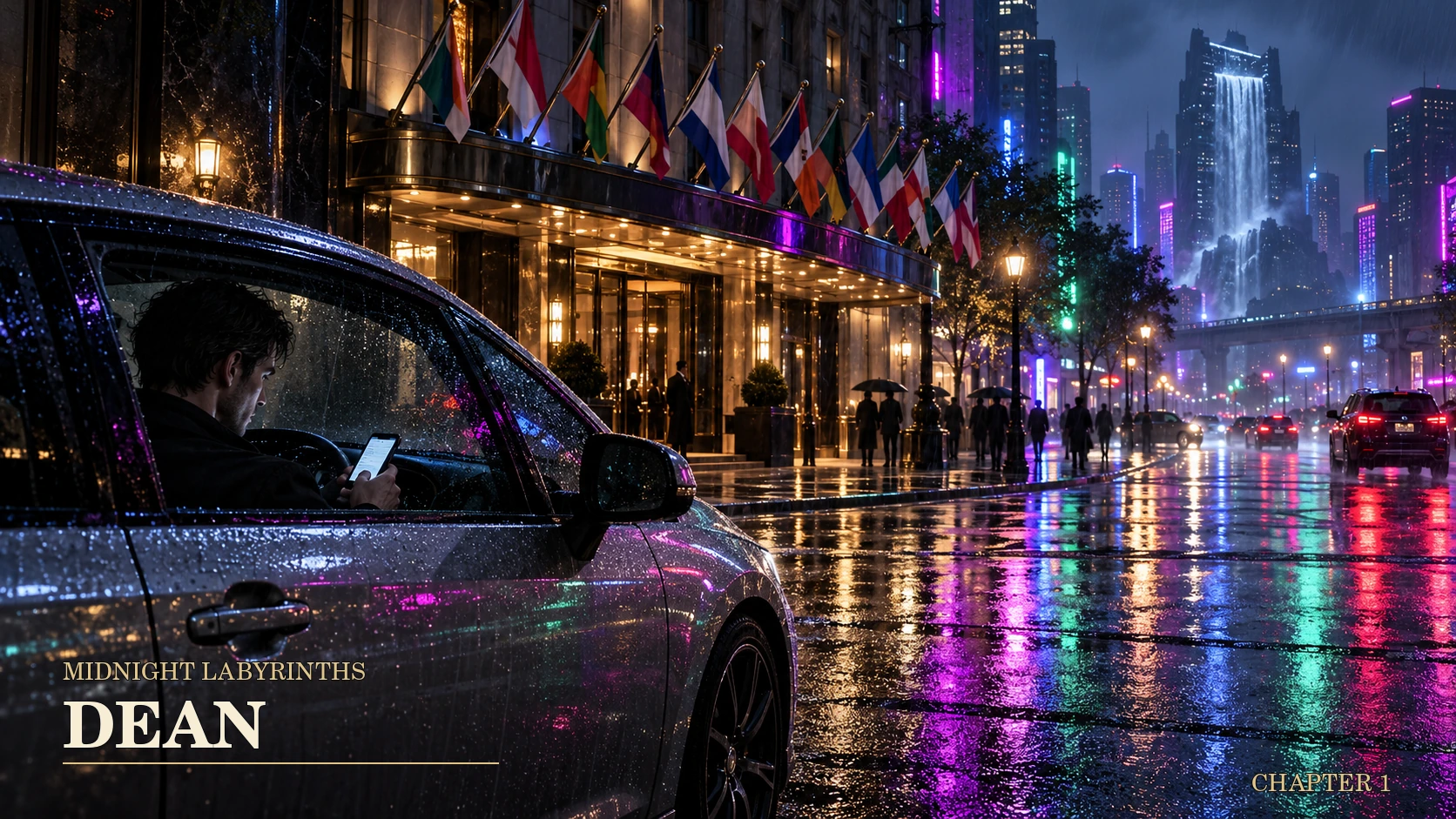
A silver Peugeot 206, modified and with tinted windows, is idling at one of the many corners of Stormport's brand-new city, a relatively young urban center whose western shore is washed by the ocean. A fine but steady drizzle falls on the asphalt, reflecting the violet, blue, green, and fuchsia neon lights, as it so often does here.
Inside the car sits Dean, staring blankly at flags hanging from a line across the street. He counts eleven. He recognizes those of France, England, and Canada. He ignores the rest, assuming they belong to Eastern European countries. He supposes the hotel on his left is trying to attract guests from those places.
He thinks about that beneath the drizzle. The windshield wiper sweeps droplets from the glass. Beyond the flags, he can see asphalt and the luxury buildings of Downtown, the tallest and most striking in Stormport. This district, where the city's financial and corporate core is concentrated, is dominated in the distance by the immense, dual Waterfalls Building, its waterfalls spilling from the fifty-sixth floor—a symbol of Stormport's famous skyline.
Then something breaks the weak calm of his confused mind. A chat message arrives on his mobile device and rings a bell. It is midnight. Dean knows that every night, at this same hour, he will receive a message. Before picking up his phone and reading it, he takes a moment to watch people coming and going along the sidewalk.
Some carry umbrellas, others do not. Even so, not many pedestrians move through Downtown's streets at this hour. It is cold outside, or so he thinks, but he feels the heat of summer—almost unbearable—in his body despite the rain cooling the air. Perhaps the drizzle itself would offer some relief if he let himself be soaked.
Dean only wants to feel calm, at least a little, something he will not get tonight, perhaps ever again. Yet his face reveals none of what he truly feels. His apartment is in another district; he has driven to this corner as a matter of strategy.
Here, in the heart of Stormport, everything is louder and brighter. Cars, now mostly electric, move in greater numbers, and it is easier to go unnoticed. He wears black sneakers, dark jeans, and a black shirt. Then, after a sigh, he picks up the phone and reads the message. As expected, it is from Sarah.
“Hi, Dean. Good evening,” he hears Sarah say in the voice message, in a tone that is usually sweet and carefree, even businesslike and a little hurried. “Tonight I need your services at Reagan Curve, past the bridge. Two photos should do. I’m waiting for your confirmation, and I’ll transfer the other half.”
The message ends. Dean knows the location well. It is near where he is now, and he understands what he has to do without Sarah explaining anything else. He starts the Peugeot 206 and heads there.
The wheels begin rolling over the wet, colorful asphalt. The car pulls away from the hanging flags and the international hotel and heads toward the coast. Dean crosses a street on a green light after waiting through the red, reaches an avenue blazing with lights, and keeps driving. The steady drizzle soaks the windshield and forces the wipers to work.
There is silence in Dean's mind. The gunfire, explosions, and screams have gone quiet; the war no longer sounds. He is focused only on what he has to do. He smells rain, and he likes it. He sees people here and there, few of them, more vehicles than pedestrians. He sighs and feels a renewed peace. He thinks he no longer remembers the last time he saw daylight. That makes him smile.
When he reaches the northwestern edge of Downtown, where Shoretown's lights are clearly visible across the Blue River, he passes beneath Hope Bridge and enters a sharp bend, Reagan Curve, which carries him away from the riverbank and back toward Downtown. He stops the vehicle just after clearing Hope Bridge.
Now all he hears is the running engine, the wipers, and the occasional car passing through the curve. He takes his phone, wakes it, opens his chat with Sarah, follows a link, enters a password, and views a photograph of someone. The photograph remains on screen for about ten seconds, then deletes itself. It shows a slightly overweight, balding man with a kindly appearance.
Dean feels his lower back, takes a breath, and gets out of the car. He puts on a dark cloth trench coat that reaches his ankles and, soaking in the drizzle, walks away from the Peugeot. He crosses Reagan Curve. On the other side there is a solitary house, with no neighbors, almost beneath Hope Bridge. Dean reaches it, approaches the door, and knocks three times.
After several moments that stretch endlessly, someone opens the door.
Then the door opens fully. Dean remains rigidly upright as a smiling little girl greets him.
“Hello, sir. Who are you?” the girl asks.
“I need to speak to your father. Could you call him, please?” Dean says without returning her smile.
“Mmm, Dad, someone’s looking for you. I thought it was my friends.”
Dean steps aside from the open doorway. Before doing so, he catches sight of balloons and signs hanging on the walls. The girl's father, whose face matches the man in the photograph Sarah sent him, comes out of the house. He shudders when he sees Dean standing beside the door, outside the reach of the light. He sighs, leaves the house, and closes the door.
“I knew someone would find me sooner or later,” the man says.
“Let’s make it quick. We’ll go around the side of the house,” Dean says with a nod.
Resigned, the man walks past him toward the side of the house, where open ground lies beneath Hope Bridge. As he moves ahead, Dean following him, he starts to speak.
“I’m not a criminal, you know?”
“Walk,” Dean says, and nothing more.
He notices that the man is walking far too slowly, trying to buy time.
“We’re supposed to be in the land of freedom and opportunity.”
“You don’t need to talk.”
“When did moving freely to seek a better life and raise a family become a crime punishable by death?”
“Keep moving.”
“You probably don’t have a family; you wouldn’t understand. Maybe you’ve never gone hungry, never had to dig through soil or garbage to find something to eat. And I understand that. You see me like this now, with a few extra pounds, but when I crossed the Eastern Wall like so many desperate people like me, I was so gaunt my ribs barely had flesh over them,” he whines. “I’m only asking you not to do this today, please. It’s my daughter’s birthday, the only child we could have.”
The man stops and turns to face Dean, who stops as well. They are already beside the house, at the rear, where the shadow of Hope Bridge hides them from Downtown's colorful, dazzling urban and building lights.
“You know something? I don’t regret a thing. What happens to me doesn’t matter, because my family will live in Downtown, and when…”
Two buzzes sound in rapid succession, almost imperceptible among traffic and the very current of the Blue River beyond the bank. The man in front of Dean falls backward. One hole in his chest and another in his face bleed heavily before his head strikes the ground.
Even before the victim finishes collapsing, Dean puts his pistol back into the holster at his lower back, turns, and walks toward his car. He is about to cross Reagan Curve when the girl who opened the door, accompanied by her mother, comes out of the house looking for the man. Dean finds a gap in traffic, crosses, circles the Peugeot, and opens the door.
Once inside, he starts the car, and the engine sounds mingle with the screams of a wife and daughter. Dean hears the cries too clearly; he does not even look back. He checks the right mirror, then the center mirror, and as soon as he can, pulls away. He leaves the scene behind—the wrenching screams of a little girl on her birthday and those of a wife cursing helplessly in his direction.
It is over. Dean continues on, finishes crossing Reagan Curve, moves away from the Blue River's edge, and enters Downtown's streets, among the dozens of glass-fronted, mirrored, luminous buildings that fill the district like trees in a forest. He drives on with an unchanging, expressionless gaze. He stops the Peugeot near a fountain.
The crossed jets of water, released at intervals and lit from below by colored lights, sit in a pedestrian triangle amid the buildings. They give the area some air. After crossing the street, Dean circles the fountain and stops the car there. He takes a moment to stare at nothing.
Almost immediately he picks up his mobile device and writes to Sarah:
“Done. Confirm.”
Then he waits. For a moment that seems eternal, beneath Stormport's constant drizzle and the sound of the windshield wipers, Dean waits for her reply. He takes that moment to watch the fountain's jets, facing one another and colliding, lit by green and red lights. He observes them with the same expressionless face as before.
He loses track of time. He does not know how long it has been since he sent the chat message when at last the phone's chime announces a reply. He picks it up, turns it on, and reads:
“Confirmed. Transfer completed. See you tomorrow, Dean.”
Dean turns off the phone, puts it away, and remains still and silent for another moment, staring ahead without seeing the drops striking the glass or the wipers pushing them aside. His gaze is somewhere beyond. But soon he turns again and watches the jets collide. He contemplates them for a moment, then starts the vehicle and drives away from the fountain.
He has left drinks chilling at home. He will hurry up to his Midtown apartment, step onto the balcony overlooking the Blue River and Green Falls, watch the view while drinking every cold drink he left in the refrigerator, and not go to bed until the river and waterfalls stop seeming real.
Perhaps when dawn comes—or a little before, really—he will finally collapse face-down on his bed and sleep all day, until the sun goes down and, just after dusk, prepare for a new task at midnight. That is what he will do. Thinking of it gives him peace; he sighs, forgets the work he did today completely, and smiles a little.
The night is going to be enjoyable. He likes that. He already wants to be home.