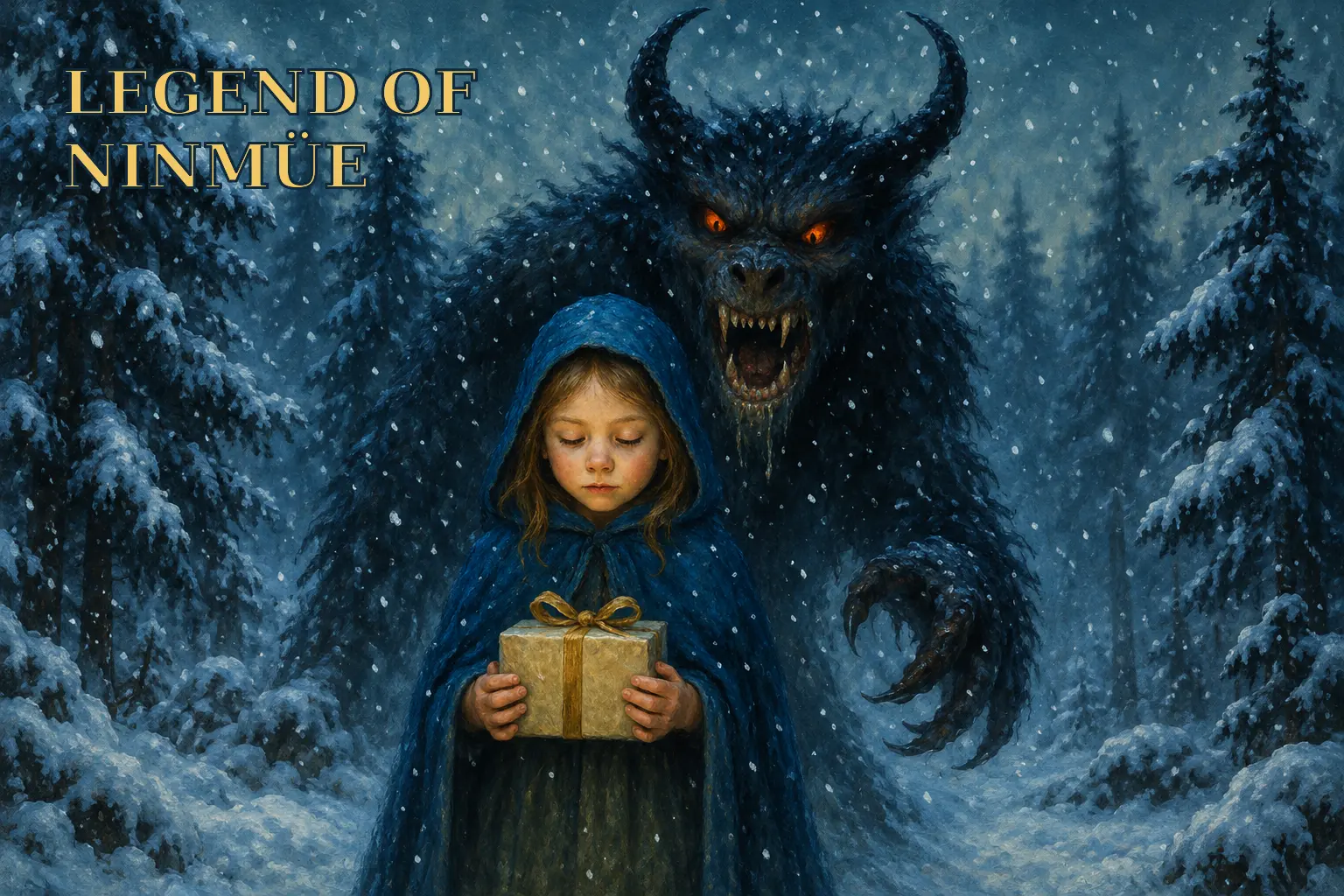
Christmas does not exist in the world of Zyllyön. There is no Bible there, nor any Christ child, and therefore nothing tied to the beliefs of Earth. Yet one legend holds special meaning for the Bredryvek people, particularly those who inhabit the northern reaches of the kingdom of Reszászország.
The legend tells of a sweet young girl named Ninmüe who, once every life cycle, would walk to the edge of the forest near her village and leave a gift upon the snow.
Ninmüe had done so since she was very small, ever since she had seen with her own eyes a hideous creature dwelling among the trees. It was said that whenever the snowfall became severe, the beast would enter the village and devour every child it could find.
But once Ninmüe began leaving gifts at the forest's edge, the attacks by the demon known as Makr ceased.
Then came a winter when Ninmüe could not leave her customary gift in the snow, for fever had left her gravely ill. That year, snow fell more heavily across northern Reszászország, the wind raged with greater violence, and thunder shook the ground beneath the villagers' feet.
Weak as she was, Ninmüe wrote three lines with a goose-feather quill and asked her sister to carry the letter to the edge of the forest. It read:
"Forgive me, Makr. I beg your forgiveness for being unable to bring you a gift this winter. I am very ill. If I do not survive the fever, please do not take the children of the village. They are good to me and always play with me. They are only afraid."
Spent by the effort, and not even knowing whether the demon could read, Ninmüe fainted.
Her sister was terrified of Makr, that loathsome demon among the trees, and could not summon the courage to approach the place Ninmüe so often visited. The letter remained clutched in the unconscious girl's hands.
Everyone in the village was terrified that night. Parents held their children close—girls, boys, even infants—then hid them where the demon could not find them. They prayed to the god Vakroy, begging him not to let that horrible creature carry their children away and devour them beneath the snow and the freezing wind.
In the darkest hours before dawn, lost in a fevered agony that may well have preceded death, Ninmüe thought she saw someone dressed in red and white moving about her room.
Night gave way to day. Kava's reddish-white glow yielded to Küny's fierce blue-white radiance, and the storm subsided. At first light, the villagers discovered that every pine tree had been adorned with colorful ribbons, especially those standing near Ninmüe's cottage.
Not one child was missing, filling parents and grandparents with joy. Then, from Ninmüe's home, a cry rang out—perhaps from her sister, perhaps from her mother.
Several villagers hurried inside. To their astonishment, the child's raging fever had vanished as swiftly as the storm. Ninmüe rose from bed with her pale cheeks now flushed a healthy red and a smile upon her face.
Beside the bed stood a rough earthenware bowl containing the dregs of a green concoction, traces of which still stained the corner of Ninmüe's mouth. Joy overwhelmed the household. When the commotion had passed, she showed everyone the letter she had written to the demon. Someone had scrawled a few words across it:
"Makr forgive."
Ever since that day, Ninmüe has kept the tradition of leaving gifts for Makr at the edge of the forest each winter. In time, the villagers also began exchanging gifts among themselves, especially with the children, and adorning the pine trees with colorful ribbons that stand out against the endless sameness of the winter snow.
Makr has never been seen again. Yet from time to time, Ninmüe and other children receive gifts that came from no relative, friend, or neighbor. The tradition endures to this day.
 THE END