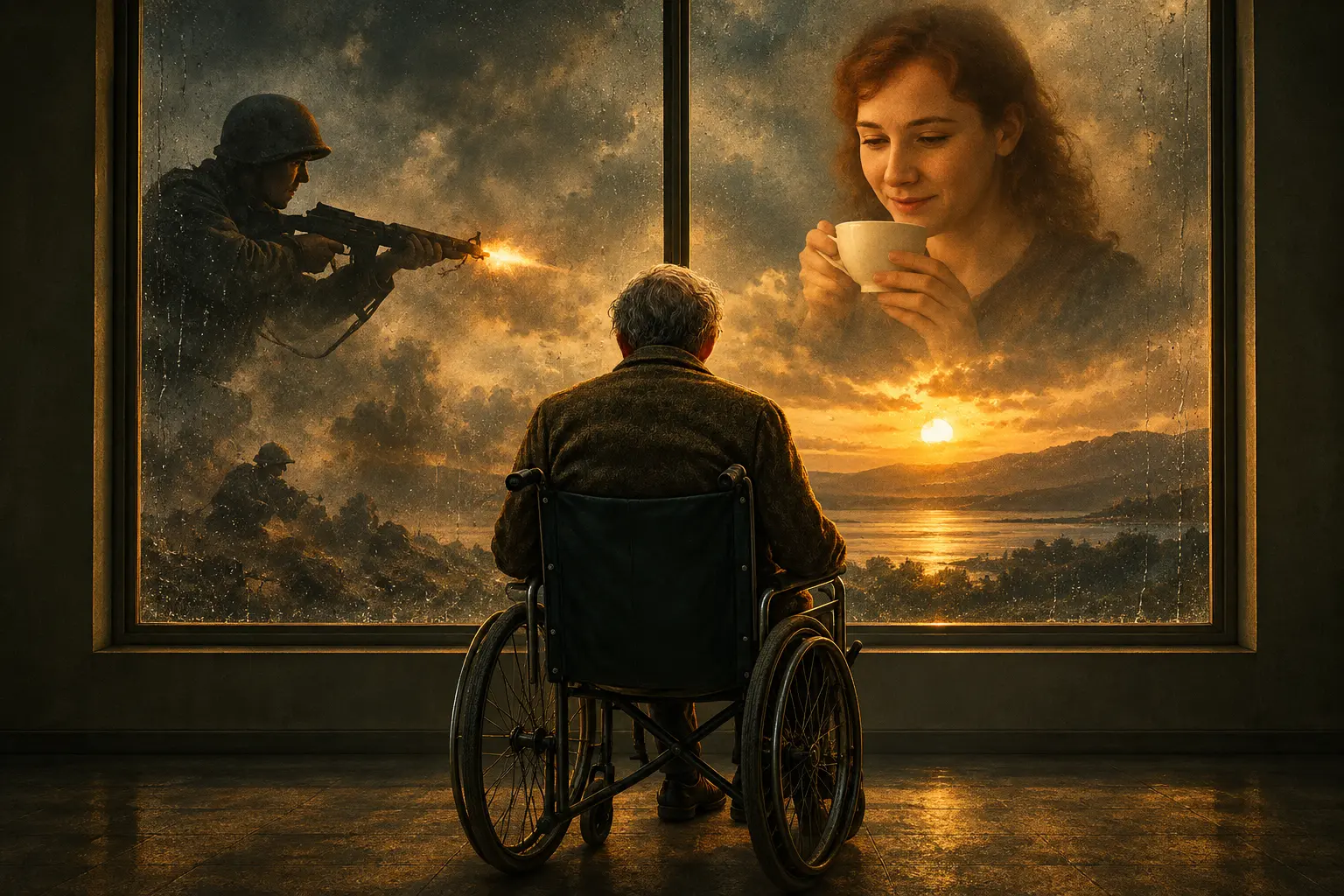
Bursts of gunfire slice through the frigid air around a young soldier named José González.
It is an autumn afternoon in 1982 on the Malvinas Islands. Twilight is drawing near. Bullets streak back and forth, bent on harm and destruction. At supersonic speed, they seek flesh to pierce and burn, or bones to shatter. A drizzle falls over the area in fine drops of water, cold as ice despite the sun's fierce glare.
No clouds conceal the king of stars. The rain drives the already low wind-chill temperature even lower for the soldiers enduring this battlefield. They have lived with this weather for weeks. Despite the cold, young José González is sweating profusely; he feels heat in equal measure with fear and hopelessness.
The enemy is close. They have cornered his comrades and José himself; there is no escape. His birthday is three weeks away. José longs to celebrate it with his family and, most of all, with Griselda, the girl to whom he became engaged before shipping out.
Private González is thinking of this when, hearing no sound from his comrades, he surveys his surroundings. He discovers that he is the only one still firing his machine gun. He is alone, defenseless, with no one covering his back. A British bullet whines menacingly past his right ear; he feels for it to make sure it has not been torn away.
He confirms that it is still where it belongs. He has lost track of how much time has passed since he began defending this fragile perimeter hours earlier. Since then, his finger has barely left the trigger except to reload. He fires at everything that moves, deafening himself with his own bursts. It is driving him mad, but he cannot stop defending himself.
He looks at the ground nearby. One of his comrades lies there on his back in the mud, dying, beyond hope. This is the very young man he had tried to rescue from the siege's opening barrage. A lethal round had struck him; he had fallen in combat and suffered from the deep wound it left.
There is nothing more José can do to save him. He leaves him on the ground, trembling, cold, deathly pale, waiting his turn for the gates of Heaven to be flung wide—if he is lucky. Many of José's comrades in arms would not qualify, especially his superiors, who will surely descend into Hell.
Suddenly, someone near his position begins shouting at the top of his lungs. González turns his head. Despite the poor visibility caused by the drizzle, he sees a desperate soldier from another battalion calling to him. He does not know the man. The soldier and several others wave their hands, warning him of the danger he faces while exposed amid the gunfire.
Before he can react to their warnings, José feels a violent, searing blow to his right arm. A bullet strikes him and passes through, nearly splitting the arm in two. The pain makes him drop his weapon. He clutches the wound with his other hand.
Seconds later, a second bullet passes clean through his right shoulder. His own blood sprays across his face at the instant of impact; skin and muscle yield and tear before the hot projectile piercing him at tremendous speed. It drives him back a couple of steps. He retreats with his backside pressed to the mud, struggling not to fall, trying to reach the unknown soldiers.
He turns his head toward them as they cover his retreat, striving to reach them, risking lifting himself from the ground to do so. At that very instant, a third bullet strikes him squarely in the chest. The blow is so powerful that he crashes backward as though he had slipped on an overpolished parquet floor.
His back hits the battlefield mud. After the third bullet, he feels no more pain. He simply lies there on the ground, motionless and silent, icy rain dripping over his cheeks and feeble rays of sunlight reaching him without a trace of warmth.
At some point he grows dizzy. His vision blurs. He sees his comrades risking themselves to come for him. Inevitably, he loses consciousness—or perhaps, if God has forsaken him, he may even have to bid farewell to his time among the living.
An indeterminate time later, José regains consciousness, weary and weak.
Although everything is badly blurred, he discovers that he is in a spacious room with large rectangular windows. The sun shines fiercely outside. González blinks heavily several times; judging by the angle of the beams streaming through the windows, he is certain it is midday.
For a while, the powerful sunlight hurts his eyes. He adjusts to it very gradually, over many long minutes. He feels weak and fragile, but no longer feels pain in the wounds from the firefight. Even so, he senses that something is wrong. Once his eyes finally adapt to the light, he tries to examine the large room.
There are around thirty beds to his left and right, all empty. A transparent mask covers his nose and mouth, with tubes running into his nostrils and mouth. When he looks beneath the sheets, he finds himself alarmingly thin. He tries to move, to rise, to sit up in bed, but can do none of it. His weakness prevents him from controlling his movements.
He lets himself fall back, his head settling once more into the hollow of the pillow. He takes a deep breath and slowly tries again. He manages to move his fingers, opening and closing his fists several times. He has no sense of time, no idea how long he has been there—perhaps hours or days. A trace of panic comes over him when he sees that his hands do not seem to be his own.
His arms, visible from the elbows to the fingertips, look terribly thin and wasted, the skin wrinkled and blotched. The scar from the bullet wound is still plainly visible on his right arm. It is a crater that leaves additional ridges halfway along the inner forearm. It has healed completely.
At once, he rushes to move his feet. As with his hands, he first tries to move his toes; they do not respond. He sees them covered by the sheets and commands them with his mind, but nothing happens. He appears to have no control over them. He abandons the attempt. A shudder runs through him as he grasps the consequences of his wounds.
He thinks of having lost control of his legs forever. His eyes immediately fill with tears; they spill over and wet his cheeks. Profound sorrow engulfs him and turns to anguish. Inevitably, he thinks of his fiancée. He remembers how beautiful she looked at the café on the corner in their Buenos Aires neighborhood, where he met her one winter afternoon.
He had been drinking a cappuccino; she, a cup of tea. He crumples in anguish at the thought that Griselda will not want to marry a cripple she must carry through the rest of her life. Who would want that? He cannot imagine life without her. It would ruin him—an existence of shattered dreams and a lost, tormented soul.
He clings to the fragile hope that his diagnosis will be temporary, like his eyes having to adjust to the light. Perhaps his legs also need time to adapt; perhaps that is all. Nothing would bring him greater joy, even if the process took years. He means to hold fast to his conviction that he will recover, however much of his life it costs him.
He wants to enjoy his fiancée's company, marry her, have children, and share tea again as they did the day they met. He smiles as he remembers her across the café table. He concentrates on that image, anchoring his hopes in overcoming his present circumstances so he can live all of it again.
He leaves behind everything that happened from the time he entered compulsory military service, through his embarkation and voyage to the Malvinas Islands, and all the hell that followed. He no longer wants to remember any of it. With some effort, he turns his head from right to left as the room's only door opens with a squeal of hinges. Several elderly people file into the ward.
Most walk with difficulty or use canes; others lean on walkers and geriatric crutches. When several of them realize that José is awake, they stop and stare in astonishment, mouths agape. A pair of nurses enter behind them. They, too, look stunned the moment they see him conscious.
"It's a miracle—this is a miracle!" one of them exclaims after rushing to the bed. "Go, tell the doctor!" she urges the other nurse, who stands petrified with astonishment. "Go on, please, call him!" The nurse reacts and runs. The one who remains studies José closely, touches his forehead, and then smiles at him warmly.
"Welcome back to life, José. You are a miracle!" She laughs, nervous and delighted at once. "How do you feel?"
González tries to speak, moving his mouth, lips, and tongue, but the words will not come easily. Instead, he makes noises—an unintelligible, meaningless kind of babble.
"Don't say anything, José. Don't strain yourself. Everything will be all right. Let's wait for the doctor."
"Gri?" José barely manages to say with greater clarity. "Gri, Gri, wh-where ith she?"
"I don't understand you, José, I'm sorry. Don't get upset; the doctor is on his way, all right?"
"My fianthée… Gri…"
"Don't worry about anything. One step at a time. Before anything else, they'll probably run several tests to assess your condition. Rest now, all right? And enjoy finally being here with us!"
González merely nods. He has no other choice.
Three hours later, after all the elderly patients have spoken to him and the nurses have comforted him, José González is placed on a stretcher and wheeled through narrow corridors into an examination room. A grave-looking doctor awaits him there, dressed in a white coat, his brow furrowed.
"All right, my friend. How are you feeling?" the doctor asks as he approaches.
"I've beedn bedtter," José answers in clumsy, feeble babbling.
"Don't worry about your speech; it will return soon," the doctor lies. "Please tell me your full name."
"Jodthé Gonfáleth." His tongue does not work as he wants it to. His name sounds perfect inside his head, but not in his mouth.
"José González, perfect. Age?"
"Nindeteedn yearth old."
"Nineteen, eh?" The doctor and nurse exchange grave looks. "Do you remember your occupation?"
"Soldgier, Firtht Sedction, Sedventh Compadny."
"Now I didn't understand a word. Did you, Nurse?"
"I think he said soldier."
"Incredible. How does he remember all that? And more importantly, how did you understand what he said?"
"I worked it out," the nurse replies with a smile.
"Mr. González, you will have to undergo very demanding rehabilitation before you can be discharged. Don't worry; this is our specialty. We'll run tests, change your diet, and design a new routine for you."
González nods in resignation. He has no choice.
After several tests, he is returned to his bed. The elderly patients sharing the ward with him are already asleep. José is exhausted and falls asleep almost at once. Before dawn, he dreams of his girlfriend, Griselda, as beautiful as ever. They are in the café on the neighborhood corner. She laughs at a silly joke he makes, and then he laughs with her.
They hold hands across the table. He takes a sip of coffee. Then he marvels at the feminine delicacy with which Griselda sips tea from the fine cup. They are smiling, happy; nothing can disturb that magical moment—or almost nothing. José wakes. Once again he returns to the crushing reality of the ward filled with old people. The nurse is beside him.
"Good morning, Mr. González."
"Ghood mordning."
"You're speaking much better today," she lies, hoping to encourage him. "You'll see. Just as the doctor said, in no time you'll be able to speak as you did before."
"My ledgs?"
"The doctor will speak to you again this afternoon about that and about your present condition in general. Now that you're awake, I'll ask them to bring some purée so you can try eating something solid," the nurse proposes as she rises from her chair.
"W-wait. Pleathe, my pardents, my fianthée, Gri…"
"Yes, yes, I know it's important to you. We'll call them, don't worry," the nurse answers before leaving to fetch the food she mentioned.
After he eats a plate of purée and a cup of gelatin, three orderlies lift him onto a stretcher and take him to the room where the doctor is waiting.
"Good afternoon, Mr. González. How are you finding your return to the land of the living?"
"Fhine."
"I see your speech is improving. Excellent. González, we need to talk. Please leave me alone with the patient," the doctor asks those present.
The nurse and the others leave. The two men are alone.
"Don't bhe afradid, Dodctor."
"It is my duty to tell you certain things about your condition, González. I earnestly ask you to remain calm. This isn't easy to say. From what I've learned, you were always an athletic, restless young man… full of vitality." The doctor keeps breaking off, even stammering and perspiring. He must stay controlled, appear firm and professional. "González, a bullet struck you in the arm. That wound healed perfectly. Another struck your shoulder. It shattered your right collarbone, which, as you can understand, has healed, though your range of movement is now restricted. Finally, a bullet struck you directly in the chest. It pierced your right lung, broke several ribs and, before exiting through your back, fractured one of your vertebrae."
Tears gather in José's eyes.
"N-no, n-no."
"González, you… will have the finest specialists. I swear to God we'll do everything in our power to help you walk again," the doctor lies.
The lie is not credible even to José, whose eyes overflow with inconsolable tears when he hears it. The doctor tries to calm him and pats his shoulder, but it offers no comfort.
"D-doeth my famdily know?"
"I haven't told you everything yet, González."
José swallows. The doctor wipes away his sweat.
"Everdything?"
"One of your comrades saved your life on the battlefield, on Darwin Island. You were dead for several seconds. Later, on the mainland, surgeons operated and removed the bullets, but you fell into a coma; you had lost a great deal of blood. Sometimes you emerged from the coma for a few minutes. You were even awake for an entire day. But you slipped back into that state and never woke again—until now. You are stable, González, but there is something else I must tell you…" The doctor looks aside and down, then to the other side, wiping the perspiration from his forehead. He summons his courage, clears his throat, and continues. "It is no longer 1982, González. It is 2003. You are a miracle of science: you have awakened after twenty-one years in a coma."
The patient begins shaking his head frantically from side to side without stopping, tears in his eyes.
"Gri…?" is the first thing he manages to ask.
"Mrs. Griselda Fortunata, your fiancée, I'm afraid she is no longer with us. She became gravely ill during the 2001 crisis. She was malnourished and had no money."
"N-nooo, n-nooo."
"She spent a great deal of time at your side."
"Gri… Gri!" José tries to shout, but produces only a weak sound that dissolves into drooling.
"I'm so sorry, González. Truly, I am so sorry."
The nurses and orderlies enter the room, hold him, and, as gently as they can in that tense moment, administer a sedative. Even so, it takes José several minutes to fall asleep. The doctor wipes his sweat with a handkerchief; the ordeal has drained him. He stands lost in thought for a moment. Finally, before leaving the room, he asks the nurse for something.
"Margarita, please see whether you can contact any of González's surviving relatives."
"Of course," she replies, nodding at the same time.
About a month later, González leaves the ward on a sunny afternoon that is not too cold. The nurse is nowhere in sight. José turns the wheels of his wheelchair and heads toward the elevator. He has regained good mobility above the waist and can eat almost any solid food.
A few days earlier, they had to sedate him heavily after he saw himself in a mirror for the first time. González now knows the medical facility well. He propels the chair through corridors and around corners until he reaches the elevator. He enters, presses a button, and the doors close. He leaves the elevator on the top floor.
He moves along and enters one of the many rooms known to be empty. Once inside, he closes the door and makes his way to the large window. He manages to open the shutters. With enormous effort, he heaves himself upward with both arms and braces against the window. He pushes the wheelchair away, and it rolls in the opposite direction. His head is now completely outside the window.
He looks down. A carpet of lush green grass stretches to the edge of the woods. With a strenuous thrust of his wrists, he pitches himself forward, dragging the dead weight of his body from the waist down. He releases the window and falls into the void. During the few seconds of his descent, his memories carry him far away.
He closes his eyes. He sees his beloved Griselda again, standing before him with that dazzling smile, her dark eyes and brown curls. In her hands is a white teacup, from which she takes one last sip, finishing her tea. Outside the café on the corner, the afternoon is cold but sunny. A heavy rain has recently fallen.
José watches Griselda, admiring her joyful smile. He sees her without opening his eyes or feeling vertigo in his headlong fall. His leap carries him toward this destiny, beside the person he loves most.
"I want to tell you something, Pepe," Griselda announces, still smiling.
"Tell me."
The young woman turns the teacup upside down and sets it on its saucer, rim down and base up. Then she traces the entire outer curve of the handle with her index finger.
"If you look very closely at this teacup and at this"—she traces the handle again with the tip of her finger—"what would you say you see?"
"What do I see? What do I see besides a teacup?" She laughs a little at the remark.
"Obviously, silly. What else would you see?" Smiling, José studies the object closely.
"A man with his arm like this…" José answers, planting his right hand on his hip.
"It could be. It could represent a person, but that isn't the person's arm."
"Hmm… why do you want me to guess this?"
"Come on, play along with me. Use your imagination and tell me what else you see."
"All right." José thinks for a second. "I know! It's a man's face, and the handle is his nose."
"Oh, no. It could be that too, but it isn't. Come on, try again. Last chance."
"Give me a clue, Gri."
"All right. It's a woman—that's the clue I can give you. What do you think this might be?"
Again, she traces the handle's outer surface with the tip of her right index finger.
"I can think of something, but there would have to be two handles." They both burst out laughing.
"Why would I ever make you guess that? Come on, what else on a woman could look like this?"
"Well, it could be…" José's eyes light up. "But only if…" He cannot find any more words.
When he looks at Griselda, he sees her radiant and smiling, glowing with a light of her own. She nods over and over, realizing that José has guessed even though he has not put it into words. With Griselda's beautiful smile upon her face, branded forever into his mind and heart, he slowly lowers his eyes and fixes them on the teacup.
He no longer sees a cup and its handle. He sees what his beloved wanted it to represent, something he had never imagined but which has just changed his life. Then, at last, he feels the crushing impact of his inevitable fall. After striking the ground, he feels nothing more. His body grows cold before any nurse finds him.
The wind stirs the clothes on his lifeless body. Somewhere beyond the reach of mortals, Griselda is still smiling. She kisses him; they laugh and celebrate together again, the teacup still upside down upon its saucer, capturing their attention one final time.
Minutes later—perhaps ten or fifteen after his final fall—a very young man, around twenty years old, enters the medical facility. Once in the lobby, he looks from side to side. His clothes are humble. A nurse happens to be hurrying through the lobby. The young man stops her, looking confused or lost.
"I'm sorry to bother you, Nurse. My name is Jacinto González. I spoke on the phone with a nurse named Margarita. Do you know her?"
"I'm Margarita. Jacinto González? Are you José González's son? I called you days ago."
"Yes. To be honest, at first I thought it was a joke. Is he alive—I mean, awake?"
"A picture is worth a thousand words. Come with me, please," Margarita tells him.
She turns on her heels and heads toward José's room, with the hopeful Jacinto following behind.
 THE END